Blog
How to Write Facebook Ad Copy That Converts
Published July 14, 2026
You're probably looking at a product page, a blank Meta ads text box, and a pile of half-formed ideas like “lead with benefits,” “try social proof,” or “maybe make it punchier.” That's where most first campaigns go wrong. The problem usually isn't effort. It's that the copy gets written before the strategy gets chosen.
If you want to learn how to write Facebook ad copy that converts, start by dropping the idea that great ads come from clever phrasing alone. Good ad copy is usually the result of good selection. You pick the right audience, the right emotional angle, the right hook, and only then do the words start doing useful work.
That shift matters most when your budget is tight. A new ecommerce founder can't afford to burn spend on random copy angles just because they sounded good in the moment. You need a repeatable way to decide what message deserves to be tested before you write a single line.
Table of Contents
- Before You Write a Word Define Your Angle and Audience
- The First Three Seconds Writing Powerful Hooks and Headlines
- From Interest to Action Crafting Body Copy and CTAs
- The Visual Handshake Aligning Copy with Creatives and Policy
- The Litmus Test A Simple Plan for Testing Your Ad Copy
- Conclusion Go Write Your First Winning Ad
Before You Write a Word Define Your Angle and Audience
Most new advertisers think they have a writing problem. They usually have an angle problem.
If your product solves five pains, appeals to three types of buyers, and can be framed in ten different ways, your first job isn't to write more. It's to decide which emotional register you're testing first. That's the part most generic Facebook ad copy advice skips.
According to this breakdown of Facebook ad copywriting gaps, most guides teach standard frameworks like problem-solution or social proof but don't show beginners how to validate which emotional angle to test before writing. The same source also notes that ads running 60+ days on performance objectives are nearly always profitable, which is why mining long-running competitor angles can be more useful than brainstorming in isolation.
Why most beginner copy misses
Beginners often write ads like they're trying to explain the whole business. That creates flat copy because it blends too many motives together.
A single ad should usually lean on one dominant angle, such as:
- Problem aware: The buyer feels the pain and wants relief.
- Skeptic aware: The buyer has seen similar products and doubts yours is different.
- Identity driven: The buyer wants a product that says something about who they are.
- Social proof led: The buyer wants reassurance that other people already trust it.
- Convenience first: The buyer wants less friction, less time, less effort.
If you skip that decision, the ad turns mushy. It says a little about quality, a little about price, a little about lifestyle, and not enough about the one reason someone should stop scrolling.
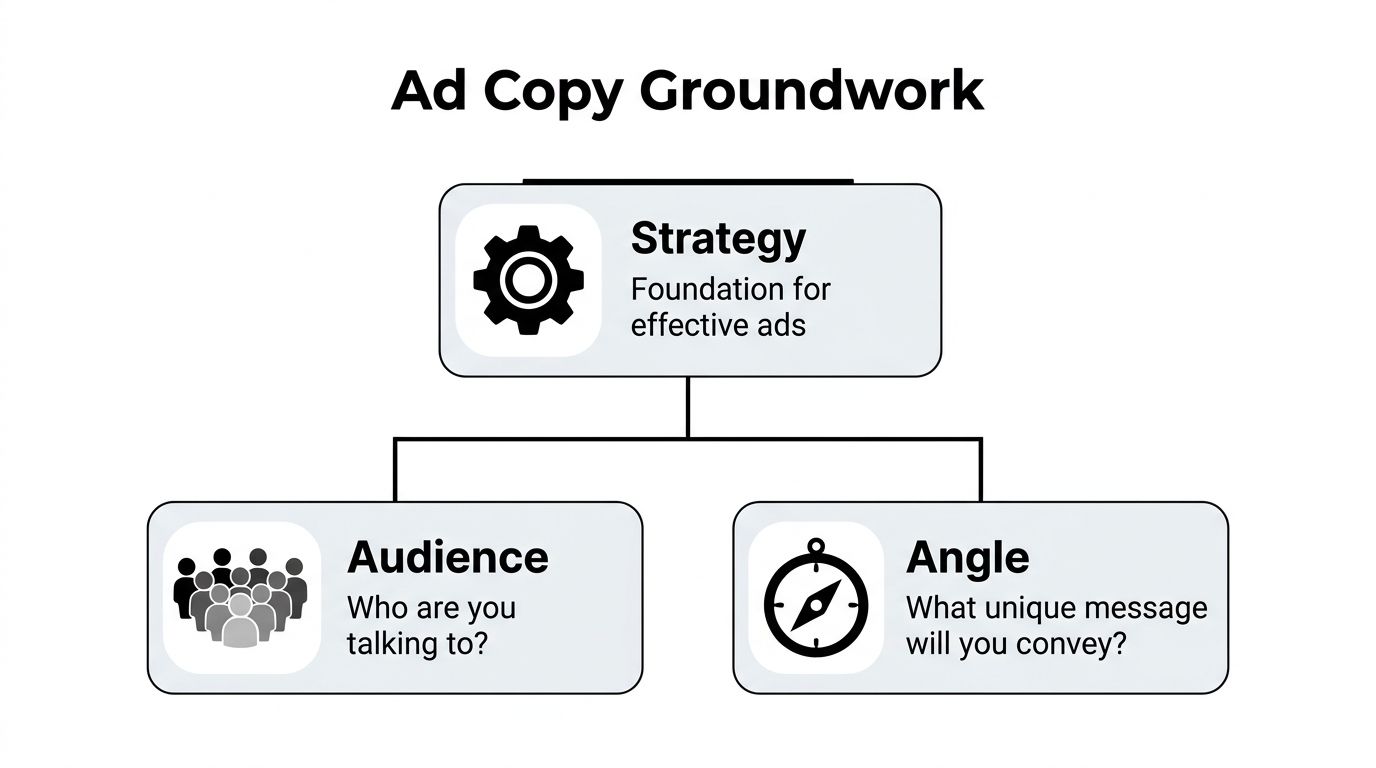
Practical rule: Don't open Ads Manager until you can finish this sentence: “This ad is for people who want ___ but hesitate because ___.”
A simple way to choose your angle
You don't need a massive research project. You need a usable buyer profile and one clear objection map.
Start with four notes:
-
What are they trying to get done
Keep it concrete. “Sleep better,” “save prep time,” “look more put together,” “avoid messy cleanup.” -
What's stopping them
Winning copy begins by tackling these issues. They may think the product won't work, costs too much, takes too long, looks low quality, or won't fit their routine. -
What have they already tried
This tells you whether your copy should educate, compare, reassure, or challenge. -
What emotional tone fits
Some products need empathy. Others need a sharper, more direct tone. Don't force one brand voice onto every offer.
If you need help building that profile, this guide on defining a buyer persona for ecommerce ads is a useful starting point.
A beginner mistake is choosing angles based on what sounds “smart.” A better approach is choosing angles based on what objection is most likely to block the click. For a portable blender, the winning angle might not be “healthy smoothies anywhere.” It might be “finally a blender that doesn't turn travel into cleanup chaos.” For a posture corrector, it might not be “better posture.” It might be “stop ending your workday feeling locked up.”
That's how to write Facebook ad copy without guessing. You decide the emotional job of the ad first. Then you write to that job.
The First Three Seconds Writing Powerful Hooks and Headlines
A Facebook ad doesn't earn attention by being complete. It earns attention by being immediate.
Your hook does that work. It's the first line people process, and it usually decides whether the rest of your copy gets read at all.
Put your effort where it changes performance
The hook deserves most of your attention. According to this Facebook ad copywriting testing methodology, 80% of total creative energy should go to the hook, and advertisers can test up to five distinct copy variations simultaneously in Ads Manager before optimizing body text.
That matches what practitioners see in real accounts. Weak hooks don't get rescued by elegant body copy. Strong hooks give average body copy a chance.
So when you sit down to write, don't draft the entire ad first. Draft hook options first. If the hook isn't sharp, the rest is mostly wasted effort.
Hook formulas that beginners can use right away
You don't need to invent a new writing style. You need reliable patterns.
The direct pain hook
Call out the exact frustration the buyer already feels.
Example for a shaving product:
“Still dealing with razor burn every other morning?”
Why it works: it meets the buyer at the problem, not at the product.
The specific outcome hook
Lead with the result, not the item.
Example for a meal prep container:
“Pack lunch in minutes, not a pile of mismatched containers.”
Why it works: it gives the reader a cleaner mental picture of life after the click.
The skepticism hook
Use this when buyers have seen too many similar offers.
Example for a red light therapy device:
“If you've tried wellness gadgets that ended up in a drawer, read this first.”
Why it works: it absorbs resistance instead of pretending it isn't there.
The mini-story hook
Start with a tiny relatable moment.
Example for a pet hair remover:
“You clean the couch, sit down, and somehow there's fur on it again.”
Why it works: the reader recognizes the scene instantly.
A hook should feel like a conversation starter, not a slogan. If it sounds like something no real customer would say or think, rewrite it.
Here's a walkthrough worth watching before you draft your first batch of hooks:
Make the headline support the hook
A common mistake is making the headline repeat the hook word for word. That wastes space.
Use the hook to stop the scroll. Use the headline to reinforce the promise, sharpen the benefit, or add purchase context.
A few simple pairings:
| Hook | Headline |
|---|---|
| Still dealing with razor burn every other morning? | Smoother Shaves, Less Irritation |
| You clean the couch, sit down, and somehow there's fur on it again. | Remove Pet Hair Fast |
| If you've tried wellness gadgets that ended up in a drawer, read this first. | Built for Daily Use |
Your hook opens the loop. Your headline should make the click feel justified.
When people ask how to write Facebook ad copy that converts, they often focus on body paragraphs. In-feed, that's backward. The hook and headline do the heavy lifting. Everything else depends on those first few words earning another second of attention.
From Interest to Action Crafting Body Copy and CTAs
Once the hook gets the stop, the body copy has one job. Build enough belief for the click.
Beginners usually overload this part. They stack features, adjectives, and brand claims until the ad reads like a product page summary. That approach rarely works for cold traffic because the buyer hasn't earned all that detail yet.
How to structure body copy for cold traffic
For cold audiences, the strongest structure is often problem first, solution second. According to AdStellar's guide to Facebook ad copy best practices, effective copy for cold traffic follows a 70% to 30% split, with 70% focused on the customer's problem and 30% on the solution. The same source notes that retargeting audiences should skip problem education and focus on differentiation and social proof instead.
That changes how you write.
For cold traffic:
- Spend more space validating the problem
- Name the daily frustration clearly
- Introduce the product as a response, not a speech
- Keep the explanation lighter than your instinct tells you
For warm traffic:
- Drop the long problem setup
- Answer “why yours”
- Use proof, comparison, and objection handling
Turn benefits into believable reasons to click
The body copy should bridge naturally from the hook. If your hook called out a pain, the next lines should deepen recognition before introducing relief.
A simple pattern works well:
- Re-state the friction: what keeps happening that frustrates them
- Show the cost of leaving it alone: annoyance, wasted time, hesitation, inconsistency
- Introduce the product's mechanism: how it helps
- Translate features into lived benefits: what changes in their routine
Example for a travel mug:
You leave the house with coffee hot. By the time you drink it, it's disappointing. A better mug doesn't just hold liquid. It keeps your drink at the temperature you wanted when you packed it, so the last sip feels like the first.
Notice what's missing. No feature dump. No generic “premium quality” language. No desperate hype.
Specificity beats puffed-up language. “Fast,” “easy,” and “high quality” usually need proof or a clearer translation into daily life.
If you want more ideas for low-friction prompts, these call to action phrases for marketing and ads can help tighten the final step.
Write CTAs that match the next step
A CTA should fit the temperature of the audience and the complexity of the offer.
“Shop Now” works when the product is simple, visual, and easy to understand quickly. But many new advertisers use aggressive CTAs before the ad has earned enough trust.
Better CTA logic looks like this:
-
Use softer CTAs when the product needs explanation
Examples: Learn More, See Why, Watch It in Action -
Use buying CTAs when the ad has already done heavy persuasion
Examples: Shop the Collection, Get Yours Today, Pick Your Color -
Use clarity CTAs when the buyer is skeptical
Examples: Compare Options, See How It Works, Read Reviews
A CTA isn't decoration. It's instruction. If the click feels like too big a leap from the copy above it, lower the friction and make the next step more obvious.
The Visual Handshake Aligning Copy with Creatives and Policy
The image or video gets attention first. The copy explains why that attention should continue. When those two parts disagree, performance usually suffers.
This is the visual handshake. The creative makes a promise. The copy must continue the same conversation.
What copy and creative should do together
If your creative shows a close-up of a messy kitchen counter, the copy should probably speak to cleanup frustration, speed, or convenience. If the visual shows a polished lifestyle scene but the copy opens with a harsh pain-first angle, the ad can feel disconnected.
The strongest combinations usually look like this:
-
Demonstration creative plus objection-handling copy
Good for products people may doubt at first glance. -
Lifestyle creative plus identity or aspiration copy
Good for fashion, home, beauty, and premium-feeling products. -
UGC-style creative plus plainspoken copy
Good when trust matters more than polish.
Here's a practical example. If your creative shows a heated eyelash curler in use, don't write copy that opens with broad beauty-brand fluff. Match the visual moment. Talk about lashes falling flat, rushed routines, or getting a cleaner lift without fiddling with a traditional tool.
Keep your message clear and compliant
Many first campaigns get tripped up when founders focus on persuasion and forget the platform has rules.
A few practical filters help before you publish:
| Check | What to look for |
|---|---|
| Claim strength | Remove anything you can't support clearly |
| Personal attributes | Avoid copy that directly calls out sensitive traits |
| Creative match | Make sure the first line fits what the user sees |
| Landing page continuity | The product page should continue the same promise |
| Readability | If the copy sounds crowded on mobile, trim it |
Policy-safe copy usually sounds better anyway. It's cleaner, less exaggerated, and more believable.
Don't promise transformation you can't prove. Don't imply certainty where buyers need trust. Don't write copy that belongs on a long-form sales page if the creative only buys you a second or two of attention.
A good Facebook ad feels coherent from first glance to click. The visual starts the story. The copy carries it. The landing page finishes it.
The Litmus Test A Simple Plan for Testing Your Ad Copy
Most losing ad copy doesn't look obviously bad. It just loses against a better angle, a stronger hook, or a clearer CTA.
That's why testing matters. You're not trying to prove that your first draft is brilliant. You're trying to find out which message the market rewards with action.
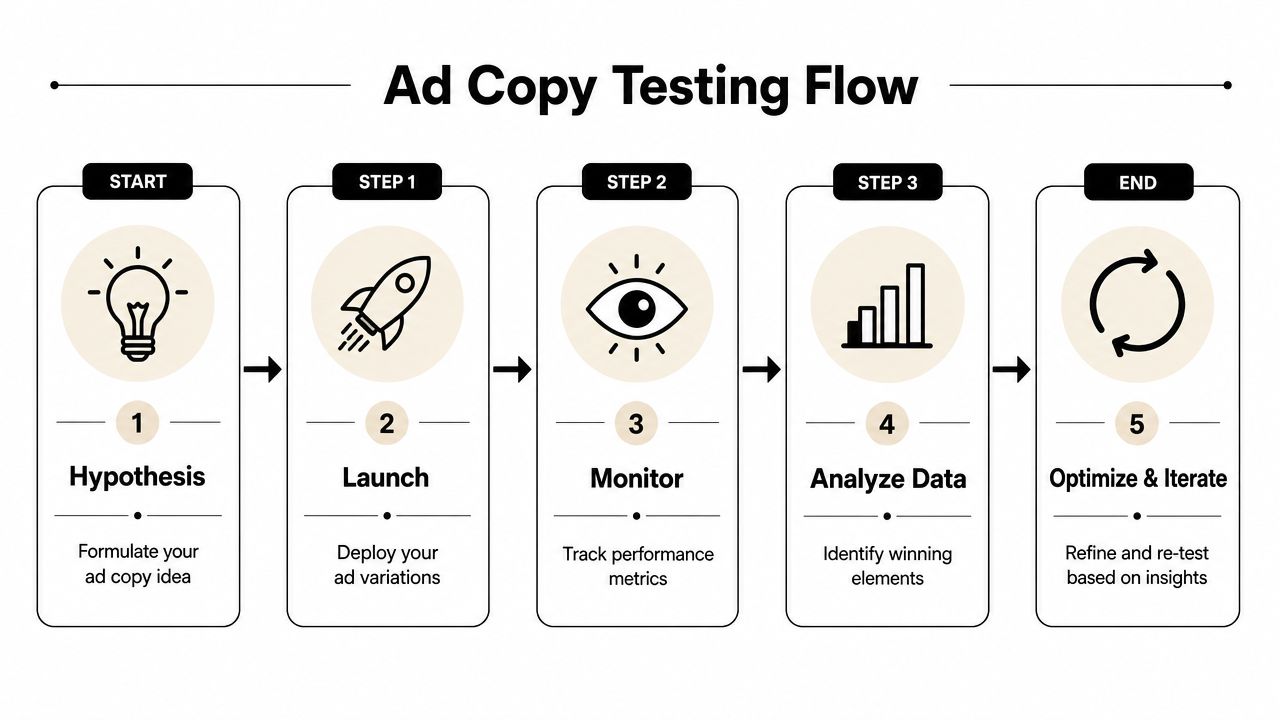
Test one variable at a time
When beginners change the hook, body copy, CTA, and creative all at once, they learn almost nothing. If performance changes, you can't tell why.
A cleaner system comes from this structured Facebook copy testing approach and the earlier practitioner framework: run tests until each variant reaches 50+ conversion events so Meta can exit the learning phase and performance metrics can stabilize. For technical copy testing, practitioners also call for at least 400 impressions per variant before drawing conclusions, and they isolate variables in rounds by testing hooks first, then body structures, then CTAs, while doubling budget only on the statistical winner. That sequence is described in the earlier linked strategy resource.
Use that logic like this:
Round one tests hooks
Keep the creative, body copy, and CTA the same.
You're answering one question: which opening angle earns more qualified attention?
Round two tests body copy
Take the winning hook and test two ways of developing it.
You might compare a shorter body against a more explanatory one, or a pain-led structure against a proof-led structure.
Round three tests CTAs
Keep the best hook and body. Change only the ask.
Here, you learn whether your audience wants to browse, compare, or buy.
If you want a cleaner framework for managing those rounds, this guide to round robin testing for ad creatives and copy is useful.
Don't test everything. Isolate one question per round.
What enough data actually looks like
A lot of beginners ask, “How many days should I let this run?”
That's the wrong question.
The useful threshold is event volume, not calendar duration. The source above explains that you should wait until each variation reaches 50+ conversions before calling a winner, rather than stopping after a fixed window like a week. A low-budget campaign may take longer to get there. A higher-budget campaign may reach that threshold much faster.
That's a hard lesson for founders who want immediate answers. But cutting a test too early creates fake certainty. You pause something that may have won if you'd let it gather enough signal.
For larger decisions, some practitioners prefer a few hundred conversions per variation before making a final call. If your spend is limited, start with the minimum threshold and stay disciplined about not forcing conclusions from noise.
Example ad copy test plan
Here's a simple template you can use.
Example Ad Copy Test Plan (Product: “Smart Mug”)
| Round | Variable Tested | Variation A | Variation B |
|---|---|---|---|
| 1 | Hook | “Coffee cold before your second sip?” | “Your mug isn't the problem. Heat loss is.” |
| 2 | Body Copy | Problem-led daily frustration copy | Outcome-led convenience copy |
| 3 | CTA | “Shop Now” | “See How It Works” |
A few operating notes make this much easier:
- Set the hypothesis first: Write down what you think each variation is testing.
- Name ads clearly: Use labels you can scan fast in Ads Manager.
- Track observations, not just winners: Sometimes a “losing” hook still reveals a useful objection.
- Budget for completion: Don't launch more variants than you can realistically feed with enough spend.
Testing is what turns copywriting from taste into process. That's when your ad account starts teaching you how to write better Facebook ad copy than any template ever could.
Conclusion Go Write Your First Winning Ad
The useful part of this process isn't the wording trick or the framework name. It's the system.
Start with the audience and the objection. Choose an angle that fits that buyer's state of awareness. Write hooks before body copy. Make the body earn belief. Match the CTA to the next step. Keep the copy aligned with the creative. Then test in rounds instead of changing everything at once.
That creates a flywheel. Each ad gives you better language for the next ad. Each test sharpens your sense of what your customer actually cares about. Each winner reduces the amount of guessing in the next sprint.
New founders often think they need to become naturally “good at ads” before they can get traction. They don't. They need a workflow that keeps them from making expensive, emotional decisions too early. That's what this approach does.
If you remember one thing, let it be this: strong Facebook ad copy starts before the writing starts. Once you choose a validated angle and write with discipline, the words get easier. More importantly, the spend gets smarter.
Go write the first version. Then let the market tell you what deserves the second.
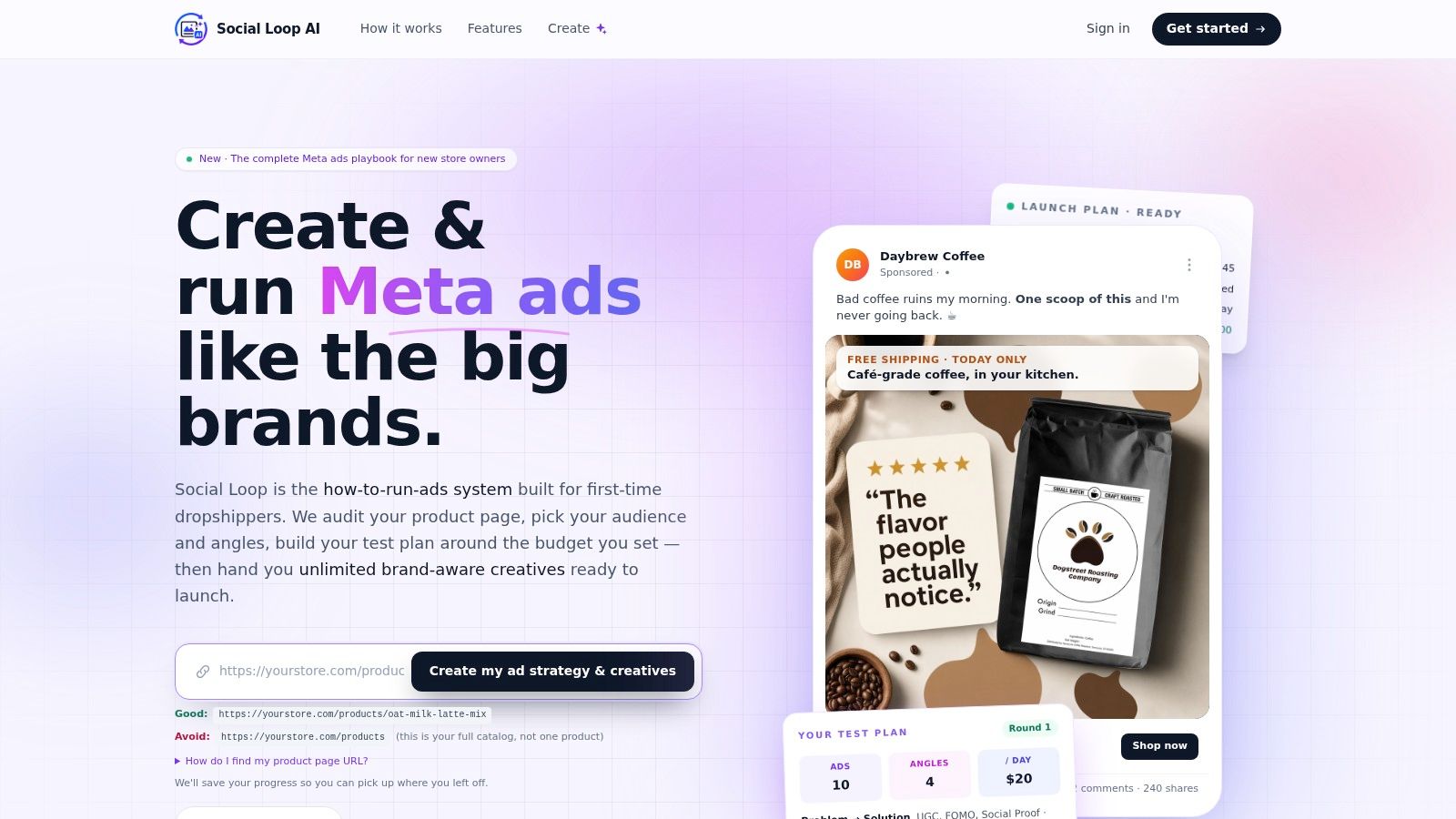
If you want help turning a product URL into angles, buyer profiles, test plans, and ready-to-run Meta creatives, try Social Loop AI. It's built for first-time dropshippers and new ecommerce founders who want a practical launch system instead of more guesswork.