Blog
Round Robin Testing: A Beginner's Guide for Meta Ads
Published June 20, 2026
You've picked a product, built the store, installed the pixel, and generated a pile of ad ideas. Now the hard part starts. Meta Ads Manager is open, your budget is limited, and every launch decision feels expensive.
That's where most first-time dropshippers freeze. They either launch everything at once and hope something sticks, or they overthink the setup so long that nothing gets tested at all. Both paths waste time. One burns cash fast. The other kills momentum.
Round robin testing gives you a better way to move. In science, the term comes from structured comparison. In ads, the useful version is simpler. You run your creatives like a tournament. Same product, controlled conditions, clear rounds, disciplined decisions. Instead of asking, “Which ad do I like?” you ask, “Which angle survives the next round?”
If you're using AI-generated creatives, this matters even more. AI can give you volume. It can't decide what your market wants. That part still comes from testing. A good process turns a batch of creative into signal. A bad process turns it into random spend.
Table of Contents
- Your First Ad Campaign Is a Gamble Until You Read This
- What Is Round Robin Testing for Ads And What It Is Not
- Planning Your First Ad Test Rounds With Social Loop AI
- Launching Tracking and Making Scaling Decisions
- Common Round Robin Testing Pitfalls That Waste Ad Budget
- From Random Spending to Repeatable Growth
Your First Ad Campaign Is a Gamble Until You Read This
Your first campaign usually feels like a coin flip dressed up as strategy. You've got product photos, some hooks, maybe a few UGC-style images, and no real confidence about what deserves budget first. That uncertainty is normal. The problem is that most beginners answer it with chaos.
They test too many ideas at once, change settings midstream, and judge performance based on emotion. One ad gets a click, so they call it a winner. Another spends for a short stretch without a sale, so they shut it off. That isn't testing. It's panic with screenshots.
A better approach is to treat ad testing like a sequence of controlled rounds. Not rigid like a lab. Structured enough that your decisions mean something. You don't need an agency dashboard or a giant budget to do this well. You need a repeatable system for comparing angles, creatives, and audiences without muddying the result.
Round robin testing for ads works best when you stop trying to predict the winner and start designing a fair contest.
It's like a sports tournament for your ads. Not every creative enters the finals. Some get eliminated early. Some surprise you. The goal isn't to prove every ad is consistent. The goal is to uncover the outlier that earns the right to more spend.
That shift changes everything. You stop launching blind. You start learning round by round.
What Is Round Robin Testing for Ads And What It Is Not
Where the term comes from
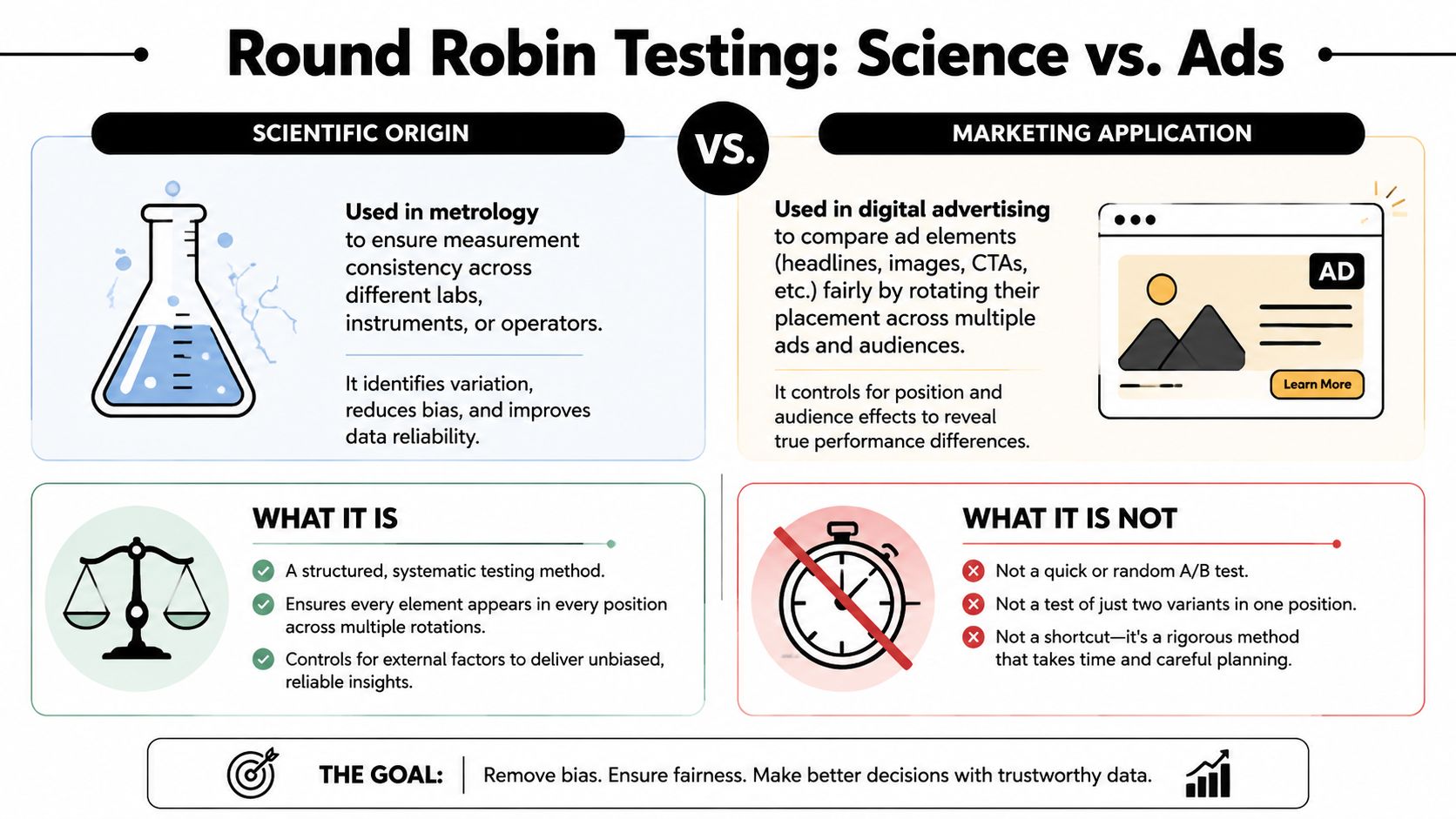
The phrase "round robin testing" started in formal test environments, where different labs measure the same sample under the same conditions to check whether the method stays consistent. The goal there is stability. Organizers want to know whether the process produces similar results across teams, tools, and locations.
Ads do not work that way.
A first-time dropshipper is not trying to prove a measurement method is repeatable. The job is to find a creative angle that can beat the rest without wasting budget on weak ideas. That is why the lab definition helps only as a starting point. The useful part is the discipline of running fair comparisons. The part to ignore is the expectation that ad performance should behave like a controlled instrument test.
That difference matters more if you're using AI-generated creatives. A batch from Social Loop AI can give you several usable concepts fast, but speed creates a new problem. If you launch everything at once with loose rules, you learn almost nothing. A practical round-by-round system fixes that. It borrows the fairness of formal round robin testing, then adapts it to the messy reality of Meta delivery, small budgets, and uneven creative quality.
What round robin testing means in Meta ads
In ad accounts, round robin testing works best as a structured sequence of test rounds. You put a small set of ads into the same round, keep the setup as consistent as possible, review the results after enough spend, cut the weak entries, and carry the strongest idea into the next round.
That makes it useful for beginners because it turns "test some ads" into a simple operating system.
What it is:
- A fair comparison: Each ad gets a similar shot under similar conditions.
- A budget screen: Small test spend decides what deserves more money.
- A decision framework: You set promotion and pause rules before launch.
- A learning loop: Each round helps you refine the next one.
What it is not:
- A messy launch: Ten creatives, three audiences, two offers, and no clean read on why one worked.
- An instant verdict: Cutting ads too early because the first few dollars looked bad.
- A statistics exercise: You are not trying to publish a paper. You are trying to find the next ad worth backing.
- A giant test matrix: Beginners usually need fewer moving parts, not more.
The practical rule is simple. Test one main variable at a time. For a new store, that is usually the angle first. After an angle proves it can attract clicks or early conversions, test execution inside that angle, such as hook, format, or visual treatment. If you mix angle, audience, CTA, image style, and offer in the same round, the result gets muddy fast. If you need a clearer breakdown of variable control, this guide to multivariate testing explains where broader testing fits and where it creates noise.
A simple pre-flight checklist
Before a round goes live, check these four items:
- One test question: Are you comparing angles, creative formats, or audiences?
- Same commercial context: Keep the product, price, offer, and landing page the same.
- Clear naming: Each ad name should show what is being tested.
- Defined actions: Decide in advance what gets paused, what gets another round, and what earns more spend.
That is enough structure for a useful first test. You are not copying a lab process. You are running a fair, budget-aware contest that gives each creative one honest chance to prove itself.
Planning Your First Ad Test Rounds With Social Loop AI
You launch five AI-generated ads on Monday. By Wednesday, two spent a little, one got a click, one got nothing, and one looked promising until the numbers went flat. That is the moment most first-time dropshippers start guessing.
A better move is to treat round robin as a practical round-by-round filter. The formal idea comes from controlled comparison. In a dropshipping ad account, the useful version is simpler. Give each creative a fair shot under the same conditions, then advance the best option to the next round without pretending you have lab-grade certainty.
Start with a test map before you touch Meta
Open a sheet first and sort your creatives by angle.
If Social Loop AI gave you a batch of usable concepts, resist the urge to upload everything and hope the algorithm sorts it out. Group each ad by the main sales idea it is pushing. Problem/Solution goes in one bucket. UGC-style proof goes in another. Social Proof gets its own group. If a creative blends two angles, label it by the one doing most of the work.
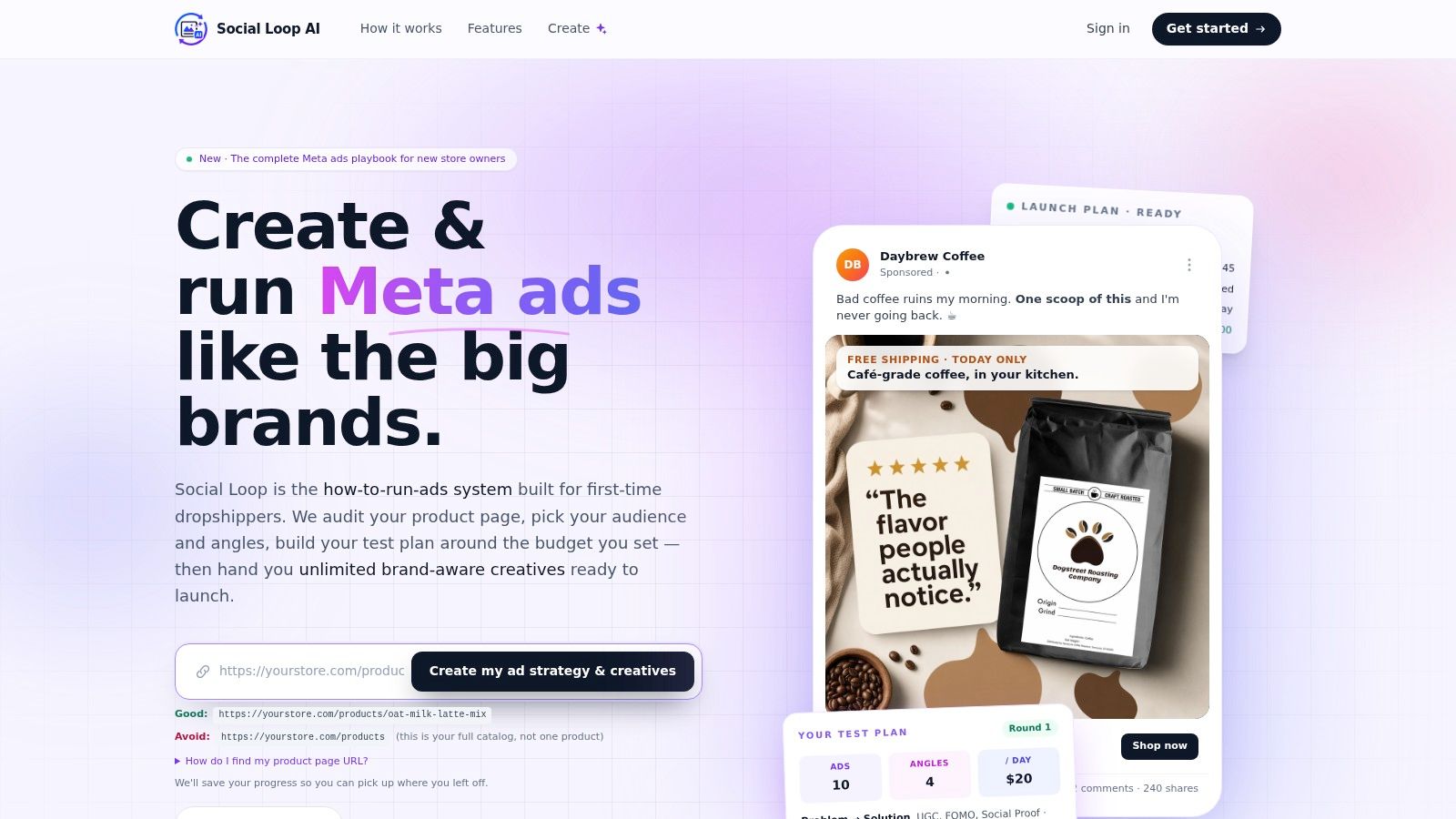
This matters because small budgets do not give you enough data to test everything at once. The practical goal is not statistical perfection. The goal is to avoid wasting money on messy comparisons.
A simple planning sheet should include:
| Round | Ad Name | Angle | Creative Type | Audience | Main Hook | Status |
|---|---|---|---|---|---|---|
| Round 1 | Ad 1 | Problem/Solution | Static image | Broad | Pain point | Testing |
| Round 1 | Ad 2 | UGC | Static image | Broad | First-person result | Testing |
| Round 1 | Ad 3 | Social Proof | Static image | Broad | Trust cue | Testing |
That table earns its keep fast. It forces clear decisions before spend starts, and it gives you a clean record when you review winners and losers later.
Practical rule: If you cannot explain what one ad is testing in a single sentence, do not launch it yet.
Build rounds that answer one question at a time
For a first campaign, simple beats clever.
Round one should usually test angles. New advertisers often want to test angle, hook, image style, CTA, and audience in one launch. That produces noise, not insight. If one angle gets stronger clicks, better landing page behavior, or early conversions, move that angle forward. Then test execution inside it.
A beginner-friendly setup looks like this:
- Round one tests angle: Compare a few distinct messages in the same broad setup.
- Round two tests execution: Keep the winning angle and test different hooks, visuals, or copy treatments.
- Round three tests refinement: Improve the best concept instead of introducing a brand-new direction.
This is the bridge between formal round robin logic and real ad buying. In metrology, the point is controlled comparison. In dropshipping, the point is controlled comparison with limited cash and imperfect data. Same principle. Different stakes.
Use these rules to keep decisions clean:
- A weak angle usually stays weak, even with better design.
- A strong angle with weak execution deserves another creative round.
- A weak angle and weak execution should be paused quickly.
To sharpen the message before launch, review frameworks for writing ad copy that maps to specific buyer objections.
Keep a decision log from day one
The ad account records results. Your log records judgment.
That distinction matters more than beginners expect. A week later, it is easy to forget why you kept one ad live, why you paused another, or whether the landing page changed in the middle of the test. A plain-language decision log protects you from that.
Use a format like this:
- Test question: Which angle gets the strongest early buying intent?
- Constant elements: Same product page, same offer, same campaign objective.
- Variable: Angle only.
- Decision rule: Weak ads get paused. Promising ads stay under review. Strong ads move to the next round.
Do not force certainty from tiny samples. Use each round to narrow the field and earn the next spend decision. That is the practical version of round robin testing for a first-time dropshipper using AI creatives. You are not trying to prove an ad is universally good. You are trying to decide whether it deserves more budget than the other options in front of you.
The following walkthrough is useful before you build your own naming and round logic:
An ad does not need to be perfect to survive round one. It needs to beat the alternatives in a fair, controlled test. That standard is realistic, repeatable, and a lot cheaper than guessing.
Launching Tracking and Making Scaling Decisions
Beginners usually think the hard part is launching. It isn't. The hard part is staying consistent once numbers start moving.
Formal proficiency testing uses clear thresholds to classify results. In that world, |z'| ≤ 2.0 is acceptable, with about 95% of scores expected in that range, while |z| ≥ 3.0 is an unacceptable outlier, according to United for Efficiency's overview of round robin testing and score interpretation. Ads don't use z-scores the same way, but the principle matters. Good operators define thresholds before emotion gets involved.
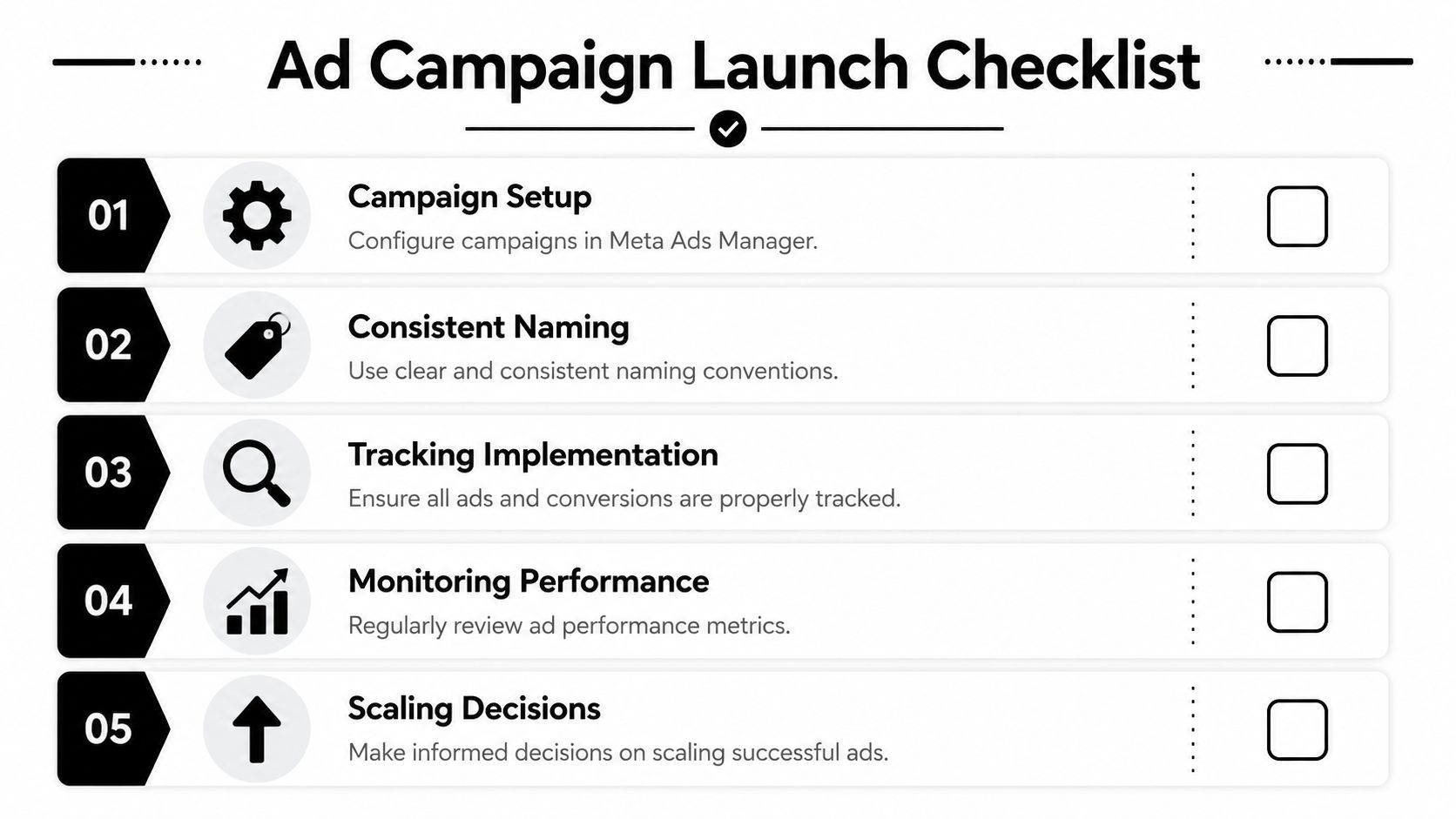
Name everything so you can read the data fast
Your campaign names should answer three questions at a glance:
- What is being tested
- Which audience is seeing it
- Which round it belongs to
If your ad names look like “New test 4” and “UGC final maybe,” you're setting yourself up to misread the account. Use a format you can scan quickly. Something like round, angle, audience, and creative type is enough.
Track the right signals in one sheet
A daily log keeps you from making decisions off memory. You don't need a fancy dashboard. A simple sheet works.
Track:
- Spend: So you know how much each ad has had a chance to prove itself.
- CTR and CPC: These show whether the message and creative are earning attention.
- CPA or ROAS: These tell you whether attention is turning into business.
- Notes: Record changes, odd delivery behavior, or anything that could explain movement.
Vanity metrics trap new advertisers all the time. A high CTR can still hide a weak buyer match. Cheap clicks can still lead nowhere. Purchases matter most, but upstream signals still help you decide whether a bad result is a messaging problem, a landing page problem, or just an ad that never had a chance.
If you want a plain-English explanation of how much confidence to place in a result, review this beginner guide to statistical significance in ad tests.
Build kill or keep rules before launch
The easiest way to waste budget is to improvise decisions mid-test. Build your rules early, then follow them unless there's an obvious tracking issue.
Don't scale because you're excited. Scale because the ad has cleared the standard you set before launch.
A simple framework:
Kill: Pause an ad when spend is building and the ad is weak across both efficiency and intent signals.
Keep watching: Leave an ad active if the result is mixed but the creative is showing clear signs of buyer interest.
Scale: Move an ad forward only when it's outperforming the round on business metrics, not just clicks.
Your exact thresholds should match your margin, product price, and target economics. The important part is consistency. Clear rules reduce the two most common beginner errors: shutting off ads too early and forcing budget into ads that look good on the surface but don't convert.
Common Round Robin Testing Pitfalls That Waste Ad Budget
First-time dropshippers usually do not lose money because testing is a bad idea. They lose money because they borrow the language of round robin testing without borrowing the discipline.
In a formal round robin, the process is controlled so the result means something. In ads, the practical version is a round-by-round system. Each round needs a clear job, enough budget to produce signal, and one main variable under review. If you skip that structure, AI-generated creatives from tools like Social Loop AI can make the problem worse, not better. You get more ad variations faster, but faster variation is not the same as better testing.
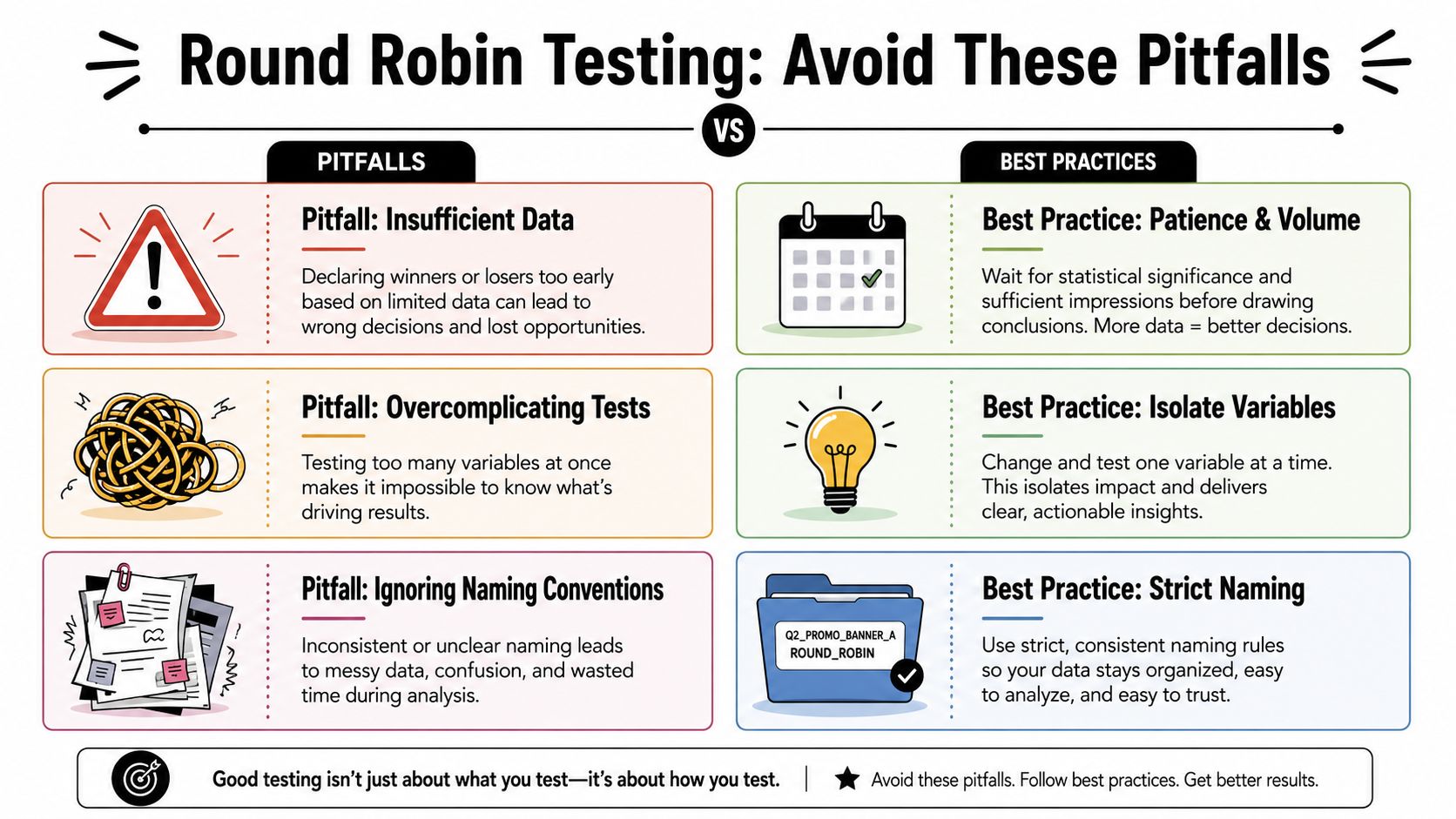
Mistake one is starving the test
A common beginner move is loading eight, ten, or twelve creatives into one launch because the asset pack is ready. Meta spreads spend thin, every ad gets a weak sample, and the account owner decides the product is the problem.
Usually, the product is not the first problem. The test setup is.
A better move is to shrink the round and protect budget per idea.
- Reduce the field: Test fewer creatives at once.
- Group by angle: Put similar hooks in the same round so you can compare like with like.
- Give each ad enough room: If an ad cannot gather enough delivery to show a pattern, it has not really been tested.
This feels slower on day one. It is cheaper by day seven because you stop paying for noise.
Mistake two is changing everything at once
Many new advertisers build one ad with a new headline, another with a new image, another with a different offer frame, and then switch audience settings too. One ad wins, but the reason is still unclear.
That is not a useful result. It is a lucky result.
Round-by-round testing works better when each round answers one question. Start with the market angle. Once an angle shows promise, test different creative executions inside that angle. After that, test audience or account structure changes if you still need improvement. This order matters because it helps you keep what worked and replace only what failed.
For AI-generated creatives, this matters even more. If Social Loop AI gives you multiple visual styles and hooks, do not test every possible combination in one batch. Turn the volume down. Pick a few angle-led variations, run the round, then build the next set based on what held attention and what drove buying intent.
Mistake three is reading noise like proof
Beginners often grab the easiest metric to understand and treat it like a verdict. A high CTR looks promising. Cheap CPC looks efficient. Early movement feels exciting.
But those numbers can hide a bad buyer match.
The reason this matters is simple. Round robin testing in ads is supposed to reduce bad guesses, not dress them up with prettier dashboard screenshots. If curiosity is high and purchase behavior is weak, the issue may be the offer, the landing page, or a mismatch between the ad promise and the product page. If click behavior is weak across the whole round, the angle itself may be off.
Naming discipline helps. If your campaign names do not show the angle, creative type, and round number, review gets messy fast. Then you cannot tell whether round two improved on round one, or whether you are comparing unrelated tests.
Mistake four is killing the lesson with the ad
A failed round still has value if you can explain why it failed.
New dropshippers often pause everything, switch products, and start over before they have learned anything useful. That resets the process and burns more budget on fresh guesswork. A better approach is to treat each round like a filter. One round may rule out a weak angle. Another may show that the concept is fine but the creative execution is bland. Another may reveal that the ad got clicks but the product page did not close the sale.
That is how the formal idea becomes useful in real marketing. You are not chasing perfect certainty. You are building a repeatable system for eliminating weak bets, one round at a time.
From Random Spending to Repeatable Growth
The big win from round robin testing isn't that every campaign becomes a hit. It's that your decisions stop being random.
Formal round robin programs rely on a structured process with phases such as registration, preparation, testing, and evaluation. When teams skip that structure, the result can be invalid, as explained in ZwickRoell's overview of round robin tests. Ad testing works the same way. If your launches are ad hoc, your conclusions will be shaky.
The practical version is simple. Plan the round. Launch cleanly. Track the same way every day. Decide with rules, not mood. Then run the next round with what you learned.
That last part matters. A losing ad still has value if it eliminates a weak angle. A messy first round still helps if it shows you where your process broke. Progress in paid social often comes from ruling out bad bets faster, not just from finding a magical winner.
For first-time dropshippers, this is the shift that separates gamblers from operators. Operators don't need perfect certainty. They need controlled learning. Once you have that, your budget starts buying insight, not just impressions.
If you've already got a batch of creatives ready, don't dump them all into one campaign and hope Meta figures it out. Put them into rounds. Give each round a job. Let the winners earn their way forward.
If you want a faster way to turn a product page into structured test rounds, angle-based creatives, and a practical launch plan, try Social Loop AI. It's built for first-time dropshippers who need a clearer way to test Meta ads without hiring an agency.