Blog
A Guide to Multivariate Testing for E-Commerce
Published May 14, 2026
Alright, you've got your ecommerce store up and running. Maybe you've even used a few AI tools to get your first ad creatives out the door. But now comes the hard part: making every single dollar of your ad budget actually work.
You’re probably familiar with A/B testing—pitting one ad or landing page against another. It's a solid start. But it can feel slow and clunky, especially when you have multiple ideas for a headline, a new product image, and a different call-to-action button.
That's where multivariate testing (MVT) comes in. Instead of testing just one big change at a time, it lets you test all those smaller elements simultaneously to see how they perform together.
Table of Contents
- Your Guide to Smarter Multivariate Testing on a Budget
- How to Design Your First Multivariate Test Plan
- From Launch Day to Winning Insights: How to Read Your Test Results
- Common MVT Mistakes and How to Avoid Them
- Common Questions (and Straightforward Answers) About Multivariate Testing
Your Guide to Smarter Multivariate Testing on a Budget
Don't let the fancy name fool you; this isn't some complex strategy reserved for giant corporations with endless marketing budgets. For a small team, multivariate testing is a secret weapon for getting sophisticated insights without needing massive traffic or a huge ad spend. It’s about understanding why something works, not just what works.

A Scenario I See All the Time
Let's put this into a real-world context. Imagine you’re a dropshipper trying to make a new product pop. You’ve got a small budget, but big ideas. You’ve come up with two killer headlines, two great product photos, and two different calls to action you want to try.
With traditional A/B testing, you'd be stuck running one test after another, burning through your budget just to find the best headline, then the best image, and so on. It's inefficient.
A multivariate test, on the other hand, combines all of these into a single, elegant experiment. You’d be testing all eight possible combinations (2 headlines x 2 images x 2 CTAs) at once. This immediately gives you a few key advantages:
- You find the single best-performing combination of elements much, much faster.
- You uncover interaction effects. This is the gold. You might find your best headline actually bombs unless it’s paired with a specific image. An A/B test would never tell you that.
- You can easily spot the duds—those individual elements that drag down conversions no matter what they're paired with.
By running a single, coordinated experiment, you get deeper insights from the same amount of traffic. This efficiency is critical when you’re on a tight budget.
In this guide, we'll get practical. I'll walk you through a sample round-by-round plan designed specifically for small ecommerce advertisers. You'll see exactly how to turn a limited ad spend into a powerful optimization engine, proving that smart testing isn't about the size of your budget—it's about the quality of your strategy.
Alright, let's talk about one of the most common questions I hear from new advertisers: should I run an A/B test or a multivariate test? It’s easy to get tangled up here, but the answer isn't about which is "better." It's about picking the right tool for the right job.
I like to think of A/B testing as my trusty sniper rifle. It's for making big, decisive changes where you need a clear winner. You'd use it to pit a completely new landing page design against your old one, or maybe test a bold new value proposition. The goal is simple: answer the question, "Which one of these two very different ideas works best?"
Multivariate testing (MVT), on the other hand, is like casting a wide net. It's what I use for refining a page or an ad that’s already getting a decent amount of traffic. MVT lets you test a bunch of smaller changes all at once—think different headlines, CTA button colors, and hero images—to see which combination of those elements drives the best results.
So, how do you decide which one to use? It really boils down to your goals, how much traffic you have, and the scale of the change you're proposing.
A/B Testing vs. Multivariate Testing Which One Is for You?
Deciding between these two powerful methods can feel tricky, but this quick comparison should help you choose the right path based on your immediate needs.
| Factor | A/B Testing | Multivariate Testing (MVT) |
|---|---|---|
| Primary Goal | Find a clear winner between two or more distinct variations. | Discover the best-performing combination of multiple elements on a single page. |
| Best For | Radical redesigns, different page layouts, testing a single, bold hypothesis. | Optimizing and fine-tuning an existing page by testing headlines, images, CTAs, etc. |
| Traffic Needs | Lower. Good for sites with less traffic or when you need answers quickly. | Higher. Requires significant traffic to test all combinations and get reliable data. |
| Complexity | Simple to set up and analyze. You get a straightforward "Version A vs. Version B" result. | More complex. You're analyzing the impact of multiple changes and their interactions. |
| Key Question | "Which of these pages is better?" | "Which combination of these elements is best?" |
Ultimately, the table above shows that your choice depends entirely on your situation. If you're making a big swing, start with an A/B test. If you're looking to refine what's already working, MVT is your friend.
When to Pick Each Method
Let's get practical. Here’s how I decide in the real world:
-
Go with A/B Testing for: Big, sweeping changes. We're talking radical redesigns, new value props, or major shifts in page layout. It’s also your best bet on lower-traffic pages because it gets you to a statistically significant result much faster.
-
Go with Multivariate Testing for: Fine-tuning your money-makers. Think high-traffic product pages, checkout funnels, or popular ad landing pages. It’s perfect for understanding how small tweaks interact with each other to lift performance.
That traffic requirement is the real kicker. Historically, as ecommerce took off, MVT gained traction because it's just more efficient than running a ton of separate tests. For instance, just adding a third option to a simple A/B test can bump up your required sample size by 33%. But if you tried to find the same winning combination by running multiple A/B tests back-to-back, you could need 100% more traffic. When you have the volume, MVT is often the smarter play. You can see some of the math on MVT efficiency for yourself.
A/B testing is for reinvention. Multivariate testing is for optimization. My advice is always to fix the big, glaring problems first with A/B tests. Once you have a winning concept and enough traffic, then you can switch to MVT to polish the details to perfection.
At the end of the day, your testing strategy should drive the decision. Ask yourself what you truly need to learn. If you're testing one big, focused idea, an A/B test will give you a clean, fast answer. If you want to dig into how multiple elements play together—and you’ve got the traffic to back it up—a multivariate test will unlock much deeper insights.
How to Design Your First Multivariate Test Plan
Alright, let's get practical. Moving from the idea of a multivariate test to actually designing one can feel intimidating, but it doesn't have to be. Forget the complex statistical models for a moment. When you're just starting out, especially on a lean budget, the key is to be strategic and focus only on the elements that truly move the needle.
So, where do you begin? The biggest mistake I see is trying to test everything at once. Instead, zero in on the heavy hitters for your Meta ads or landing pages. In almost every case, this comes down to three core components: the headline (your hook), the main visual (your creative), and the call-to-action (your CTA). These are what grab attention and convince someone to click.
For your very first experiment, I highly recommend starting with a simple but powerful 2x2 test. This means you'll pick two different headlines and two different images to test against each other. It's the perfect, low-risk entry into the world of multivariate testing.
A Quick Look at the Math
Calculating the number of versions you'll be running is simple multiplication. You just multiply the number of variations for each element you're testing.
In our 2x2 example, it looks like this:
2 Headlines x 2 Images = 4 Total Combinations
Your testing software will then automatically create and serve these four unique combinations to your audience, gathering data on which one performs best. A simple setup like this can uncover some incredibly powerful insights. You might find Headline A flops with Image 1 but is a runaway success with Image 2—a connection a standard A/B test would have completely missed.
Your first test plan shouldn't be a massive, sprawling experiment. It should be a focused question. By starting with a 2x2 or 2x3 test, you can get meaningful data without needing an enormous amount of traffic.
Deciding between a broader A/B test and a more refined multivariate test really comes down to your immediate goal. This flowchart breaks it down beautifully.
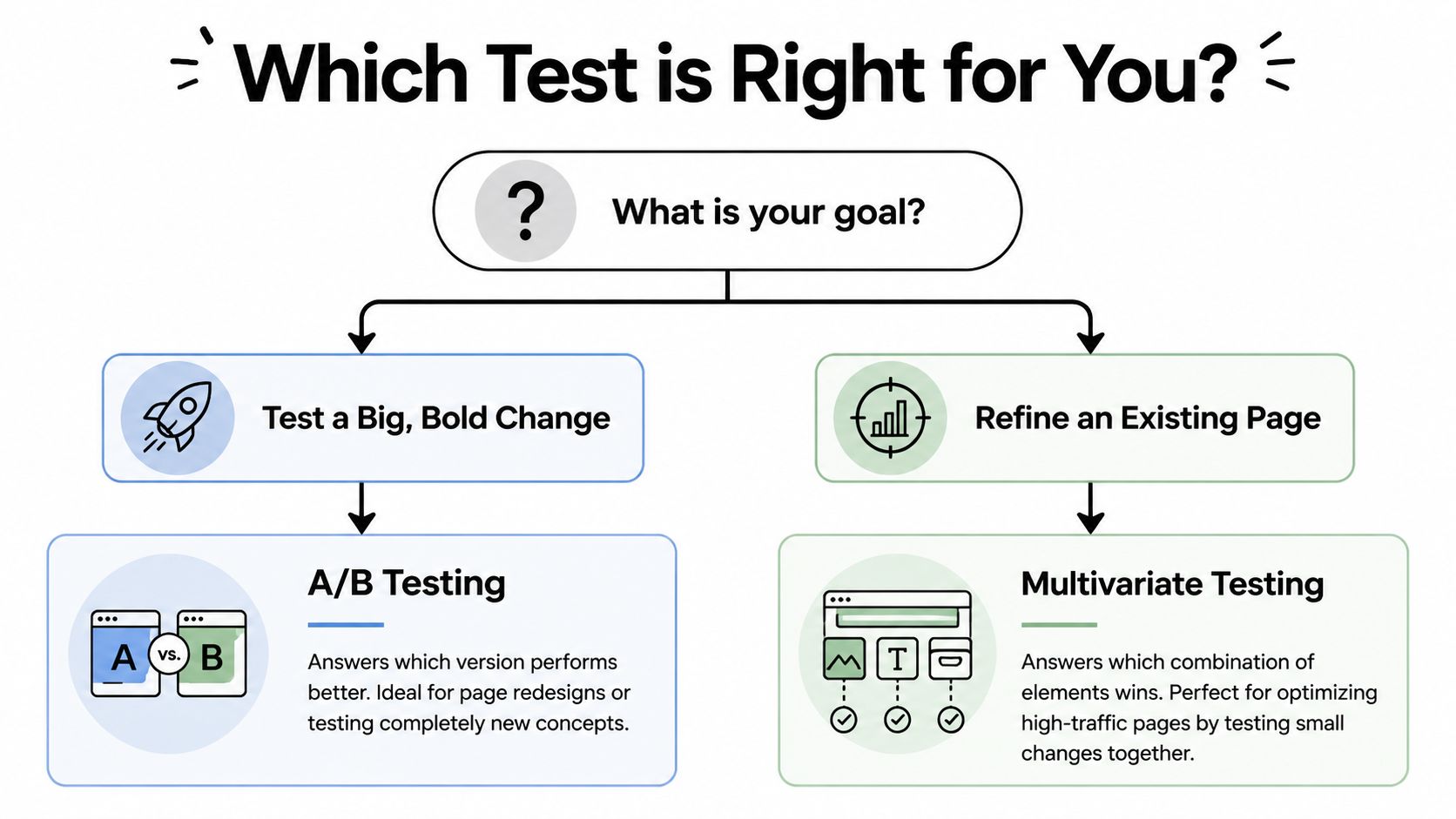
As you can see, when you’re ready to fine-tune an existing page by optimizing how its most important elements work together, multivariate testing is the way to go.
Do You Have Enough Traffic?
This is the big question, isn't it? The number of combinations in your test directly impacts how many visitors you'll need to get a reliable result. The more combinations you run, the more traffic you'll need to spread across them.
For a smaller ecommerce store, this is a critical planning step. A test with 4-6 combinations is often a realistic goal. Trying to run a test with 12 or more versions, however, could take months to produce a clear winner, burning through your budget in the process.
Before you launch anything, take a few minutes to use a free online sample size calculator. These tools will typically ask for three key pieces of information:
- Your page's current conversion rate
- The minimum lift you're hoping to achieve
- The number of variations in your test
This quick calculation will give you a solid estimate of the traffic you'll need per variation. If that number looks way too high for your budget or timeline, don't worry. Just scale back your test. Reduce the number of variables or variations, focusing only on the most critical hypotheses. You can always build on your findings in the next round.
From Launch Day to Winning Insights: How to Read Your Test Results
Alright, your multivariate test is live. You've done the hard work of setting it all up, and now the data is starting to trickle in. The temptation to check your dashboard every five minutes is real, but this is where patience becomes your most valuable asset.
The most common—and costly—mistake I see teams make is calling a test too early. You need to let it run until you hit statistical significance. Think of this as the point where you can be confident the results aren't just a fluke. The industry standard is 95% confidence, meaning there's only a 5% chance the outcome is due to random luck.

Most testing tools, like Google Optimize or VWO, will show you this confidence level. Resist the urge to declare a winner just because one variation shoots ahead in the first 48 hours. Early results are notoriously unreliable. Let the numbers mature.
The Real Gold: Uncovering Interaction Effects
Finding the single best combination is a solid win, no doubt. But the true power of multivariate testing is digging into the why behind the results. This is where you uncover interaction effects—the fascinating ways different elements play off each other.
Here’s a classic example I’ve seen play out many times. Let's say your data shows a specific ad image is an absolute dud when paired with your original, benefit-focused headline. You'd be tempted to throw it out. But wait. When you look closer, you see that same "losing" image, when combined with a new, more aggressive "fear of missing out" headline, is suddenly your top performer.
That's an interaction effect. It's a powerful insight that a simple A/B test would have completely missed.
Your goal here isn't just to find the one winning formula. It’s to understand how each piece contributes to the whole and, just as importantly, to identify the consistent losers that poison every combination they touch.
This level of analysis is a game-changer, especially for small e-commerce shops in crowded markets. For instance, I've seen a test where, after segmenting the results, a "losing" combination turned out to be a massive winner for a specific audience segment, boosting their conversions by 18%. In another case, digging into the interactions proved that a certain color palette in a video ad increased engagement by 22%, but only when paired with a direct, punchy headline. You can learn more about the mechanics behind this in Optimizely’s detailed glossary on MVT.
As you start sifting through your results dashboard, look for these patterns:
- Is there one headline that consistently lifts performance, no matter what image it’s paired with? That’s your workhorse.
- Do you have a call-to-action button that seems to drag down the conversion rate of every variation it's in? Time to kill it for good.
This is how you turn a spreadsheet of data into genuinely profitable business decisions. These are the insights that will fuel your next, even smarter, round of tests.
Common MVT Mistakes and How to Avoid Them
It’s easy to get carried away when you first start with multivariate testing. The temptation is to throw everything at the wall to see what sticks. But that’s a rookie mistake that burns through cash with nothing to show for it.
I see this all the time: someone gets excited and designs a massive 81-combination test with three headlines, three images, three CTAs, and three offers. On paper, it sounds thorough. In reality, it stretches your traffic so thin that you'll never get a clear winner, especially on a tight budget.
Instead, rein it in. Think smaller and smarter. Stick to 4 to 8 high-impact combinations by pitting your top two headlines against your two best images, for example. This focused approach gives you clean, actionable data much, much faster.
Focus on Bold Changes
The other big trap is getting bogged down in tiny, insignificant changes. Honestly, nobody cares if your button is #0000FF or #0000CC. When you need results and you're short on time and money, you have to make bigger swings.
Go for bold changes. Test a fundamentally new value proposition. Pit a "20% off" offer against a "Free Shipping" one. These are the kinds of changes that actually move the needle. In fact, data from Optimizely has shown that bolder tests can achieve statistical significance up to 40% faster. That's a huge deal when you’re running ad batches with a tool like Social Loop AI and need to find a winner before your budget runs out.
The goal of budget MVT isn't just finding a winner—it's finding one quickly. But don't let impatience make you call a test before the data is solid.
When handled correctly, the payoff is well worth the effort. We're seeing shops that adopt MVT achieve 28% better feature optimization compared to those sticking only with simple A/B tests. Avoid these common pitfalls, and you’ll be on your way to getting real growth from your ad spend.
If you want to dig deeper into the numbers, there's a wealth of campaign data on different testing techniques and their impact that’s worth a read.
Common Questions (and Straightforward Answers) About Multivariate Testing
Even with a perfect plan on paper, a few questions always crop up once you start building your first multivariate test. I've heard them all, so let's get you the answers you need.
How Much Traffic Do I Really Need for This?
This is the big one, and the honest answer is: it depends. The right amount of traffic hinges on your current conversion rate and, crucially, how many different combinations you're throwing into the mix.
Before you even think about launching, your first step should always be to run the numbers through a free online sample size calculator. It's non-negotiable.
As a practical benchmark, if your test has more than 4-6 combinations, I'd want to see at least 5,000-10,000 visitors hitting that page every month. If your traffic numbers aren't there yet, you're better off sticking with simple A/B tests. You'll get clear, reliable results without having to wait months for the data to come in.
Can I Run a Multivariate Test for Free?
You absolutely can. Fancy, paid tools are nice to have, but you can get started without spending a penny. For one, Google Analytics has built-in features for setting up experiments.
Another way to do it on the cheap is to run a manual test. On a platform like Meta Ads, for instance, this just means creating a separate ad for every single combination. The trade-off for saving money is that you have to be incredibly organized. A well-maintained spreadsheet is your best friend here for tracking everything meticulously.
What Are the Best Elements to Test First?
You'll get the most bang for your buck by focusing on what people see the second they land on your page. Start with the elements "above the fold" because they have the biggest impact on that critical first impression.
My go-to starting points are always:
- Your Headline: This is your make-or-break moment. It’s the hook that either pulls people in or pushes them away, so it should be at the very top of your test list.
- Hero Image/Video: Your main visual sets the entire mood and is the first thing that catches the eye.
- Primary Call-to-Action (CTA): Don’t just tinker with button colors. Focus on the actual words—the CTA copy itself.
These three elements are what determine whether someone sticks around to learn more or hits the back button.
Ready to stop guessing and start building a real ad strategy? Social Loop AI turns your product URL into a full-funnel Meta ads launch plan and a batch of on-brand creatives in under 10 minutes. Get your first ad batch today.
Composed with Outrank