Blog
Master Buyer Persona Definition: Your 2026 Ecommerce Guide
Published July 1, 2026
A buyer persona is a detailed, semi-fictional profile of your ideal customer, built from research, that helps you understand their motivations, challenges, and buying habits so you can create ads and landing pages that connect with them. In practice, most stores don't need a huge stack of personas either. Three to four buyer personas account for over 90% of a company's total sales volume, which means focus usually beats trying to speak to everyone.
You launch your first Meta campaign, pick some interests, write a few lines of copy, and hope the product sells. A day later, the clicks are weak, add-to-carts barely move, and your budget feels like it vanished into thin air.
That usually isn't just an ad problem. It's a customer understanding problem.
New dropshippers often think buyer personas are a branding exercise for bigger companies. They aren't. A usable persona helps you answer the questions that control ad performance: What pain is this person trying to solve? What makes them hesitate? What kind of promise feels believable from a new store? What should the product page say first?
If you don't know those answers, you end up writing generic ads for a generic audience. Meta can only optimize so much when your message doesn't match the person seeing it.
This guide treats the buyer persona definition the way it should be treated for ecommerce. As a working tool for profitable Meta ads. You'll learn what a persona really is, what goes inside it, how to build one when you have zero customer history, and how to turn that profile into ad angles and landing page copy you can use.
Table of Contents
- Introduction Stop Guessing and Start Targeting
- What Is a Buyer Persona and Why It Matters for Ecommerce
- The Anatomy of a High-Impact Ecommerce Persona
- How to Build a Persona with Zero Sales Data
- From Persona to Profit How to Fuel Your Meta Ads
- Common Buyer Persona Mistakes and How to Fix Them
- Conclusion Your Persona Is a Living Document
Introduction Stop Guessing and Start Targeting
Most first-time store owners don't fail because they picked the worst product on the internet. They fail because they try to sell a decent product with blurry messaging.
You can see this in small decisions. The headline says "premium quality" because that's what every store says. The ad image looks nice but doesn't answer a real objection. The landing page lists features before it earns trust. None of it is completely wrong. It just isn't aimed at one clear buyer.
A buyer persona fixes that. It gives you a practical profile of the person most likely to buy, including what they want, what worries them, what language they use, and what finally pushes them to act. Once you have that, your ads stop sounding like they were written for the whole internet.
What guessing looks like in a live campaign
Without a persona, a new dropshipper usually does all of this at once:
- Targets broad interests: hoping Meta will find the right people from weak signals.
- Writes vague hooks: lines like "Upgrade your lifestyle" that don't connect to a specific problem.
- Uses the wrong proof: showing product aesthetics when the buyer needs trust, shipping clarity, or ease of use.
- Builds generic product pages: pages that describe the item but don't address the buyer's fear.
Practical rule: If you can't explain why one person would buy your product today and another person would scroll past it, your targeting is still too fuzzy.
The good news is that you don't need a giant research team to fix this. You need a simple system for turning customer clues into a profile you can use in ad copy, creative angles, and landing page structure.
What Is a Buyer Persona and Why It Matters for Ecommerce
A solid buyer persona definition is simple: it's a research-based profile of the customer you're trying to persuade. Not a broad group. Not "women interested in skincare" or "men who like fitness." A persona is closer to a cheat sheet for one type of buyer.
That cheat sheet helps you answer the deeper question behind every sale. Not just who the customer is, but why they buy.
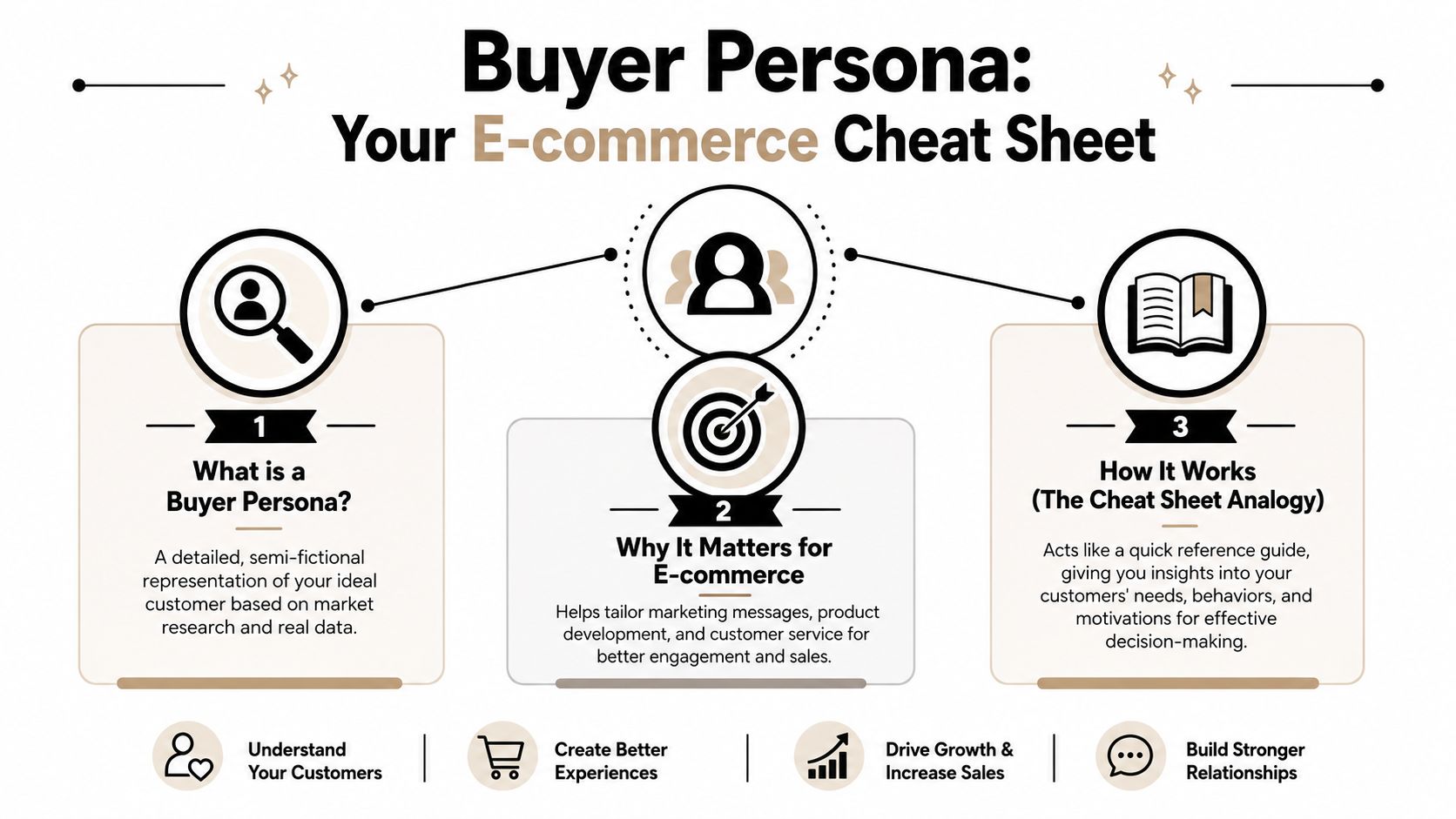
A target audience is broad. A persona is usable.
A target audience might be "women ages 25 to 40 who shop online." That's useful for media buying, but it doesn't tell you how to write a hook.
A buyer persona goes further. It might be:
- A first-time apartment renter who wants her space to look put together without spending too much
- A busy dog owner who's frustrated by shedding and wants something easy to use
- A gym beginner who's motivated by confidence more than performance stats
Those are very different buyers, even if they overlap in age, gender, or interests.
The part most beginners miss
A persona is often treated like a static demographic card. That's too shallow. The stronger view is that a persona is a dynamic, research-based hypothesis about how someone buys. According to BuyerPersona.com's explanation of the 5 Rings of Buying Insight, when priority initiatives are mapped to decision criteria, conversion rates increase by 20 to 30% because the message meets buyers at the moment they're ready to change.
For ecommerce, that matters because a Meta ad doesn't have much time to work. Your ad has to meet the buyer at the right emotional moment. Maybe she's annoyed by a daily problem. Maybe he's worried about trust because your store is new. Maybe they're comparing options and looking for a reason to stop scrolling.
A persona isn't a character for your brand deck. It's a shortcut to better hooks, better objections handling, and better product-page copy.
Why this matters more for a new store
Established brands can get away with weaker messaging because people already know them. New stores can't.
When nobody recognizes your brand, your ad has to do more work. It has to signal relevance fast. It has to make the promise feel specific. It has to reduce uncertainty. That's why the buyer persona definition isn't just academic for ecommerce. It's the foundation for every ad angle you test.
The Anatomy of a High-Impact Ecommerce Persona
A useful persona isn't long because long looks professional. It's useful because it gives you the inputs needed to make better ads.
For a first-time dropshipper, that means capturing the details that shape buying behavior. You don't need dozens of profiles either. According to Delve AI's buyer persona statistics roundup, three to four buyer personas account for over 90% of a company's total sales volume. For most small stores, one strong starter persona is enough to launch, and a few more can cover the bulk of future demand.
The core parts that actually matter
Think of your persona like a one-page brief with these pieces:
- Goal: What is this person trying to achieve?
- Pain point: What frustrates them right now?
- Motivation: Why does fixing this matter emotionally?
- Buying trigger: What event or moment makes them ready now?
- Objection: What stops them from buying today?
- Decision style: Do they buy fast, compare reviews, ask a partner, or wait?
- Trust signals needed: What proof helps them feel safe?
Here are simple ecommerce examples:
- Pain point: worried the item won't match the photos
- Objection: unsure whether a new store is trustworthy
- Buying trigger: wants a quick fix before an upcoming trip or event
- Trust signal needed: shipping clarity, product demo, clear returns
Ecommerce Buyer Persona Components
| Component | What It Is | Key Question to Ask |
|---|---|---|
| Goal | The outcome they want | What are they hoping this product helps them achieve? |
| Pain point | The problem they feel now | What annoys them enough to search for a solution? |
| Motivation | The deeper emotional driver | Why does solving this problem matter to them personally? |
| Buying trigger | The event that starts the search | What happened recently that made this product relevant now? |
| Objection | The reason they hesitate | What would make them say “not yet”? |
| Decision process | How they evaluate options | Do they compare reviews, ask someone else, or buy quickly? |
| Trust need | The proof they require | What would make a new store feel credible? |
A weak persona versus a strong one
A weak persona says, "Female, 29, likes online shopping."
A strong persona says, "Works long hours, wants products that save time, scrolls Instagram at night, worries about wasting money on low-quality items, and needs to see simple proof before buying."
The second version gives you direction. It tells you your ad should probably lead with convenience, not luxury. It suggests your landing page should show product use clearly before listing features.
If you need help tightening the promise your product makes to that buyer, studying a few value proposition examples for ecommerce offers can make your persona more practical, because the best personas connect directly to the promise on the page.
The best persona detail is the detail that changes your ad, headline, or offer.
How to Build a Persona with Zero Sales Data
No sales data doesn't mean no research. It just means you have to borrow signals from places where your future customers are already talking.
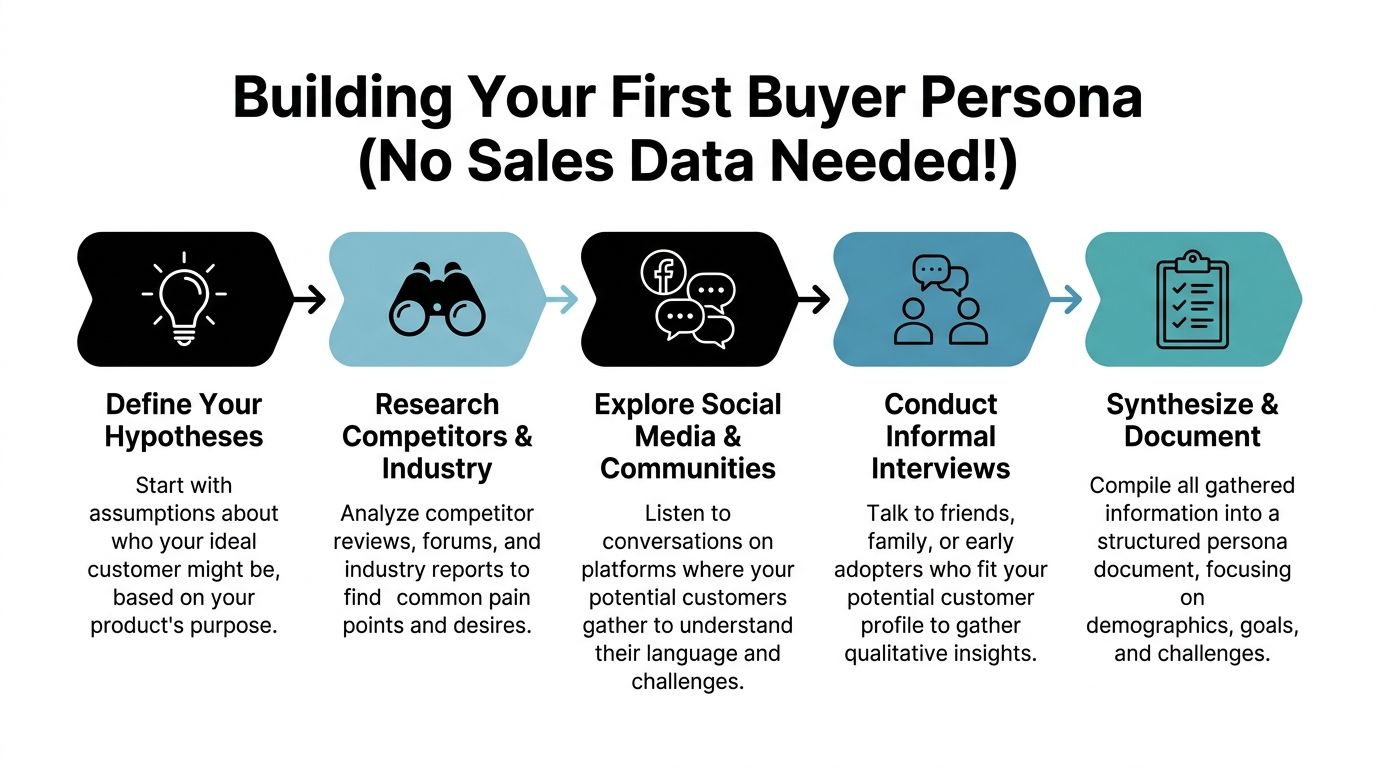
A high-standard persona usually comes from direct customer research. According to Miro's guide to buyer personas, an expert-level persona requires a minimum of 10 recorded and transcribed buyer interviews to identify recurring behavioral clusters. Most new dropshippers don't have that yet, so the goal is to approximate those insights with public data and a few informal conversations.
Start with a rough hypothesis
Before you research, write down your first guess.
If you're selling a posture corrector, your hypothesis might be: "This is for desk workers who feel stiff after long hours and want relief without building a whole exercise routine."
That first guess isn't the persona. It's your starting point. Research will either sharpen it or prove parts of it wrong.
Mine places where buyers speak in plain language
The best raw material isn't polished marketing copy. It's messy, emotional language from real people.
Look in these places:
-
Competitor reviews on Amazon or Shopify
- Read the five-star reviews for desired outcomes
- Read the one-star and three-star reviews for objections
- Copy phrases people repeat, such as fit issues, trust concerns, or delivery frustration
-
Reddit threads and Facebook groups
- Search the problem, not just the product
- Notice what people complain about before they ever mention buying
- Watch for exact wording like "I need something easy" or "I don't trust random brands"
-
TikTok and Instagram comment sections
- Check creator videos in your niche
- Read comments under product demos, before-and-after clips, and problem-focused content
- Look for skepticism, excitement, and questions
If five different people describe the same frustration in slightly different words, you've probably found a real pain point.
This kind of listening is the foundation of data-driven marketing for small ecommerce brands, even when your own store hasn't collected much data yet.
A video walkthrough can also help if you prefer to see persona building in action:
Use informal interviews if you can
You don't need to wait for paying customers. Talk to people who resemble your likely buyer.
Ask simple questions:
- What bothers you most about this problem now?
- What have you already tried?
- What would make you trust a product like this?
- What would make you hesitate before ordering from a new store?
Don't lead them. Let them talk.
If they say, "I hate buying from stores that hide shipping times," that's better than any guess you'll make on your own. Write down their words exactly. Good ad copy often comes straight from these phrases.
Turn your notes into a starter persona
Once you've gathered enough raw language, summarize it into one profile. Keep it lean.
Include:
- One sentence on who they are
- Their main problem
- Their deeper motivation
- Their top objections
- What proof they need
- What kind of ad angle fits them best
For example:
"Nina is a busy office worker who wants pain relief she can use at home without a complicated routine. She worries cheap products won't work, doesn't trust vague product claims, and responds best to clear demos and simple explanation."
That isn't perfect. It doesn't need to be. It only needs to be good enough to guide your first round of ads more accurately than guesswork.
From Persona to Profit How to Fuel Your Meta Ads
A persona becomes valuable when it changes what you launch.
For first-time dropshippers, defining buyer personas often determines financial success or failure. According to Vibe's analysis of buyer persona and ad angle alignment, 68% of failed Meta ad campaigns stem from mismatched audience psychology and ad angle, and brands that explicitly connect persona psychographics to ad angles see 40% higher engagement.
A sample persona for a new product
Let's say you're selling a compact portable blender.
Your persona isn't "health-conscious women." That's too broad.
A better persona is:
Maya, 27, works long shifts, wants quick breakfasts, tries to eat better, and feels guilty when busy mornings push her toward expensive or unhealthy options. She likes convenient products but worries cheap gadgets break fast. She needs to believe cleanup is easy and the blender is strong enough for daily use.
That single profile can shape your whole launch.
Match the persona to the right ad angle
Different persona insights lead to different angles.
| Persona insight | Best ad angle | What the ad should emphasize |
|---|---|---|
| She feels rushed in the morning | Problem to solution | Show the chaos, then show a simple fix |
| She wants to feel like someone who has her life together | Identity | Position the product as part of her routine |
| She doubts quality | UGC or demo | Show the product working in a believable way |
| She fears wasting money | Objection handling | Address durability, ease, and practical use |
If you want to sharpen the campaign setup around those choices, reviewing a few Meta ads best practices for ecommerce testing can help you turn persona signals into clearer test variables.
Turn persona notes into actual ad copy
Here are direct examples.
Problem to solution angle
Hook: Mornings are rushed enough without skipping breakfast again.
Body: Blend a quick smoothie in minutes, take it with you, and stop relying on overpriced grab-and-go options.
CTA: See how it fits into a busy routine.
This works because it meets Maya at the point of daily frustration.
Identity angle
Hook: For people trying to make busy days feel a little more put together.
Body: A small habit can change the tone of your morning. Quick blend, easy cleanup, less chaos.
CTA: Build a simpler routine.
This works because it speaks to self-image, not just function.
A strong ad angle doesn't describe the product first. It describes the buyer's situation first.
Objection-handling landing page copy
Your product page should continue the same conversation.
If Maya worries about quality and cleanup, your page can open with:
- Headline: Fast smoothies without the bulky blender mess
- Support line: Compact, easy to rinse, and built for everyday use
- Trust section: Show close-up product demo, clear cleaning steps, and shipping details early
- FAQ prompt: "Is it easy to clean?" and "Can it handle daily use?"
Notice what changed. You're not stuffing random benefits into the page. You're answering the persona's likely doubts in order.
Keep the translation simple
A practical formula helps:
- Pain point becomes the hook
- Motivation shapes the promise
- Objection determines the proof
- Decision style influences the page layout
Once you see that pattern, the buyer persona definition stops being theory. It becomes input for creative testing.
Common Buyer Persona Mistakes and How to Fix Them
Most bad personas don't fail because the owner forgot to fill in a template. They fail because the persona never becomes specific enough to guide real decisions.
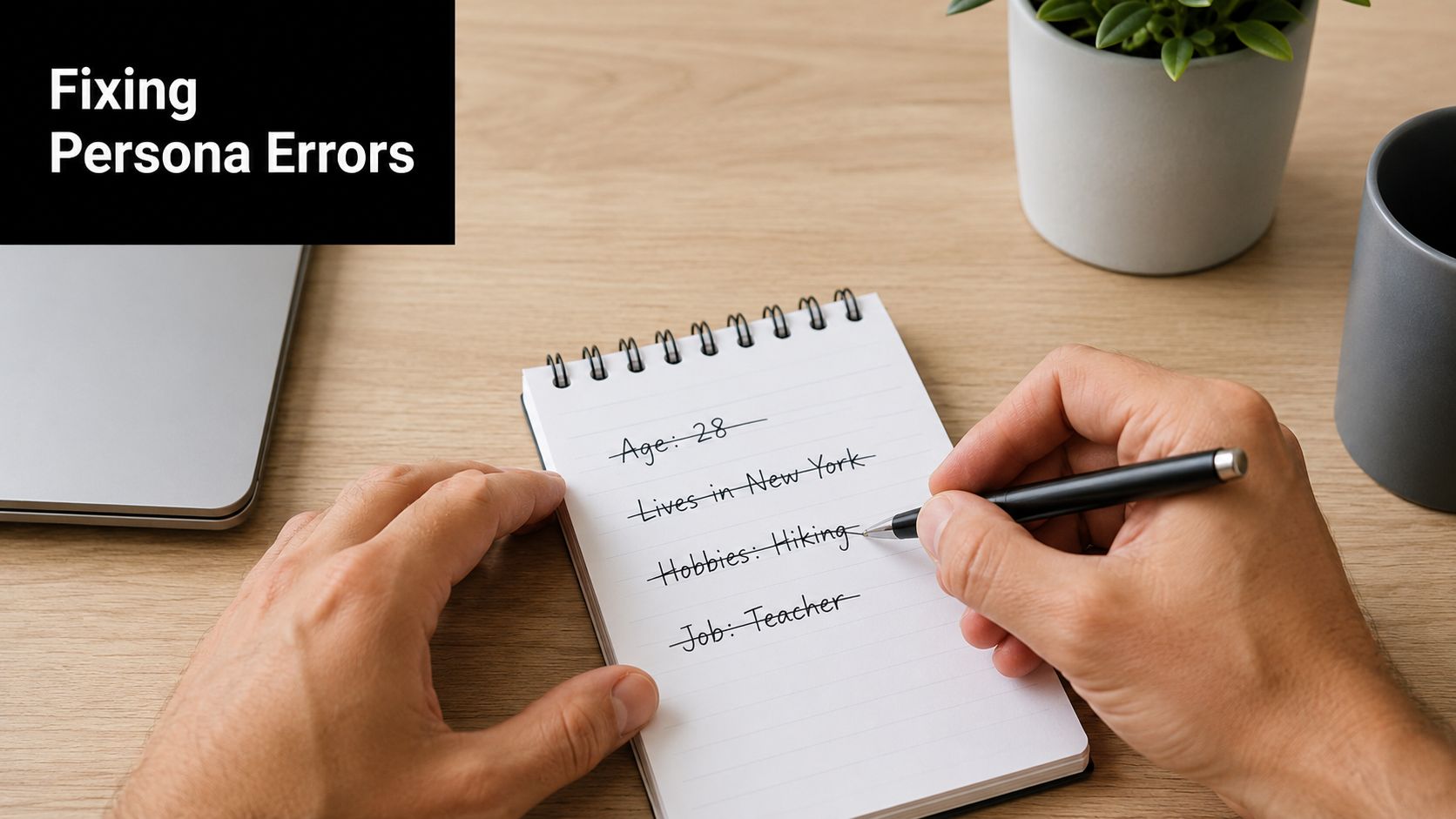
Mistake one. Writing a profile that's too generic
"Women 20 to 40 who like beauty products" isn't a persona. It's a loose audience bucket.
Fix it by adding buying context. What are they trying to solve? What are they afraid of? When do they shop? What makes them trust a product from a new store?
A sharper version sounds like a real buyer. That gives your ads a clear tone and angle.
Mistake two. Focusing only on demographics
Age and gender can matter, but they don't write your copy for you.
Psychographics do more of the heavy lifting. Values, fears, motivations, and objections shape the language that gets attention. If your persona tells you someone wants convenience but secretly fears wasting money on junk, your ad has a much clearer job.
Mistake three. Making the persona up from your own preferences
This happens all the time with first-time founders. You assume buyers care about the same features you care about.
They often don't.
Instead, pull language from reviews, comments, and conversations. Even a rough starter persona should sound like it came from outside your own head.
Reality check: If your persona could fit almost any product in your niche, it's too vague to improve your ads.
Mistake four. Creating too many personas too early
Some beginners build six or seven personas before they launch a single campaign. That usually creates confusion, not clarity.
Start with the one buyer most likely to convert first. Expand later when real orders, customer messages, and ad results show a meaningful second pattern.
Mistake five. Treating the persona like a school assignment
A persona isn't finished when the document is pretty. It's finished when it changes your ad creative, page copy, offer framing, and objections handling.
Use this quick before-and-after check:
-
Before: "Our customer values quality."
-
After: "Our customer worries low-cost products will feel flimsy, so the ad should show product use close-up."
-
Before: "Our customer wants convenience."
-
After: "Our customer wants fewer morning steps, so the headline should promise speed and simplicity."
When every persona note points to a message decision, the profile becomes useful.
Conclusion Your Persona Is a Living Document
Your first buyer persona isn't your final answer. It's version one.
That matters because buyers don't think the same way at every stage. According to HubSpot's buyer persona definition guide, top-of-funnel concerns like price and trust differ from bottom-of-funnel barriers like shipping and return policy. The same source notes that 73% of SMBs still use a single persona across all stages, while brands using dynamic, journey-aware personas achieve 2.4x higher ad relevance scores.
For a new ecommerce store, that means your persona should evolve as you learn. Early on, your profile may focus on cold traffic questions like "Can I trust this product?" and "Is this relevant to me?" Later, after you get more clicks, carts, and customer messages, you'll start seeing deeper patterns about purchase timing, objections, and post-click hesitation.
Keep updating the document with real signals:
- Ad comments: what people ask or doubt
- Product page behavior: where attention drops
- Customer messages: what people want clarified
- Post-purchase feedback: what nearly stopped the sale
A strong buyer persona definition isn't static. It gets smarter every time a real buyer reacts to your ads. That's why good ecommerce operators don't treat personas as branding paperwork. They treat them as active launch assets.
If you're ready to turn a product URL into a clear buyer profile, practical Meta ad angles, landing-page fixes, and test-ready creatives, Social Loop AI helps first-time dropshippers launch faster with a guided system built for real ecommerce decisions.