Blog
Data Driven Marketing: A Guide for Small Ecommerce
Published May 24, 2026
You've probably done some version of this already. You find a product that looks promising, build a clean Shopify store, launch a few Meta ads, and wait for sales. A few days later, the spend is gone, the clicks don't convert, and you're left guessing what failed. Was it the product, the landing page, the ad angle, the audience, or the offer?
That guessing loop is what kills small ecommerce stores.
Data driven marketing is the way out. Not the enterprise version with giant dashboards and analysts. The practical version. The one that helps a solo founder make better calls before burning more budget. Salesforce describes data-driven marketing as using information from customer interactions, website analytics, social engagement, and market research to understand behavior and optimize campaigns in real time. In the same ecosystem of industry research it cites, 72% of marketers said improved marketing performance was the top benefit of data-driven strategies, and 78% of organizations said it increases lead conversion and customer acquisition (Salesforce on data-driven marketing).
For a first-time dropshipper, that matters for one reason. You don't have enough money to “test everything.” You need a tighter system.
The stores that improve fastest usually don't have magical products. They have shorter feedback loops. They read the signals in front of them, fix obvious friction early, test angles with a reason behind them, and stop funding bad ideas just because they “feel right.”
That's what this guide is about. A low-budget way to use data before launch, during testing, and inside a simple weekly review process so your store runs on evidence instead of hope.
Table of Contents
- Stop Guessing and Start Growing with Your Data
- Understanding Data-Driven Marketing
- Essential Data Sources and KPIs for Ecommerce
- Your 5-Step Data-Driven Marketing Roadmap
- Data-Driven Marketing in Action
- How Tools Like Social Loop AI Accelerate Growth
- Your Next Steps in Data-Driven Marketing
Stop Guessing and Start Growing with Your Data
Most early ad accounts fail for a boring reason. The founder launches campaigns before they've earned the right to scale. The product page is weak, the messaging is fuzzy, the offer isn't sharp enough, and the creative doesn't match what the page promises. Then they try to solve all of that by changing audiences.
That's backwards.
Good data driven marketing starts by treating marketing as a series of decisions you can test. Every click, scroll, add-to-cart, abandoned checkout, and repeat page visit tells you something useful. Not everything is equally important, though. On a small budget, you need to care less about vanity and more about friction.
Practical rule: If your page and offer aren't convincing, more traffic just buys you faster disappointment.
Beginners usually overcomplicate things. They think “data” means spreadsheets, attribution software, and advanced models. In practice, the first wins usually come from simple questions:
- Why did people click but not buy
- Which message got attention
- Where did the page lose trust
- Which creative angle earned the strongest intent
- What should be paused immediately
When you start looking at your store this way, the job changes. You're no longer trying to be lucky. You're trying to remove uncertainty one test at a time.
That mindset is especially important if you're dropshipping or launching a new product with limited proof. You don't have years of customer history. What you do have is fast behavioral feedback. Used well, that's enough to make smarter calls than a founder who relies on gut feel alone.
Understanding Data-Driven Marketing
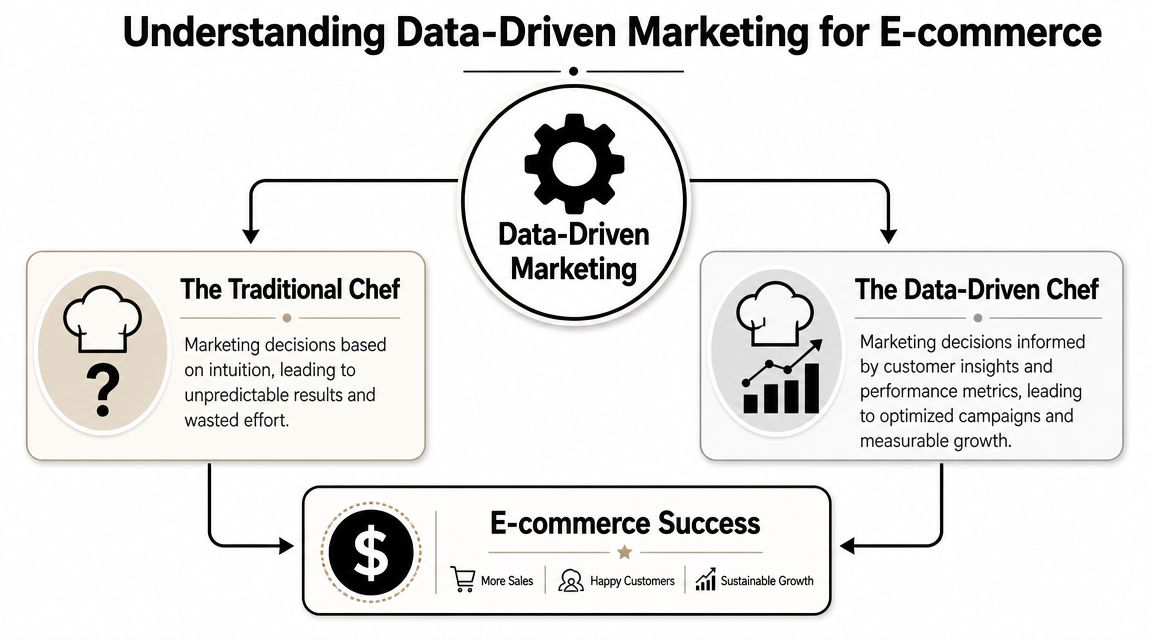
A simple way to understand data driven marketing is to compare two cooks.
One cook throws ingredients into a pan and hopes the meal works. The other follows a recipe, tastes as they go, adjusts seasoning, and notes what changed the result. Both are “creating,” but only one can repeat success.
Marketing works the same way.
Smart data beats big data
Beginners get scared off by the term because it sounds like something built for large brands. It isn't. For a small ecommerce store, the useful version is just smart data. Signals that help you answer a decision.
You don't need a warehouse full of historical customer records to start. You need to know things like:
- Traffic behavior from Shopify or WooCommerce
- On-site actions from GA4
- Ad response from Meta Ads Manager or TikTok Ads Manager
- Purchase patterns from your order data
- Message fit from what people click and what they ignore
A June 2024 Statista survey showed that marketing decision-makers saw data-driven marketing as most useful for email marketing at 47%, customer experience at 46%, and paid advertising at 41%. The same survey found that 95% rated their data strategies as successful when combining somewhat successful and very successful responses (Statista survey on where data-driven marketing is most useful).
That matters because it shows this isn't some side tactic. It's already part of day-to-day execution in the areas that directly affect a small store's sales.
What data driven marketing looks like in a small store
For a new store, data driven marketing isn't about building a perfect model. It's about making fewer bad bets.
It looks like this:
- Checking message match between ad and product page before launch
- Watching landing page behavior to find trust gaps and confusion
- Comparing ad angles instead of throwing out random creatives
- Using audience behavior to separate cold traffic from warmer intent
- Reviewing results weekly so you know what to keep, cut, or rewrite
The best small-budget marketers don't collect more data than everyone else. They act on the right signals faster.
That's the core shift. Data isn't there to make you feel informed. It's there to help you choose.
Essential Data Sources and KPIs for Ecommerce
Most beginners already have enough data to improve. They just look in the wrong places or track too many things at once. If your store is on Shopify or WooCommerce and you're running paid traffic, you can get useful answers from three sources before you ever touch advanced reporting.
Your three core data sources
Start with the platforms you already use every day.
- Your ecommerce platform gives you order data, product performance, sessions, conversion trends, and where buyers drop during checkout.
- GA4 helps you see behavior on the site itself. Which pages get attention, where people leave, which devices struggle, and whether visitors move deeper into the funnel.
- Your ad platform shows which hooks, creatives, headlines, and audiences earn clicks and downstream intent.
Those three sources are enough to spot most early-stage problems. If you want a cleaner way to understand ad-side numbers, this guide to ad performance metrics for ecommerce campaigns is a useful companion.
What usually doesn't work is obsessing over one dashboard in isolation. A cheap click in Meta means nothing if the product page repels buyers. A page with decent conversion means less if the ad attracts the wrong person. The useful view comes from reading them together.
The KPIs worth watching early
You do not need a giant scorecard. You need a short list tied to the stage you're in.
| Marketing Goal | Key KPIs | What It Tells You |
|---|---|---|
| Traffic and awareness | Link clicks, landing page views, click-through rate | Whether your ad gets attention and whether traffic actually reaches the page |
| Product page engagement | Bounce patterns, time on page, scroll behavior, add-to-cart rate | Whether visitors understand the offer and feel enough interest to continue |
| Conversion and sales | Initiated checkout, purchase rate, conversion rate | Whether your page, offer, and checkout flow are strong enough to turn intent into orders |
| Profitability | Cost per purchase, average order value, return on ad spend | Whether the campaign can support scale without destroying margin |
| Retention and follow-up | Email signups, returning visitors, repeat purchases | Whether you're building value beyond the first click |
A few practical notes matter here.
First, landing page views are often more useful than raw clicks because they tell you whether people reached the page. Second, add-to-cart rate is one of the best early diagnostics for a new store. If ads get attention but hardly anyone adds to cart, the problem often sits in the page, offer, or product-market fit. Third, cost per purchase only becomes meaningful once the upstream steps are healthy enough to trust.
Working rule: Track one KPI per funnel stage. If you track ten at once, you'll avoid making the hard decision.
For a beginner, the cleanest setup is this: one metric for ad attraction, one for page engagement, one for buying intent, and one for profitability. That's enough to tell you where to investigate next.
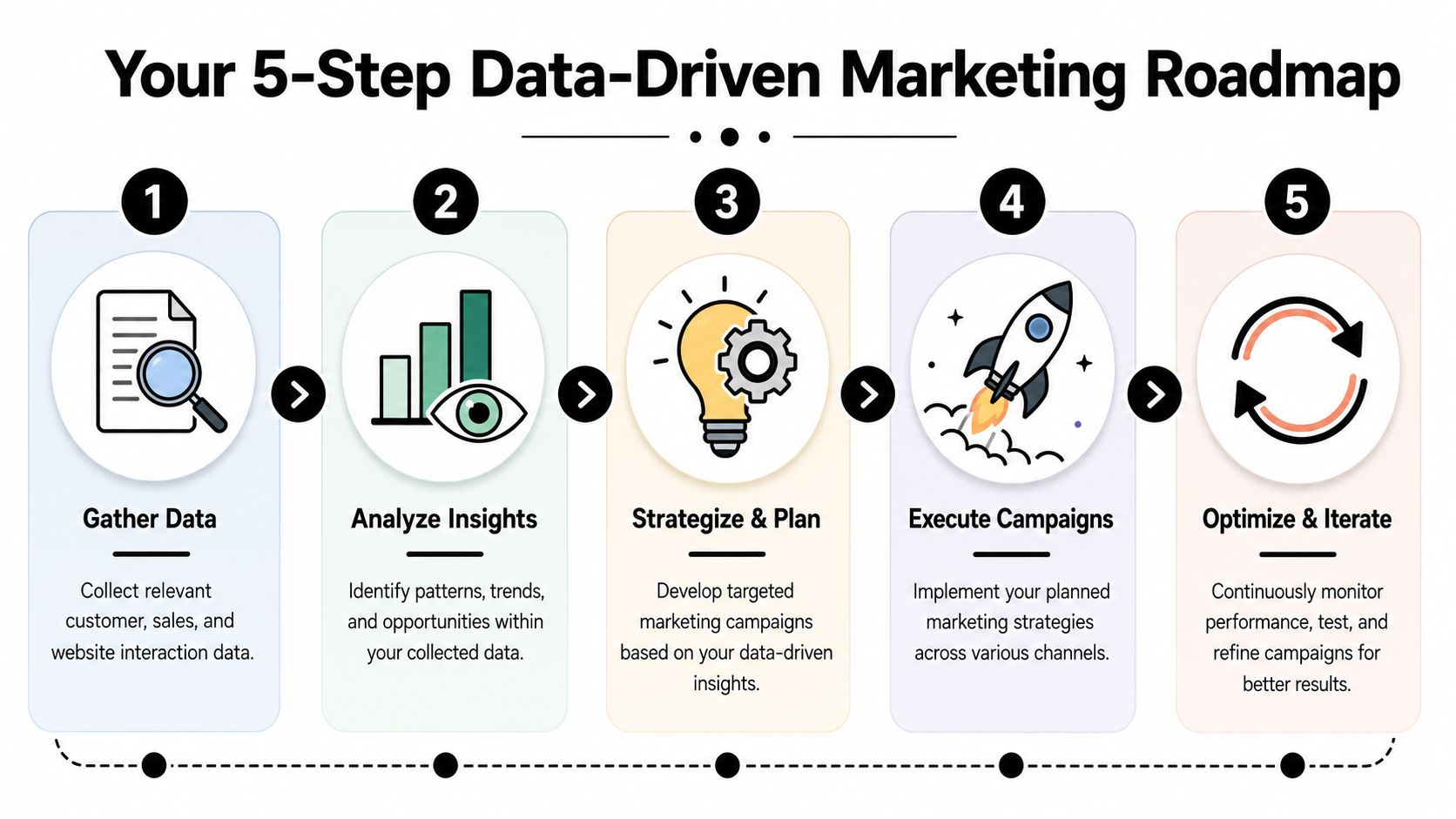
Your 5-Step Data-Driven Marketing Roadmap
The fastest way to waste money is to treat launch day as the start of learning. For a solo founder, the cheapest lessons come before the first campaign goes live.
Recent industry analysis points out a gap that matters a lot for beginners. Most advice focuses on optimizing after launch, but for new sellers the most effective use of data is often pre-launch. That includes signals like landing-page readiness, message-match quality, hook clarity, and whether your angle answers a real objection before budget gets spent (analysis of pre-launch diagnostic gaps in data-driven marketing guidance).
1. Audit your foundation
Before you buy traffic, inspect what that traffic will hit.
Read your product page like a skeptical customer. Is the promise obvious in the first screen? Does the hero image support the claim? Is the offer easy to understand without effort? Are shipping, returns, delivery expectations, and trust cues visible?
A basic pre-launch audit should cover:
- Clarity of offer. Buyers should understand what the product is, who it's for, and why it's different.
- Message match. If your ad says “solve back pain while working,” the page can't open with vague lifestyle fluff.
- Objection handling. Size, materials, shipping time, setup, quality, and refund concerns should be answered directly.
- Mobile experience. Most small-store traffic arrives on mobile. If the page feels slow, cramped, or confusing there, ads won't save it.
Weak pages create misleading ad data. The ad looks bad, but the true failure happens after the click.
A useful way to do this is to score the page manually before launch. Give each area a simple pass, weak, or fail rating. That forces honesty.
2. Set up tracking before traffic arrives
Tracking isn't glamorous, but it's essential.
You need the basics working before launch: platform pixel, primary events, GA4, and consistent naming on campaigns and ad sets. If you skip this, you won't know whether a bad result came from poor execution or bad measurement.
Keep the setup simple:
- Install the pixel correctly and verify key events.
- Connect GA4 so on-site behavior has a second view.
- Use clear naming conventions so you can tell angle, audience, and creative type apart later.
- Test the funnel yourself from landing page to checkout.
Later, if the business grows, more advanced attribution and unified measurement matter. But early on, clean event tracking beats fancy reporting.
To sharpen your testing structure, learn the basics of multivariate testing for ad and landing page experiments. Most beginners don't need complexity. They need cleaner comparisons.
Here's a useful walkthrough to watch before your first serious test cycle:
3. Segment with simple buyer intent
Early-stage segmentation should be light. Don't build twelve audiences you can't interpret.
Start with behavior:
- Cold visitors who've never seen you
- Engaged visitors who viewed products or spent time on site
- High-intent users who added to cart or started checkout
- Existing customers for upsells, bundles, or repeat offers
That alone gives you better control over messaging. Cold traffic needs a hook and a clear problem-solution story. Warm visitors need reassurance. Cart abandoners often need objection handling, a cleaner offer, or a reminder of what made them click in the first place.
4. Run hypothesis-driven tests
Random testing burns budget. Hypothesis-driven testing creates learning.
A weak test sounds like this: “Let's try some new creatives.”
A strong test sounds like this: “We believe a problem-solution angle will outperform a generic lifestyle angle because the product solves an obvious daily frustration, and cold traffic needs faster clarity.”
That difference matters. Now you know what you're testing, why it might work, and what result would support or reject the idea.
Three solid early tests for dropshippers:
- Angle test. Problem-solution vs UGC-style demo vs social proof.
- Hook test. Direct pain point vs aspirational outcome.
- Offer framing test. Simple discount vs bundle vs risk-reversal language.
Try to hold most variables still while testing one thing that matters.
The point of testing isn't to prove you're right. It's to find the fastest way to stop being wrong.
5. Build a weekly feedback loop
Most founders either check ads obsessively every hour or avoid the dashboard because it stresses them out. Neither habit helps.
Run a weekly review instead. Same day, same process, same questions.
A simple loop:
| Review Area | Question to Ask | Typical Action |
|---|---|---|
| Creative | Which angle attracted the best quality traffic | Make more variants of the strongest angle |
| Landing page | Where did intent stall | Rewrite the weak section or improve trust cues |
| Audience | Who showed the strongest buying behavior | Separate warm retargeting from cold prospecting |
| Offer | Did price, bundle, or framing create friction | Adjust positioning before increasing spend |
| Budget | Which campaign deserves more room | Scale carefully, pause obvious losers |
This is how data driven marketing becomes manageable on a small budget. You don't need a perfect system. You need one that helps you make the next better decision.
Data-Driven Marketing in Action
Theory sticks better when you can see the decisions play out. So take a fictional founder named Alex. He's running a new dropshipping store with limited ad budget and no agency.

Alex fixes the page before blaming the ad
Alex launches a product that gets decent clicks from Meta, but purchases barely show up. His first instinct is to kill the audience and test broader targeting.
Instead, he checks the page. Mobile visitors land, scroll a little, and leave. The headline is vague, the first image doesn't explain the product well, and the shipping info is buried.
He rewrites the headline to match the ad promise, moves proof and delivery details higher, and simplifies the call to action. Only then does he retest traffic.
That's a classic beginner win. The ad wasn't the full problem. The page was leaking intent. If you're working through a similar issue, this breakdown of how to increase conversion rates on ecommerce pages helps diagnose what to fix first.
Alex tests angles instead of random creatives
On the second round, Alex doesn't ask for “more ads.” He tests three distinct angles.
One ad leads with the frustration the product solves. Another shows a UGC-style demo. A third leans on social proof language. He keeps the offer mostly consistent so he can judge the messaging, not a dozen mixed variables.
The results give him direction. The UGC-style creative gets attention, but the problem-solution angle brings stronger buying behavior. That tells him cold traffic needs clearer context, not just aesthetic content.
Alex stops scaling noise
Later, Alex sees one ad set spike for a short stretch and almost doubles down out of excitement. But the rest of the funnel tells a different story. The traffic looks curious, not committed. Add-to-cart behavior is weak, and the page isn't holding people long enough.
So he doesn't scale the noise.
Good operators don't reward a temporary spike. They look for a signal that survives contact with the whole funnel.
He keeps the stronger angle, rewrites the page section tied to the biggest objection, and retests. That's what data driven marketing looks like in practice. Not glamorous dashboards. Better decisions with less self-deception.
How Tools Like Social Loop AI Accelerate Growth
Manual analysis works. It also gets messy fast when you're writing ad angles, auditing a landing page, planning tests, reviewing outcomes, and trying not to lose the thread between them.
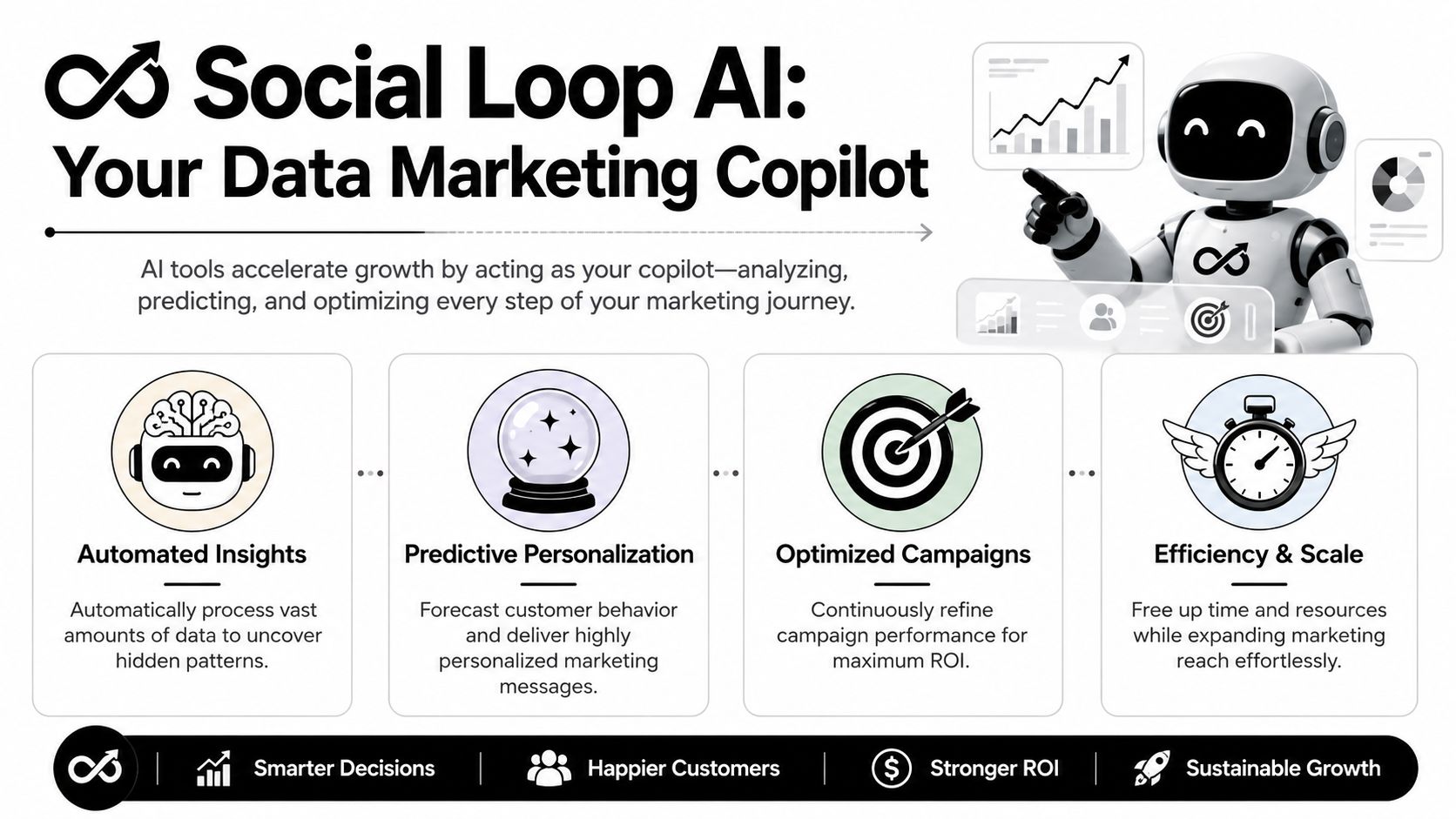
That's where AI tools become useful. Not because they replace judgment, but because they shorten the distance between signal and action.
Where AI actually helps a beginner
The strongest use of AI in data driven marketing isn't “make me smarter than everyone else.” It's “help me spot patterns and choose faster.”
ThoughtSpot's overview of advanced workflows explains the shift well. AI-powered systems can support diagnostic analytics to identify why performance changed, predictive analytics to forecast what's likely to happen next, and prescriptive analytics to recommend the next best action. That allows marketers to move budget toward stronger ROAS opportunities faster than manual review alone (ThoughtSpot on diagnostic, predictive, and prescriptive analytics in marketing).
For a beginner, that usually shows up in four useful ways:
- Landing page diagnosis that highlights clarity gaps, missing trust signals, and weak message match
- Creative angle planning that forces more structured tests instead of random ad batches
- Pattern spotting across hooks, offers, and objections
- Next-step recommendations so you know whether to scale, pause, or retest
That's a lot more useful than a fancy chart that tells you what already happened but gives you no clue what to do next.
What to automate and what to keep manual
Not everything should be handed to a tool.
Automate the repetitive work. Use systems to review pages, organize tests, generate structured creative directions, and surface which variables deserve another round.
Keep these parts human:
- Offer judgment. A tool can suggest framing, but you still need to know if the offer is compelling.
- Taste and brand fit. Not every “high-performing” style suits the store you're trying to build.
- Final budget decisions. Software can recommend. You still need to decide how much risk to take.
- Customer understanding. Founders who read product reviews, comments, and objections directly make better calls.
The right setup feels like a copilot. It reduces grunt work, sharpens your testing loop, and helps a solo operator behave more like a disciplined growth team.
Your Next Steps in Data-Driven Marketing
Don't try to implement everything this week. That's how good advice turns into another abandoned tab.
Pick one action that changes how you work right now. Audit your product page before your next ad launch. Track one more funnel KPI for seven days. Rewrite an ad test as a real hypothesis instead of a guess. Run one weekly review and make one hard decision based on the results.
That's enough to start.
The core advantage of data driven marketing isn't complexity. It's clarity. You stop asking, “What should I try now?” and start asking, “What did the last round teach me?” That shift makes your store calmer to run. It also makes growth more repeatable.
Small stores rarely lose because they lacked advice. They lose because they keep funding uncertainty. Build a tighter loop, trust behavior more than opinions, and let the next test earn its budget.
If you want a faster way to apply this process, Social Loop AI helps first-time dropshippers and new ecommerce owners turn a product URL into a practical Meta ads launch plan, landing page fixes, structured angle tests, and brand-aware creatives without needing an agency or a full growth team.