Blog
Confused by Ad Performance Metrics? Get Our 2026 Guide
Published May 22, 2026
You open Meta Ads Manager, and the screen fills with numbers that all seem urgent. CPM is climbing, CTR looks decent, CPC feels high, and purchases are flat. If you're a first-time ecommerce founder, that dashboard can feel less like a control panel and more like a test you didn't study for.
The good news is that ad performance metrics aren't there to intimidate you. They're feedback. Each one tells you where a shopper moved forward, where they hesitated, and where your budget is leaking. Once you stop treating metrics as isolated scores and start reading them as a sequence, the dashboard gets much simpler.
That's how small-budget accounts stay sane. You don't need to optimize everything at once. You need to identify the next decision. Keep spending, pause the ad, refresh the creative, broaden the audience, or fix the product page. The numbers help you choose.
Table of Contents
- Why Your Ad Performance Metrics Matter More Than Ever
- The Foundational Metrics for Ad Delivery and Engagement
- Measuring What Actually Matters for Your Business
- How to Read the Story Your Meta Ads Are Telling
- Your Game Plan for Testing vs Scaling Campaigns
- Tracking Your Success and Making Smart Decisions
- Common Questions About Ad Performance Metrics
Why Your Ad Performance Metrics Matter More Than Ever
A new store owner usually makes the same mistake. They look at one ugly number, assume the whole campaign is broken, and start changing five things at once. By the next day, they can't tell whether the ad failed, the audience was wrong, or the landing page did the damage.

That reaction is normal. Meta gives you a wall of signals, but it doesn't tell you which one deserves your attention first. Founders on a small budget feel this even more because every wasted day feels expensive.
The useful shift is to stop asking, "Are these metrics good or bad?" and start asking, "What decision does this metric help me make?" That's the practical use of ad performance metrics. They help you spot the bottleneck.
Practical rule: Metrics don't exist to impress you. They exist to tell you what to fix next.
If your ad isn't getting shown enough, the problem is delivery. If people see it but don't click, the problem is usually the message, creative, or audience fit. If they click but don't buy, the problem moves downstream to the product page, offer, or checkout experience.
That framing turns the dashboard into something manageable. You're not trying to master every acronym. You're trying to follow a shopper's path from impression to click to purchase and identify where that path breaks.
For first-time ecommerce founders, that's the core skill. Strong products still fail when the founder reads the wrong signal. Weak creative can look promising for a day. Good creative can look weak if the page kills intent after the click. Metrics help you separate those cases.
The Foundational Metrics for Ad Delivery and Engagement
The easiest way to understand ad performance metrics is to think in sequence. Before someone buys, your ad has to get delivered, get noticed, earn a click, and then justify what you spent to get that visit.
A foundational milestone in ad measurement came with CTR, which is calculated as clicks divided by impressions. Industry references consistently treat CTR as a core efficiency indicator, and CPM measures cost per 1,000 impressions. Together, CTR and CPM formed the early backbone of modern ad analytics, as explained in BidsCube's guide to measuring ad performance.
Start with delivery before you judge the ad
Think of CPM as the cost of renting attention. You're paying to place your ad in front of people. If CPM is high, that doesn't automatically mean your campaign is bad. It can mean you're in a competitive audience, using a format with more expensive inventory, or trying to buy attention at a crowded time.
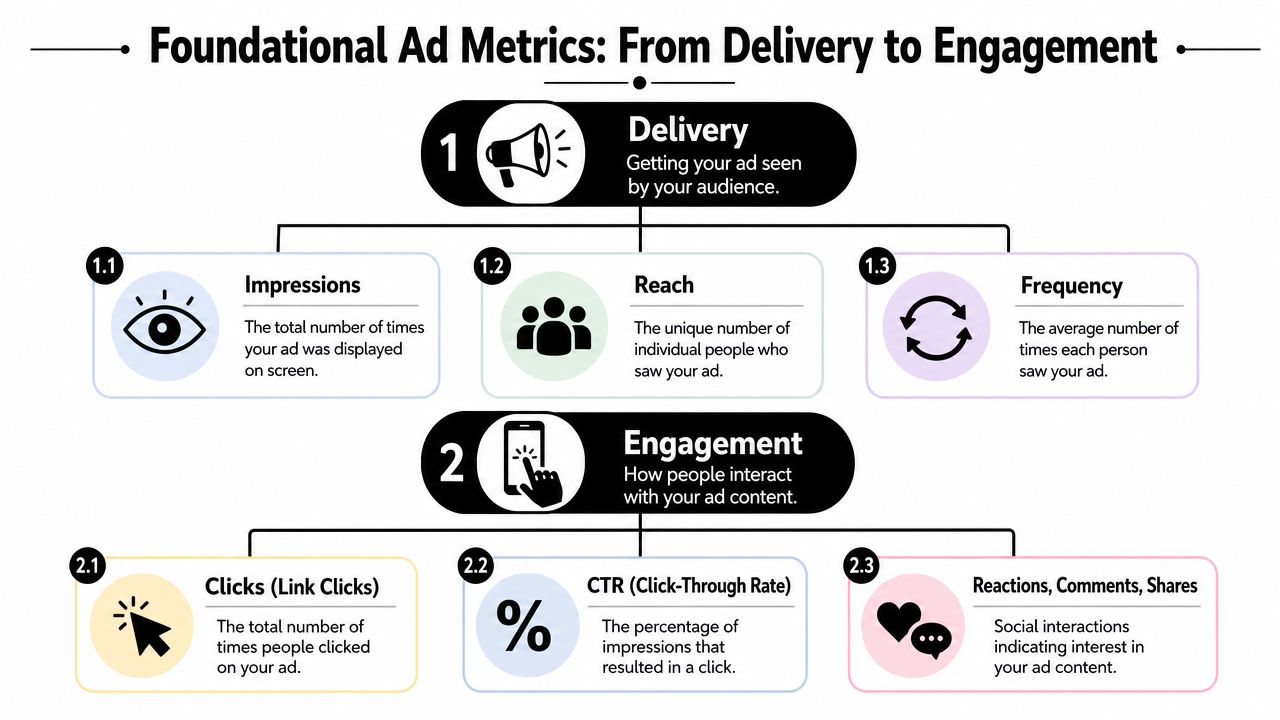
Then come impressions, reach, and frequency.
- Impressions tell you how many times the ad was served.
- Reach tells you how many unique people likely saw it.
- Frequency tells you how often the average person saw it.
These are delivery metrics. They answer a basic question: did Meta put your ad in front of enough people for the rest of the funnel to matter?
Move from interest to cost
Once the ad gets seen, CTR tells you how many impressions turned into clicks. In plain terms, it's the share of people who noticed the ad and cared enough to tap.
Then you get CPC, or cost per click. That's the cost of each visit generated by the ad. If CPM is what it costs to rent attention, CPC is what it costs to get someone into your store.
Finally, you have CPA, or cost per acquisition. That's the cost to get the action you care about, usually a purchase for ecommerce. However, many first-time founders jump too early. They open the dashboard, see a rough CPA, and kill the ad before understanding whether the actual issue is delivery, click quality, or the page experience after the click.
A simple way to think about the chain looks like this:
| Stage | Main Metric | What you're asking |
|---|---|---|
| Delivery | CPM, Impressions, Reach, Frequency | Is the ad getting enough exposure? |
| Engagement | CTR | Does the ad create interest? |
| Traffic Cost | CPC | Am I paying a reasonable price for visits? |
| Outcome | CPA | What does it cost to get a customer? |
When founders skip straight to CPA, they often miss the upstream problem. Bad creative, weak targeting, and a clunky product page can all produce the same painful result.
Measuring What Actually Matters for Your Business
A lot of beginners confuse ad performance with business performance. They aren't the same. An ad can attract clicks and still lose money. A campaign can look efficient in the dashboard and still be unworkable once product costs, shipping, and margins enter the picture.
A good ad is not always a good business decision
For performance campaigns, CTR should be treated as a traffic-quality signal, not a success metric by itself. It tells you the share of impressions that produced a click, while conversion rate tells you the share of those clicks that completed the desired action. In practice, a high CTR paired with weak conversion rate usually points to a message-to-landing-page mismatch, weak offer clarity, or low post-click intent, as outlined in Playwire's breakdown of digital ad performance metrics.
That distinction matters because first-time store owners often celebrate the wrong win. They see clicks coming in and assume sales should follow. But the click only means the ad earned curiosity. It doesn't mean the shopper trusted the page, liked the price, understood the offer, or felt ready to buy.
The business-side metrics that matter most are:
- Conversion rate. How well your store turns clicks into purchases or other desired actions.
- ROAS. Revenue generated relative to ad spend.
- Frequency. How often the same person sees your ad, which can help explain fatigue and falling response over time.
- CPA. The practical cost to acquire a customer.
If you're trying to get sharper on acquisition costs, this guide on cost per acquisition is a useful companion because it keeps the focus on decision-making rather than textbook definitions.
Key Meta Ad Performance Metrics at a Glance
| Metric | What It Measures | Calculation | What It Tells You |
|---|---|---|---|
| CPM | Cost to buy exposure | Cost per 1,000 impressions | How expensive it is to get your ad served |
| CTR | Share of impressions that become clicks | Clicks / Impressions | Whether the ad earns initial interest |
| CPC | Cost of each click | Ad spend / Clicks | What you're paying for traffic |
| CPA | Cost of each acquisition | Ad spend / Conversions | What it costs to get the result you want |
| Conversion Rate | Share of clicks that convert | Conversions / Clicks | Whether the page and offer turn visits into action |
| ROAS | Revenue relative to ad spend | Revenue / Ad spend | Whether the campaign produces enough revenue to justify spend |
A founder doesn't need to obsess over every metric equally. What matters is the relationship between them.
For example, if CTR is healthy but conversion rate is weak, don't rush to make new creatives. The ad probably did its job. Look at the product page headline, the first screen on mobile, offer clarity, shipping visibility, social proof, and checkout friction.
If CTR is weak but conversion rate is decent, you may have the reverse problem. The page converts interested visitors fine, but the ad isn't filtering and attracting enough of them. That's usually a creative or audience problem.
The ad gets the click. The store closes the sale. You need both.
ROAS sits above all of this because it pulls the business question back into focus. But even ROAS shouldn't be read in a vacuum. If ROAS is weak, find out why. Low conversion rate, poor average order value, high CPA, and ad fatigue can all feed the same outcome.
How to Read the Story Your Meta Ads Are Telling
Good media buyers don't stare at single numbers. They compare signals. That's how you move from reporting to diagnosis.
Use metric combinations, not single metrics
One of the most useful operating habits is to pair metrics that explain each other. Delivery metrics explain whether the ad had enough exposure. Engagement metrics explain whether the message resonated. Outcome metrics tell you whether the traffic was worth paying for.
A practical example is frequency plus CTR. A common rule is to watch them together because rising frequency with falling CTR is a classic ad-fatigue pattern. It usually means the same audience is seeing the ad too often, and you need a creative refresh or broader targeting. The same guidance recommends daily pacing checks for spend and CPA, plus weekly reviews of frequency and CTR trends, according to Neurons' ad testing metrics guide.
If you need to diagnose whether this problem is tied to audience selection, a primer on demographic targeting can help you decide whether to broaden, narrow, or split your targeting rather than guessing.
The most common diagnostic patterns
Use these patterns when you're inside Ads Manager and trying to decide what to do next:
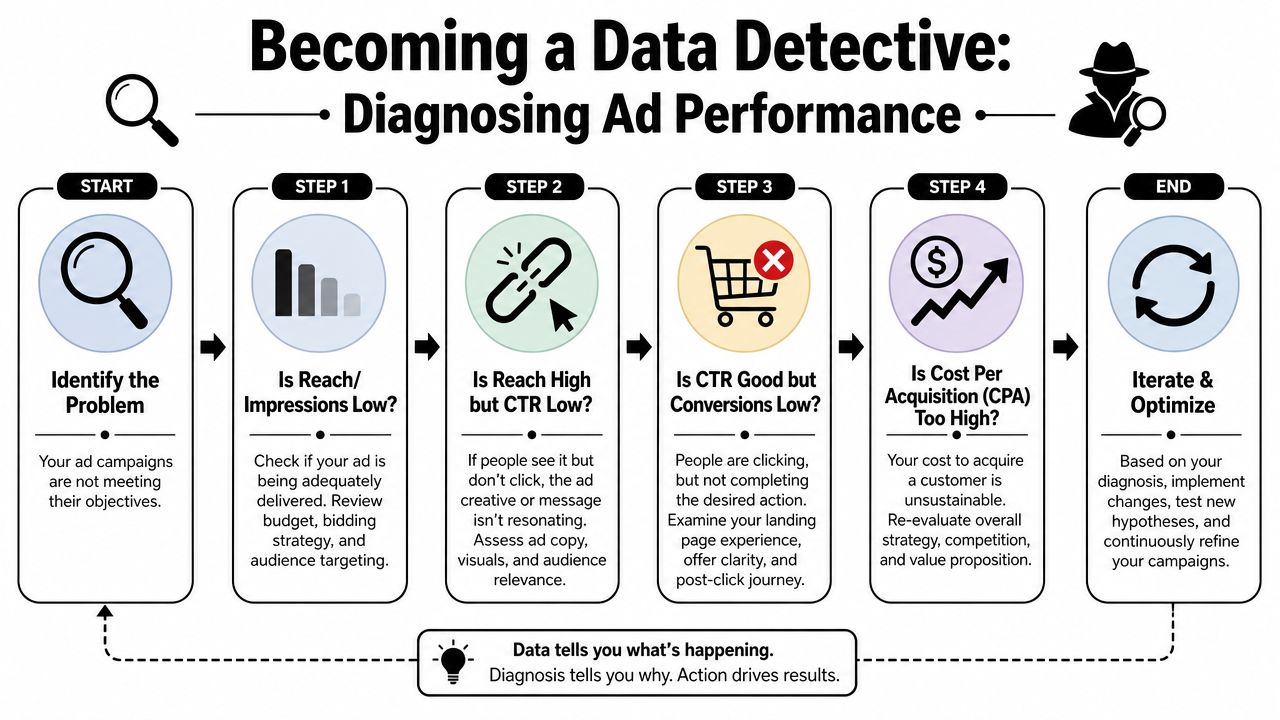
- Reach is low and impressions are weak: Your ad may not be getting enough delivery to produce reliable signals. Check budget allocation, audience size, and whether the campaign setup is too restrictive.
- Reach is healthy but CTR is low: People are seeing the ad and ignoring it. The likely issue is creative angle, copy, hook, visual, or audience-message fit.
- CTR is strong but conversion rate is low: The ad created interest, but the post-click experience broke momentum. Look at product page relevance, price framing, trust signals, shipping clarity, and mobile usability.
- CPA is too high even when CTR and conversion rate look decent: The economics may be the issue. Your margin, average order value, or offer structure may not support paid acquisition yet.
- Frequency rises while CTR falls: That's fatigue. The audience has seen the same promise too many times.
You can also use a quick diagnostic matrix:
| What you see | Likely issue | First action |
|---|---|---|
| Low delivery | Setup or audience constraint | Review campaign structure and audience breadth |
| Low CTR | Creative or targeting mismatch | Test a new hook, visual, or angle |
| Good CTR, low conversion rate | Landing page or offer problem | Align the ad promise with the product page |
| Rising frequency, falling CTR | Ad fatigue | Refresh creative or expand audience |
| High CPA despite decent engagement | Business economics bottleneck | Recheck pricing, bundle strategy, or margins |
Don't optimize the loudest metric. Optimize the metric closest to the real bottleneck.
Many beginners often get stuck. They try to improve everything at once, then learn nothing. Better diagnosis comes from changing one meaningful variable, then reading how the metric chain responds.
Your Game Plan for Testing vs Scaling Campaigns
The metric you care about most should change with the stage of the campaign. Testing and scaling are different jobs. If you use the same standard for both, you'll either kill ads too early or scale ads that never had a solid profit foundation.

Industry guidance increasingly stresses finding the single biggest bottleneck first, whether that's creative fatigue, conversion rate, average order value, margin, or LTV. That matters a lot for first-time ecommerce advertisers because they often pause ads too quickly based on one noisy metric instead of identifying what limits profitable scale, as discussed in AdMetrics' article on scaling past plateaus.
What matters in the testing phase
When you're testing, your main goal is learning. You're trying to answer questions like:
- Which hook gets attention?
- Which angle pulls qualified clicks?
- Which audience responds at all?
- Which creative deserves more budget?
That means leading indicators matter more. Watch CTR, CPC, thumb-stopping quality in the creative, and whether early traffic looks aligned with the offer. If an ad can't earn attention, it rarely becomes a winner later without major changes.
But don't overreact to rough early CPA during testing. Small budgets produce noisy data. A test ad can look expensive before the funnel has enough signal to settle. What matters is whether the campaign is teaching you something useful.
If you're structuring creative tests deliberately, multivariate testing can help you separate what changed in the hook, visual, headline, or audience instead of blending all the variables together.
What matters in the scaling phase
Once an ad has proven it can attract the right traffic and the store can convert that traffic, the priority shifts. Now you're protecting efficiency while increasing spend.
At this stage, watch:
- CPA to make sure acquisition cost stays within what your business can support.
- ROAS to judge whether increased spend is still producing acceptable revenue.
- Frequency to catch fatigue before performance slides too far.
- Conversion rate to make sure the store experience is holding up as volume rises.
A practical tool can help keep those signals organized. Social Loop AI is one example. It turns a product URL into a Meta launch plan, generates ad creatives around defined angles, and then lets you log results so you can decide what to scale, pause, or retest based on the metrics coming back.
Later in the cycle, it helps to hear the same distinction explained another way:
The mistake to avoid is treating a scaling problem like a testing problem. If spend rises and performance dips, don't immediately launch ten new creatives. First identify whether the issue is fatigue, audience saturation, weaker economics, or a page that can't carry larger traffic volume.
Tracking Your Success and Making Smart Decisions
Most founders don't need more metrics in Ads Manager. They need fewer columns and cleaner decisions.
Build a dashboard you can actually use
Customize your Meta Ads Manager columns so the first screen answers the only questions that matter. A simple setup usually includes delivery, engagement, traffic cost, and outcome metrics in one view.
A practical column set might include:
- Delivery metrics: Impressions, Reach, Frequency, CPM
- Engagement metrics: Link Clicks, CTR
- Traffic cost metrics: CPC
- Outcome metrics: Purchases, CPA, Conversion Value, ROAS
Keep the view focused. If every report pulls in dozens of metrics, you'll spend more time scanning than deciding.
It also helps to review on two rhythms instead of one:
| Review rhythm | Best for |
|---|---|
| Daily | Spend pacing, obvious CPA spikes, delivery issues |
| Weekly | Frequency drift, CTR trends, creative fatigue, broader decision-making |
Make three decisions only
Every campaign review should end with one of three actions.
Scale when the campaign is producing acceptable acquisition cost and revenue quality, and the trend is stable enough that adding budget won't be reckless.
Pause when the campaign clearly isn't moving in the right direction and the bottleneck isn't something that more spend will solve. Examples include persistently weak CTR, obvious landing-page mismatch, or economics that don't work.
Retest when the signal is incomplete or when you know what variable needs another shot. Maybe the hook worked but the page didn't. Maybe the audience was too broad. Maybe one creative angle deserves a cleaner test.
If the data is unclear, don't force a dramatic decision. Tighten the test and collect cleaner signal.
One more operational detail matters for ecommerce stores: your attribution window. Meta can report results over a defined post-click period, such as a click-based window that gives purchases time to show up after the ad interaction. If you judge campaigns too quickly without respecting the attribution setting you're using, you'll misread performance and cut ads before all the results are recorded.
Common Questions About Ad Performance Metrics
My CTR is strong, but I have no sales. What's wrong?
Usually the problem is after the click. Check whether the landing page matches the promise in the ad, whether the offer is easy to understand, and whether the page builds trust quickly on mobile.
How long should I wait before pausing an ad?
Base the decision on spend and signal quality, not the clock. Time alone doesn't tell you much if delivery is uneven or the sample is still thin.
Is a certain ROAS automatically good?
No. ROAS only means something in the context of your margin, shipping costs, discounts, and operating model. A number that works for one store may be unprofitable for another.
My metrics changed suddenly overnight. Did the campaign break?
Maybe, but don't panic. Sudden CTR spikes, impression drops, or engagement swings can point to tracking issues, creative fatigue, audience saturation, or platform delivery changes. Recent guidance suggests using moving averages and similar methods to flag deviations from historical patterns instead of reacting to one-day swings, as covered in Meegle's overview of anomaly detection in ad performance.
What should I optimize first if my budget is small?
Find the biggest bottleneck. If nobody clicks, fix the ad. If people click and don't buy, fix the page or offer. If both look decent but results still don't work, inspect the business economics before buying more traffic.
If you're launching your first product and want a simpler way to go from product page to test plan, Social Loop AI helps new ecommerce owners build Meta ad creatives, organize testing angles, and make clearer scale, pause, or retest decisions without needing an agency workflow.