Blog
Master What Is Marketing Copy: Boost Your Sales in 2026
Published July 9, 2026
Marketing copy is persuasive text designed to drive a specific action that makes money, such as a click, sign-up, or purchase. Well-optimized marketing copy across digital channels often converts in the 2% to 5% range, and top ecommerce campaigns can exceed 10%.
If you're staring at a blank Shopify product page, a Meta ad draft, or a product detail section that sounds like a spec sheet, you're in the same place most new store owners start. The mistake isn't usually that you can't write. It's that nobody told you marketing copy isn't mainly about sounding clever. It's about choosing the right angle, then expressing it clearly enough that a buyer feels, "Yes, this is for me."
That matters a lot in ecommerce, where buyers move fast and compare options faster. A weak angle gives you polished words that don't land. A strong angle gives you copy that feels relevant the second someone sees it. That's why high-performing ad teams don't just ask, "How do we write this?" They ask, "What problem are we entering through, and why would this audience care right now?"
Table of Contents
- What Is Marketing Copy and Why It Drives Sales
- Marketing Copy vs Other Writing You See Online
- The Core Elements of Persuasive Marketing Copy
- Simple Frameworks for Writing Copy That Converts
- Common Mistakes and a Pre-Launch Checklist
- How to Automate and Scale Your Ad Copy
What Is Marketing Copy and Why It Drives Sales
A new store owner usually starts with the wrong question. They ask, "What should I write on this page?" The better question is, "What action do I need the visitor to take, and what belief needs to happen first?"
That's what marketing copy is. It's writing built to move a buyer toward a decision. Not to fill space. Not to sound professional. Not to describe every product detail. Its job is to persuade.
The clearest way to understand it is to compare two product descriptions.
- Description only: "Waterproof travel backpack with multiple compartments and padded straps."
- Marketing copy: "Keep your laptop, charger, and clothes organized in one waterproof backpack, so you can travel without digging through a mess at the airport."
The first line names the product. The second line sells the outcome.
According to Pimberly's marketing copy definition, well-optimized marketing copy across digital channels typically converts at 2% to 5%, while top-performing ecommerce campaigns can exceed 10%. That same source says companies that invest in professional marketing copywriting often see website traffic increase in the 30% to 50% range compared with periods when copy is generic or unoptimized.
Practical rule: If the copy doesn't make the next step feel obvious, it isn't finished.
For a beginner, this changes how you write everything from product pages to Meta ads. You don't start with the product. You start with the buyer's friction.
A few reliable questions help:
- What problem is the shopper already aware of?
- What outcome do they want soon?
- Why is this product a credible way to get there?
- What exact action should they take next?
If you want a broader view of how this fits into the discipline, this guide on copywriting in marketing is a useful companion.
Marketing Copy vs Other Writing You See Online
People mix up marketing copy with almost every other kind of writing on the internet. That confusion causes bad briefs, messy landing pages, and ads that sound like blog posts.
Marketing copy is built for action. Other writing can support it, but it doesn't replace it.
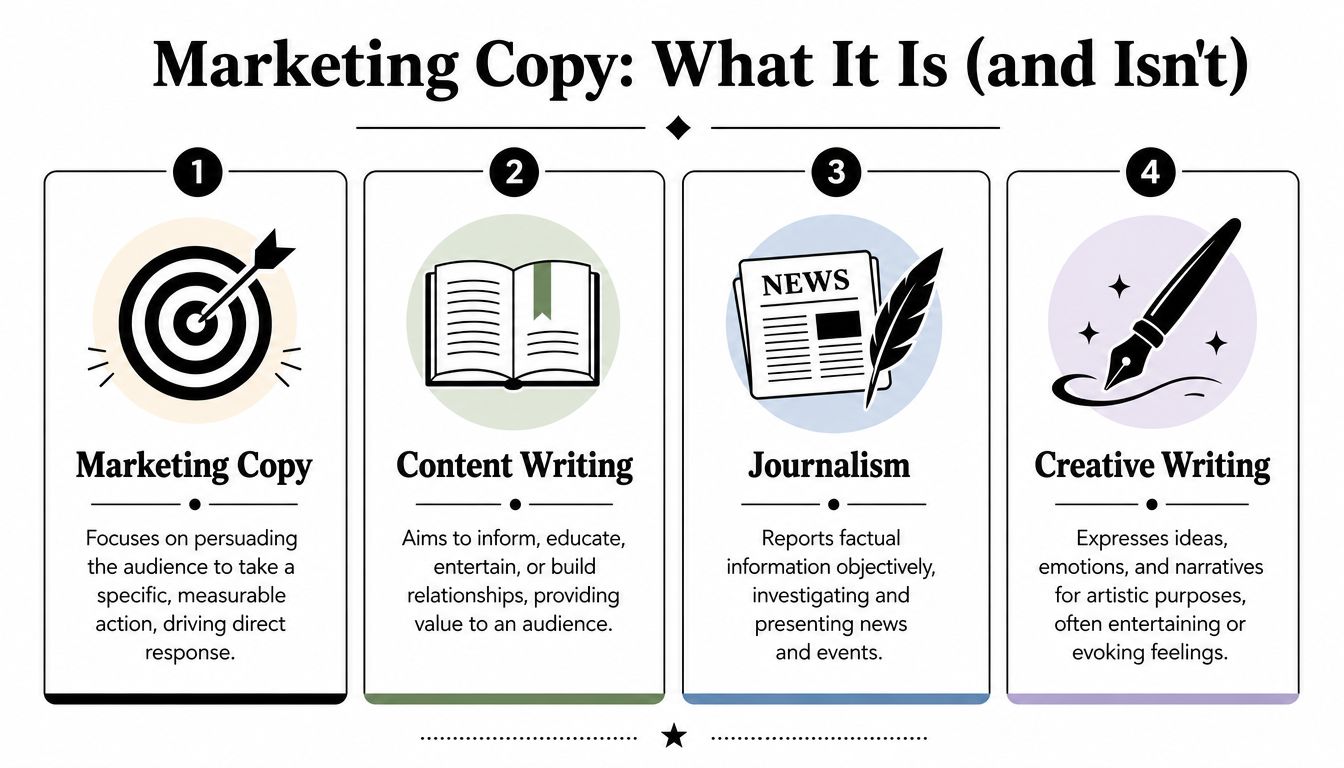
A clear side-by-side view
| Type of Copy | Primary Goal | Example | Success Metric |
|---|---|---|---|
| Marketing copy | Persuade someone to take a specific action | Meta ad, sales email, product page headline | Clicks, leads, sales |
| Content writing | Educate, build trust, attract attention over time | Blog post, buying guide, newsletter article | Engagement, readership, assisted conversions |
| UX copy | Help users navigate and complete tasks | Button text, error message, checkout prompt | Task completion, fewer drop-offs |
| Technical copy | Explain how something works | User manual, setup guide, product documentation | Clarity, support reduction, successful use |
The difference shows up in the sentence itself
A blog post might say, "Choosing the right gym bag depends on how often you commute and what gear you carry."
Marketing copy would say, "Carry shoes, clothes, and your laptop in one bag that still fits under your seat."
UX copy would say, "Add to cart."
Technical writing would say, "The lower compartment is designed to separate shoes from electronics."
All four are useful. Only one is trying to create immediate buying momentum.
A lot of weak ecommerce pages fail because they use informative writing where persuasive writing belongs.
There's another modern layer to this. Marketing copy also has to work for discovery, especially on search-driven pages. According to Indeed's guide to marketing copy, 72% of marketing agencies consider SEO-based copywriting essential for ranking higher in Google searches, and that correlates to a 50% increase in organic lead discovery.
That doesn't mean stuffing keywords into awkward sentences. It means writing copy that both humans and search engines can understand. A category page for "portable blenders" still needs buying intent, not just text volume.
Where beginners usually get confused
They think one page should do everything at once. So they write:
- Too much education: The visitor never gets pushed toward a decision.
- Too much description: The product sounds accurate but forgettable.
- Too much brand fluff: The buyer still doesn't know why they should care now.
Good ecommerce pages often combine multiple writing types. But the conversion sections need marketing copy to lead.
The Core Elements of Persuasive Marketing Copy
Strong copy has a simple structure. It gets attention, builds relevance, and asks for action. If one of those parts is weak, the whole thing feels off.
The hook gets attention
Your headline or opening line has one job. Make the right person stop and think, "That's me."
For a Meta ad, that might be:
- Weak hook: "Premium posture corrector now available"
- Better hook: "If your shoulders slump by noon, this gives your upper back support without changing your whole routine"
The better version enters through a felt problem. That's what strong angles do.
The body turns interest into desire
The middle of the copy explains why the product matters. Here, beginners often list features and assume the benefit is obvious.
It usually isn't.
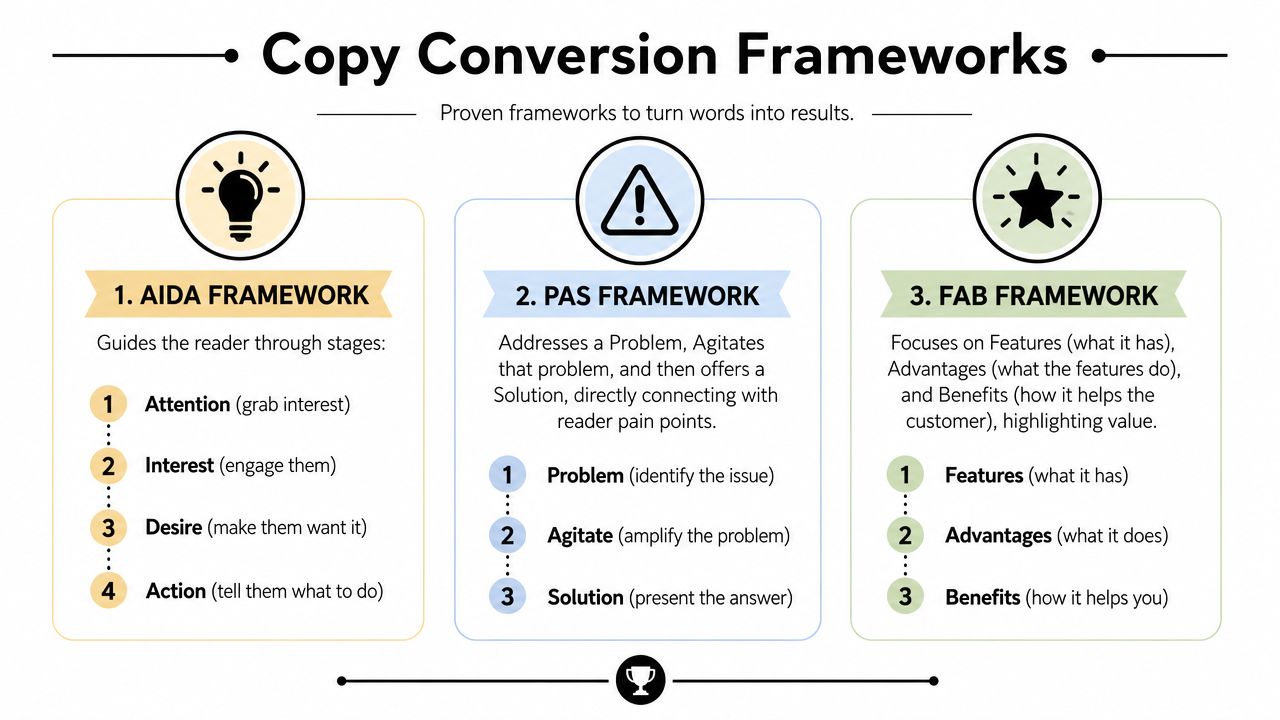
A feature is what the product has. An advantage is what that feature does. A benefit is why the buyer cares. According to Jeremy Moser's breakdown of the FAB framework, when every feature is explicitly linked to a user benefit, engagement rates increase by 28–35%.
Here's what that looks like in practice:
- Feature: 24-hour battery
- Advantage: Holds charge all day
- Benefit: You can leave home in the morning without packing a charger or hunting for an outlet later
That last line is what sells.
Field note: Buyers don't purchase features. They purchase relief, convenience, status, confidence, speed, or control.
A useful way to edit your draft is to underline every feature and ask, "So what?" Keep going until the answer sounds like a real-life payoff.
If you're trying to keep that payoff consistent across product pages, ads, and emails, a defined brand voice development process helps keep the copy persuasive without sounding random.
The CTA tells the reader what to do next
A call to action is the handoff. It tells the buyer what to do while motivation is still high.
Good CTAs are specific:
- Shop the bundle
- Start your free trial
- See available colors
- Get the size guide
Weak CTAs blur the next step:
- Learn more
- Click here
- Submit
The best CTA depends on buyer readiness. Cold traffic often needs a lower-friction action. Warmer traffic can handle a stronger ask.
Simple Frameworks for Writing Copy That Converts
Frameworks are useful because they stop you from rambling. They give your draft a shape, especially when you're writing a Meta ad, a landing page section, or a product description under time pressure.
This visual gives you the three most useful structures at a glance.
AIDA for product discovery
AIDA stands for Attention, Interest, Desire, Action. It's a strong fit when the buyer doesn't know your product yet and needs a guided introduction.
A simple ecommerce example:
- Before: "Our insulated bottle is durable, sleek, and made from stainless steel."
-
After using AIDA:
Attention: "Your iced coffee shouldn't turn warm before lunch."
Interest: "This stainless steel bottle helps keep drinks at the temperature you want while fitting standard cup holders."
Desire: "So your commute, desk setup, and gym bag all get one bottle that keeps pace."
Action: "Choose your color and order yours today."
For a Meta ad, AIDA works well when the visual already shows the product in use. The copy then gives the viewer a reason to care and a next step to take.
A practical walkthrough can help if you're turning these frameworks into actual campaign assets. This guide on how to write ad copy is useful for that.
PAS for pain-aware buyers
PAS means Problem, Agitate, Solution. This is one of the most effective structures for ecommerce because many products exist to remove friction, discomfort, wasted time, or confusion.
According to Drip's copywriting examples, PAS-structured email and ad copy outperforms generic copy by 31% in conversion rates.
Here's a Meta ad example for a storage product:
- Before: "Modular drawer organizers for kitchens, bathrooms, and offices."
-
After using PAS:
Problem: "Opening a junk drawer shouldn't feel like starting a scavenger hunt."
Agitate: "When cables, tools, and random extras pile up together, every quick task takes longer."
Solution: "These modular organizers separate the mess into grab-and-go sections, so you can find what you need fast."
For a product page, PAS can lead the opening paragraph or a benefit block right under the product title.
Start with the pain the customer already feels. Don't make them work to connect the dots.
Problem to Solution for fast-moving Meta ads
This is the lean version. It's especially helpful when you're writing short ad copy, primary text for social posts, or compact landing page sections.
Use it when:
- The product solves one obvious pain point
- The audience is already problem-aware
- You need speed and clarity over storytelling
Example for a skincare product:
- Problem: Makeup slides off by midday
- Solution: A gripping primer that helps your look stay put longer without feeling heavy
Example for a pet product page headline:
- Problem: Dog hair on every seat after one drive
- Solution: A back-seat cover that protects your car and installs in minutes
How to choose the right framework
Don't pick a framework because it sounds smart. Pick one based on buyer awareness.
- Use AIDA when the shopper needs orientation and motivation.
- Use PAS when the pain is active and emotionally loaded.
- Use Problem to Solution when the offer is straightforward and the ad needs to land fast.
This short explainer is worth watching if you want another take on how these frameworks work in real campaigns.
A framework won't save a weak idea. If the angle is off, even a clean AIDA or PAS structure still underperforms. The structure organizes the message. The angle gives the message life.
Common Mistakes and a Pre-Launch Checklist
Most beginners think copy fails because the sentences aren't polished enough. In practice, the bigger problem is often upstream. The copy is built on a weak angle.
Most weak copy has an angle problem
A strong angle connects your product to a current buyer desire, frustration, fear, or goal. A weak angle sounds technically correct but emotionally flat.
According to this discussion of weak angles in marketing copy, copy often fails primarily because of a weak angle, not poor writing. The core problem is a dead angle that doesn't align with the buyer's current problem or desired outcome.
That shows up in common mistakes like these:
- Feature-first openings: The copy starts with the product instead of the buyer's pain.
- Vague promises: The reader can't tell what changes after purchase.
- Generic CTAs: The next step feels disconnected from the promise.
- Message mismatch: The ad promises one thing, but the landing page opens with something else.
- Trying to say everything: Too many benefits means no main idea sticks.
If your first line could apply to five competing products, the angle probably isn't sharp enough.
A lot of bad drafts improve quickly once you ask a harder question: "What specific reason would this person care today?" That's the core reset.
A practical checklist before you launch
Use this before you spend on traffic.
- Lead with the buyer's problem: Can someone understand the pain point or desired outcome in the first few seconds?
- Make the benefit concrete: Does the copy describe what gets easier, faster, cleaner, safer, or more enjoyable?
- Check message continuity: Does the product page continue the same angle used in the ad?
- Remove empty adjectives: Words like premium, cutting-edge, and amazing usually need proof or replacement.
- Tighten the CTA: Does the action fit the stage of awareness?
- Read it aloud: If it sounds stiff, the audience will feel that stiffness too.
- Test another angle: If the draft is clear but still bland, the issue may be the premise, not the wording.
One useful habit is to write three angle options before writing one final ad. For example: convenience angle, problem-solution angle, and identity angle. That forces strategic thinking before sentence polishing.
How to Automate and Scale Your Ad Copy
Once you understand the fundamentals, the bottleneck changes. It isn't "How do I write one ad?" It's "How do I generate multiple angles, hooks, and variations without losing consistency?"
That's where systems help. Not because they replace judgment, but because they reduce the repetitive work that slows new ecommerce teams down.
What to systemize first
If you're running Meta ads for a product catalog, these are the first things worth turning into repeatable workflow steps:
- Buyer input: Define who the product is for, what they care about, and what objection blocks the click.
- Angle selection: Choose a few distinct angles instead of rewriting the same pitch repeatedly.
- Hook generation: Draft several opening lines tied to each angle.
- Body copy variation: Match the body text to pain point, awareness level, and offer strength.
- CTA alignment: Make sure each ad asks for the right next step.
That sequence matters. Teams often automate headline generation before they clarify the angle. That creates volume without strategy.
What good automation should actually do
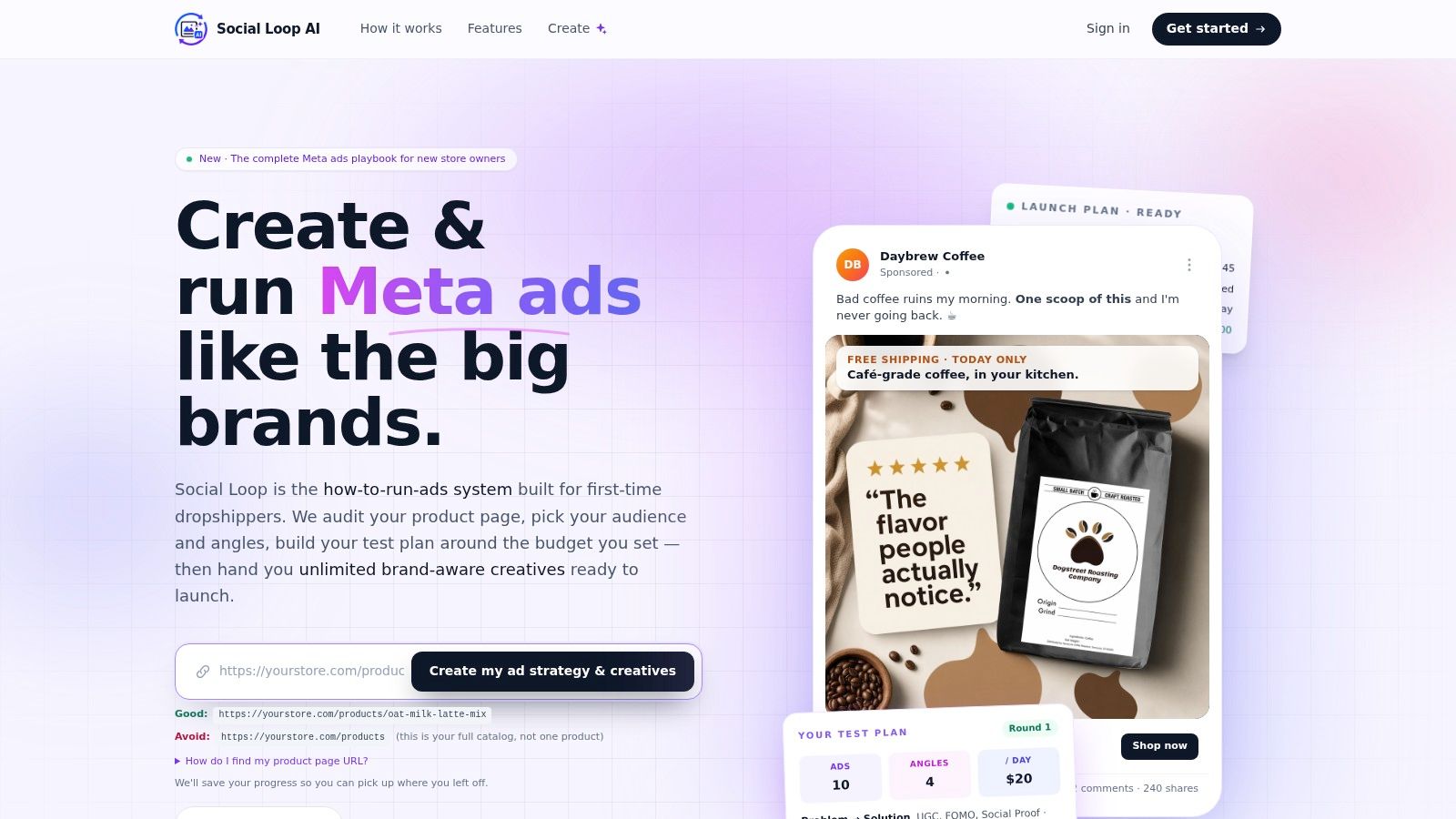
A useful copy system should help you move from product URL to campaign-ready assets in a structured way. It should audit the product page, surface likely buyer motivations, suggest angle options such as problem-solution or social proof, and generate ad variations that stay connected to those choices.
It should also help with the less glamorous but important work:
- Spotting weak landing page messaging
- Keeping hooks tied to the same buyer problem
- Organizing creative batches by angle
- Making retesting easier after results come in
Good automation doesn't guess your strategy for you. It makes your strategy easier to apply at scale.
For first-time founders, that's the value. You still need judgment. You still need to decide which angle fits the audience. But you don't need to rebuild the same workflow from scratch every time you launch a new product or test a new creative set.
If you're launching Meta ads and want help turning a product page into angles, hooks, CTAs, and ready-to-test creatives, Social Loop AI is built for that workflow. It gives new ecommerce owners a practical way to move from blank page to ad launch plan without hiring an agency or guessing what to write.