Blog
Brand Voice Development: E-commerce Ads That Convert
Published July 3, 2026
Most advice on brand voice development starts in the wrong place. It starts with adjectives on a whiteboard. Playful. Premium. Bold. Human. Then a new store owner tries to turn those words into Meta ads and ends up with copy that sounds polished but generic.
That approach breaks because early-stage ecommerce brands don't need a prettier personality document. They need a performance voice. A voice built from product truth, buyer language, and ad angles that can earn the click.
For a new store, brand voice isn't a creative exercise first. It's an input into hooks, CTR, landing-page clarity, and conversion. It should help you answer practical questions fast. Should this ad sound reassuring or challenging? Should this product be sold through a Problem→Solution angle or an Identity angle? Should your Instagram caption feel more conversational than your Meta primary text while still sounding like the same brand?
Get this right and voice stops being fluff. It becomes an operating system for creative testing.
Table of Contents
- Your Starting Point Product Audits and Buyer Personas
- Connecting Voice Traits to Winning Ad Angles
- Building Your Practical Brand Voice Toolkit
- Activating Your Voice in Meta Ads and Social Posts
- The Final Step Testing and Iterating Your Voice
- Your Voice Is Your Most Underrated Growth Tool
Your Starting Point Product Audits and Buyer Personas
A useful brand voice starts with two inputs. What the product does and how the buyer talks about the problem. If either input is weak, your voice drifts into empty branding language.
Start with the product page, not the mood board
Open your product page and audit it like a media buyer, not like a designer. Pull out the hard truths first.
Look for:
- Core job-to-be-done: What problem does the product solve in plain English?
- Most believable benefit: Which claim feels concrete enough to anchor ad copy?
- Proof elements: Reviews, demos, feature explanations, guarantees, comparisons.
- Friction points: Vague promises, confusing specs, missing trust signals, weak headlines.
If the page says a smart mug "redefines your morning ritual," that's not raw material. If it says it helps keep coffee at your preferred temperature during long work sessions, that gives you something you can write from.
Practical rule: If a sentence can't become a hook, headline, or objection-handling line, it probably doesn't belong in your voice foundation.
Many first-time founders often overreach. They write the voice they want to have, not the voice their product has earned. If you're selling a problem-solving item, sounding too aspirational can hurt clarity. If you're selling an identity product, sounding too technical can flatten desire.
The second part of the audit is audience data. SmashBrand's brand voice development roadmap notes that teams need granular audience demographics and psychological drivers such as values, interests, and lifestyles to shape messaging that connects. It also warns that voice training can't be a one-time exercise. For a small store, that means revisiting your notes as you learn from customers, comments, and ad results.
Build a proto-persona from real buyer language
You don't need a giant persona deck. You need a proto-persona you can use to write ads this week.
Start with real language from:
- Competitor reviews on Amazon, Shopify, or niche stores
- Reddit threads and forums where people describe the problem in their own words
- Comments on competitor ads where objections show up fast
- Your own customer messages, even if it's only a small sample
A good proto-persona includes:
- Situation: When do they need this product?
- Pain: What annoys them enough to act?
- Desired outcome: What do they want to feel, save, avoid, or fix?
- Objection language: What makes them hesitate?
- Identity cues: What kind of person do they believe they are?
If you need a tighter framework, use a clear buyer persona definition for ecommerce messaging and strip it down to copy inputs. You don't need fictional hobbies unless those hobbies shape the ad angle.
For example, a smart mug buyer might not just be "female, works from home." More useful is this: drinks coffee slowly, gets interrupted during work, hates reheating, wants a desk setup that feels efficient, skeptical of gimmicky gadgets. That gives you voice direction. You can sound competent, tidy, and reassuring instead of vague and trendy.
Brand voice development gets easier when you stop asking, "What should our brand sound like?" and ask, "What language helps this buyer trust this product faster?"
Connecting Voice Traits to Winning Ad Angles
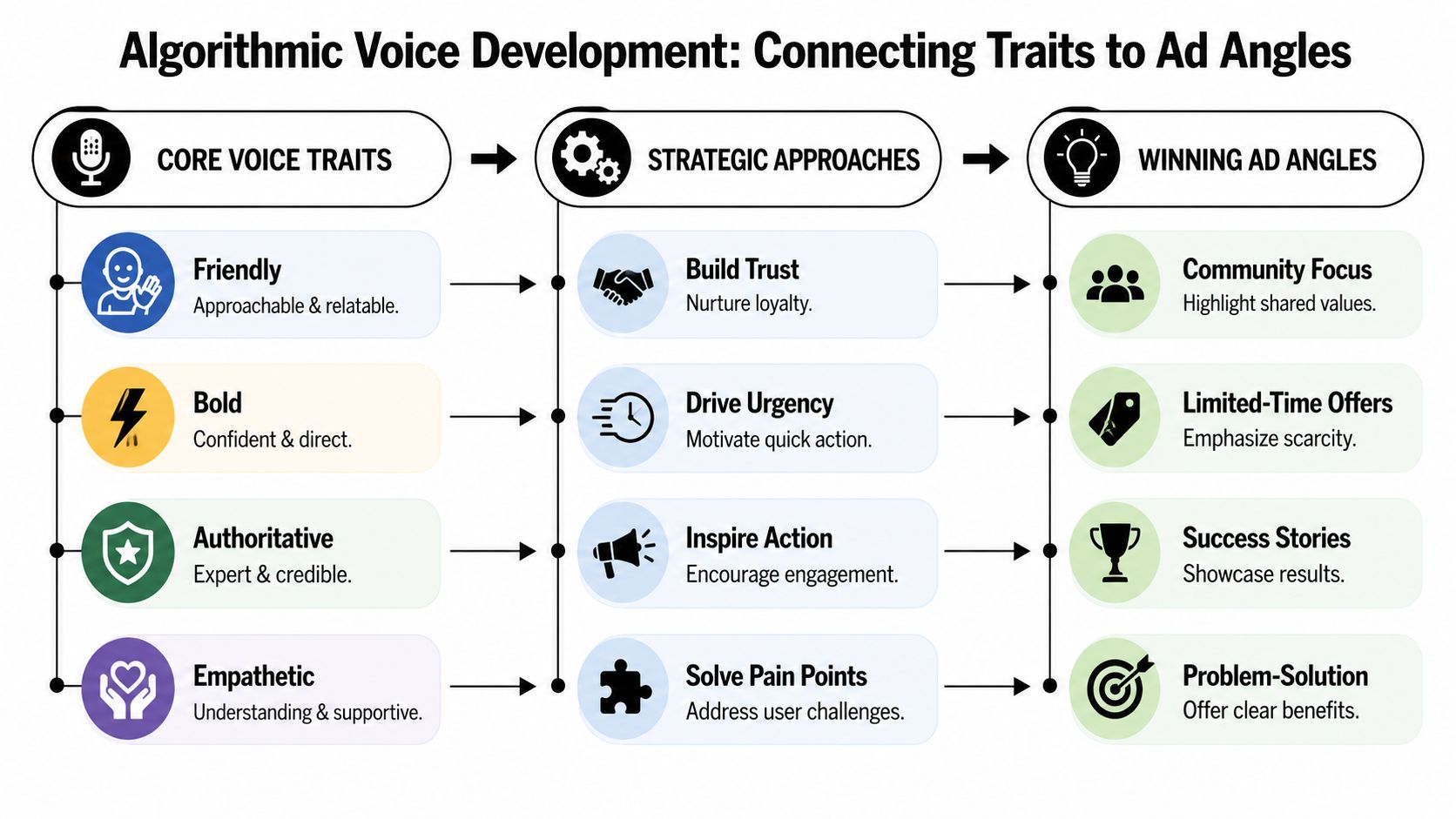
A voice trait only matters if it improves an angle. "Friendly" is not a strategy. "Friendly" attached to a warm Social Proof ad for skeptical shoppers can be useful. Detached from context, it says almost nothing.
Why generic voice traits fail in ads
Most new brands end up with voice descriptors that are too broad to guide creative decisions. Bold. Authentic. Relatable. Minimal. Those words sound fine in a guideline doc, but they don't tell a copywriter how to write three different hooks for three different objections.
This is why platform-specific voice tagging matters. The underserved idea here is simple: tag voice to the angle and objection, not just the channel. A projection from BDI Agency says 52% of new brands fail because their voice is too generic, not because it's inconsistent. That's a useful warning for beginners because the underlying problem often isn't mismatch. It's blandness.
When I review weak ad accounts, I usually see one of two mistakes:
- Everything sounds the same: Every ad uses the same polite brand tone, so Problem→Solution, UGC, and FOMO all blur together.
- Every angle becomes a different personality: The brand sounds clinical in one ad, meme-heavy in the next, and luxury-styled on the landing page.
Neither works well. The fix is a controlled system. Pick a small set of core traits, then define how those traits express themselves inside each angle.
A simple voice-to-angle map
Choose 3 to 5 core traits. Fewer than that can make the brand too flat. Too many and nobody can use the guide consistently.
Here is a practical mapping approach:
| Core trait | Best use case | Angle fit | What it sounds like |
|---|---|---|---|
| Authoritative | Explain products with friction or learning curve | Problem→Solution | Clear claims, direct wording, less fluff |
| Empathetic | Reduce skepticism and acknowledge pain | UGC, Social Proof | "If you've tried X and it still didn't work..." |
| Bold | Push action and contrast old vs new behavior | FOMO, Identity | Sharp hooks, stronger verbs, decisive CTA |
| Friendly | Make the brand feel low-risk and accessible | Social Proof, Community | Casual phrasing, low-pressure reassurance |
| Witty | Differentiate in crowded feeds | Identity | Memorable phrasing without hiding the offer |
Don't assign traits randomly. Match them to the buyer's stage and the ad's job.
A good voice doesn't stay flat across every ad. It stays recognizable while changing pressure based on the objection in front of it.
A practical example helps. Say your brand traits are authoritative, calm, and encouraging.
- In a Problem→Solution ad, authoritative leads. You explain the pain, introduce the mechanism, and keep the copy tight.
- In Social Proof, calm and encouraging lead. You lower resistance and make the buyer feel safe.
- In an Identity ad, encouraging can move to the front. The tone can become more self-directed and aspirational without losing the core voice.
This is a key value of brand voice development for ecommerce. It gives you variation without chaos. You can test multiple ad angles while staying coherent enough that the landing page and follow-up content still feel connected.
Building Your Practical Brand Voice Toolkit
A voice strategy is only useful if it becomes a tool you can use during production. For a solo founder, that means one page. Not a polished deck. Not a brand book nobody opens. One page you can keep beside Ads Manager while writing hooks.
Create a one-page voice sheet
Start with a short voice purpose statement. One line is enough. Example: "We explain useful products in a calm, credible, no-hype way that helps skeptical buyers feel informed."
Then define 3 to 5 core tone adjectives. Keep them operational. "Clear" is better than "visionary." "Reassuring" is better than "world-class."
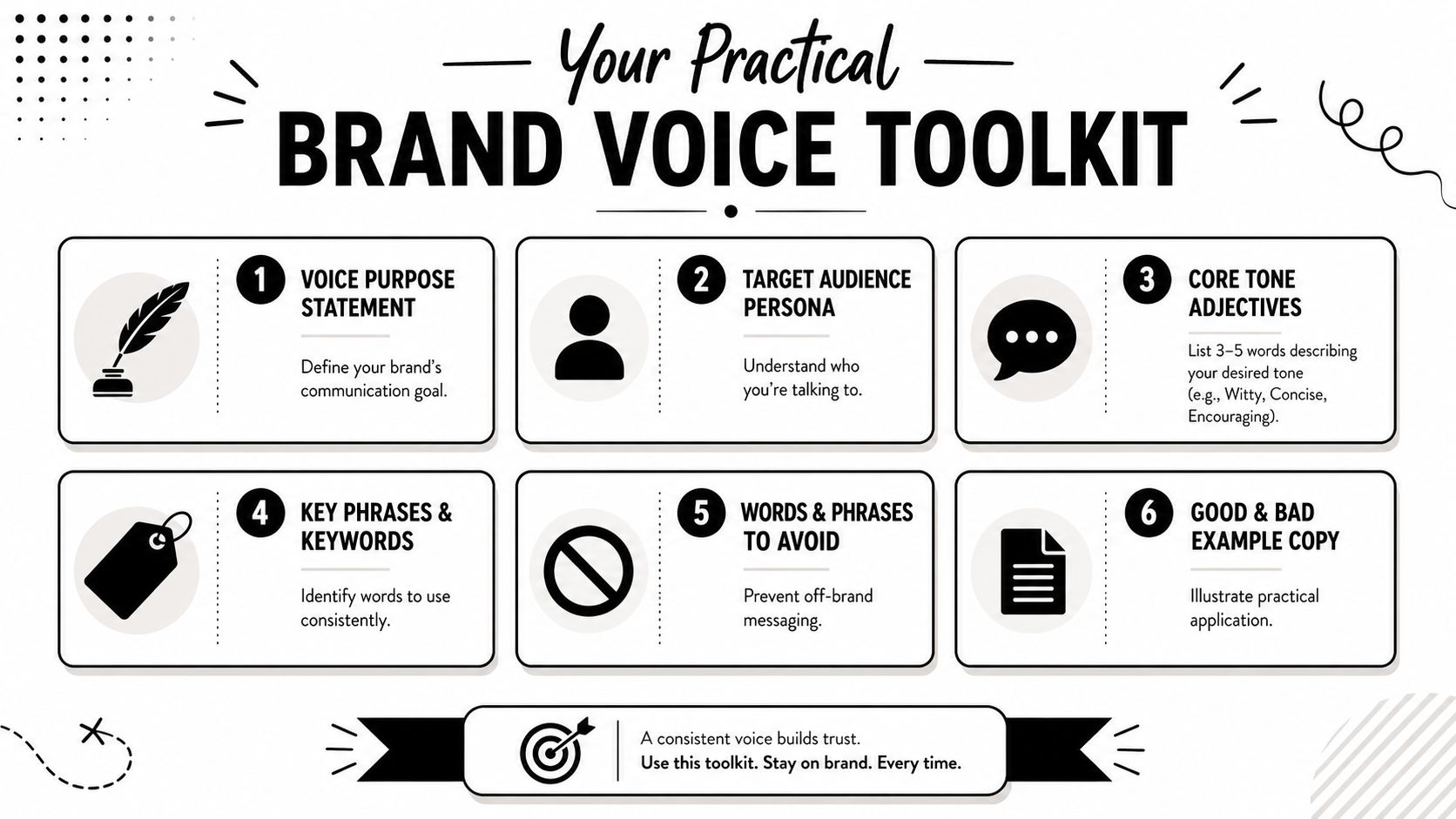
Next, build your lexical palette. A lexical palette enables many brands to finally become usable. One documented case found that a targeted brand voice initiative increased engagement by 94% within a single quarter after the brand created detailed guidelines with 20 words to use versus 20 words to avoid and applied them consistently across channels. That pattern is worth borrowing because it forces real decisions.
A simple setup:
- Words to use: practical, daily, simple, proven, reliable, easy, desk-ready, focused, clean, useful
- Words to avoid: game-changing, luxury, elite, magic, flawless, insane, viral, premium, iconic
That list should come from your product truth and buyer language. If your buyer is skeptical, avoid inflated claims. If your buyer wants identity and status, your avoid-list will look different.
Brand Voice Copy Templates
Templates save time because they lock in structure without making every ad identical. Use them for hooks, headlines, body copy, captions, and CTA lines.
| Template Type | Formula | Example (for a 'Smart Mug') |
|---|---|---|
| Hook | Problem + interruption + promise | Your coffee shouldn't be cold before your second email. This smart mug helps keep it at your preferred temp. |
| Hook | Identity + behavior | For people who take their desk setup seriously, cold coffee isn't part of the plan. |
| Headline | Product + outcome | Smart Mug for Longer Hot Coffee |
| Headline | Pain removed | Stop Reheating Your Coffee All Morning |
| Body copy | Pain + mechanism + use case | If your coffee goes cold while you work, this mug helps keep it at your chosen temperature so you can sip when you're ready. |
| Social caption | Observation + relatability + soft CTA | If you answer three messages before your first sip, this one's for you. |
| CTA line | Outcome-focused action | Keep your next cup hot |
Don't over-template your copy. If every ad uses the same cadence, performance drops because the creative starts feeling mass-produced. The point is to create a repeatable writing surface, not a script.
Use a final check before publishing:
- Does this sound like the buyer's world?
- Does this angle match the voice pressure?
- Does the copy avoid words that weaken trust?
- Could this line live on the ad and the product page without sounding like two different brands?
Activating Your Voice in Meta Ads and Social Posts
Most founders understand voice in theory and lose it in execution. The ad starts sounding one way, the caption another, and the product page another. Buyers feel that disconnect even when they can't name it.
Here, examples help more than rules.
Let's use a hypothetical smart mug with this voice profile: precise, calm, modern, helpful. Not flashy. Not quirky. Not luxury-coded.
One product, two angles, one voice
Angle 1: Problem→Solution
This angle works when the buyer has a clear annoyance and the product solves it directly.
Meta hook:
"Your coffee keeps going cold because your workday doesn't stop for it."
Primary text:
"If you take one sip, get pulled into work, and come back to a cold mug, this fixes a small problem that happens every day. The smart mug helps keep your drink at your preferred temperature, so your coffee is ready when you are."
Headline:
Keep Coffee Hot While You Work
That voice is calm and specific. It doesn't oversell. It explains.
Angle 2: Social Proof
Now the job changes. You're not introducing the mechanism first. You're reducing doubt.
Meta hook:
"The desk upgrade people didn't think they'd use this much."
Primary text:
"People buy this for the novelty and keep using it for the routine. It fits neatly into a work setup and removes the constant microwave trip that breaks focus."
Headline:
A Small Upgrade You Notice Daily
Same voice. Different pressure. Less explanation, more lived-in credibility.
A conversational human voice can also improve comprehension. Jacob Tyler cites experimental studies showing an 18% increase in factual knowledge retention when brands use a conversational human voice. For product education in Meta ads, that's practical. If buyers understand the product faster, your copy has a better chance of earning the click.
If you want a stronger framework for structuring those ads, this guide on how to write ad copy for performance-focused campaigns is a useful companion.
Keep the claim load low in the hook. Feed attention first, then explain just enough to earn the next click.
How the same voice shifts for social
Your social post shouldn't read like a shrunk-down ad. It still needs the same core voice, but the posture changes.
Instagram caption:
"Cold coffee after two meetings is a terrible reward for being productive. This smart mug keeps your drink where you want it, which makes your desk setup feel a lot more finished."
TikTok-style caption:
"Work from home people know the pattern. Pour coffee. Get distracted. Forget coffee. Reheat coffee. Repeat."
Both are consistent with the brand, but the rhythm changes. Meta copy usually needs a faster stop-scroll opening. Social captions can breathe a bit more and lean into observation.
Here is a useful creative breakdown to study before you draft your own variations:
What doesn't work is copying the same block of text everywhere. Platform adaptation matters. Core voice stays stable. Sentence shape, opening style, and emphasis can move.
A quick before-and-after shows the difference:
- Weak generic line: Meet the ultimate smart mug for modern lifestyles.
- Stronger voice-led line: If your coffee sits longer than your to-do list allows, this mug keeps up better than a regular one.
The second line sounds like it belongs to a real buyer situation. That's what you're aiming for.
The Final Step Testing and Iterating Your Voice
A voice document is a hypothesis. The market decides whether it's useful.
Too many founders treat brand voice development like a setup task they can finish once. They choose traits, write a few examples, and move on. That's not enough if you're buying traffic. Once money hits Meta, voice becomes a performance variable.
Treat voice like a test variable
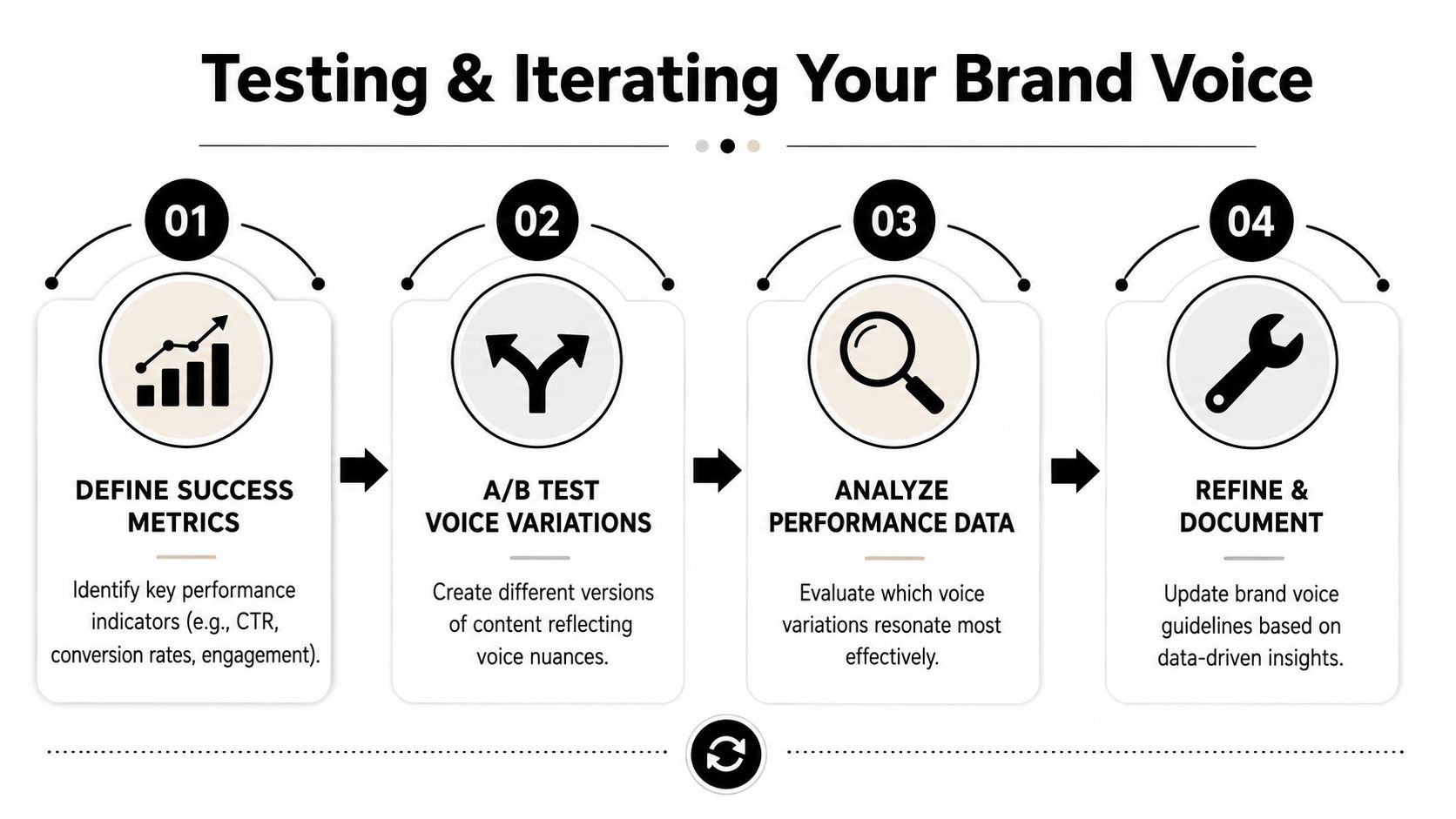
The cleanest way to do this is to tag every creative by angle, voice variation, and audience.
For example:
- Problem→Solution + authoritative + skeptical buyer
- UGC + empathetic + first-time buyer
- Identity + bold + status-driven buyer
Then compare performance round by round. Don't change everything at once. If you're testing a witty voice against a more direct one, keep the core offer and angle as stable as possible so you can learn what the tone itself contributed.
Consistency affects revenue, not just aesthetics. Brands that maintain voice consistency across channels can achieve up to a 23% increase in revenue, and 90% of customers expect consistent interactions across platforms, according to Fullcast's brand voice research as provided in the verified data above. The point isn't to sound identical everywhere. It's to make the buyer feel they are dealing with the same brand from ad to landing page to email.
What to log after each round
Keep your tracking simple. A spreadsheet is enough if the tags are clean.
Log:
- Creative ID
- Angle
- Voice variation
- Audience or objection
- CTR
- Conversion outcome
- Landing-page notes
- What to do next
If a direct, credible tone consistently earns better clicks for one product category, update the guide. If a playful variation gets attention but weak purchase intent, narrow where you use it. That's how voice gets sharper.
For a practical process, this guide to round-robin testing for ad creative decisions matches the way small ecommerce teams launch and refine batches.
The best-performing voice is rarely the one that sounds most impressive in a document. It's the one buyers understand fast and trust enough to act on.
The stores that improve quickly don't defend their voice choices. They test them, document them, and keep the parts that survive contact with real traffic.
Your Voice Is Your Most Underrated Growth Tool
For a new ecommerce brand, voice isn't decoration. It's part of the conversion path.
It shapes the hook that earns the stop, the line that lowers skepticism, the headline that matches buyer intent, and the landing-page copy that keeps the click from going to waste. When voice is vague, every ad angle starts sounding interchangeable. When voice is built from product truth and buyer language, your creative gets clearer fast.
That's why brand voice development works best as a performance system. Audit the product. Mine real customer language. Map traits to angles. Build a usable toolkit. Launch with intent. Then let the numbers tell you where the voice is too soft, too generic, too clever, or exactly right.
A good voice doesn't just describe the brand. It helps the buyer decide.
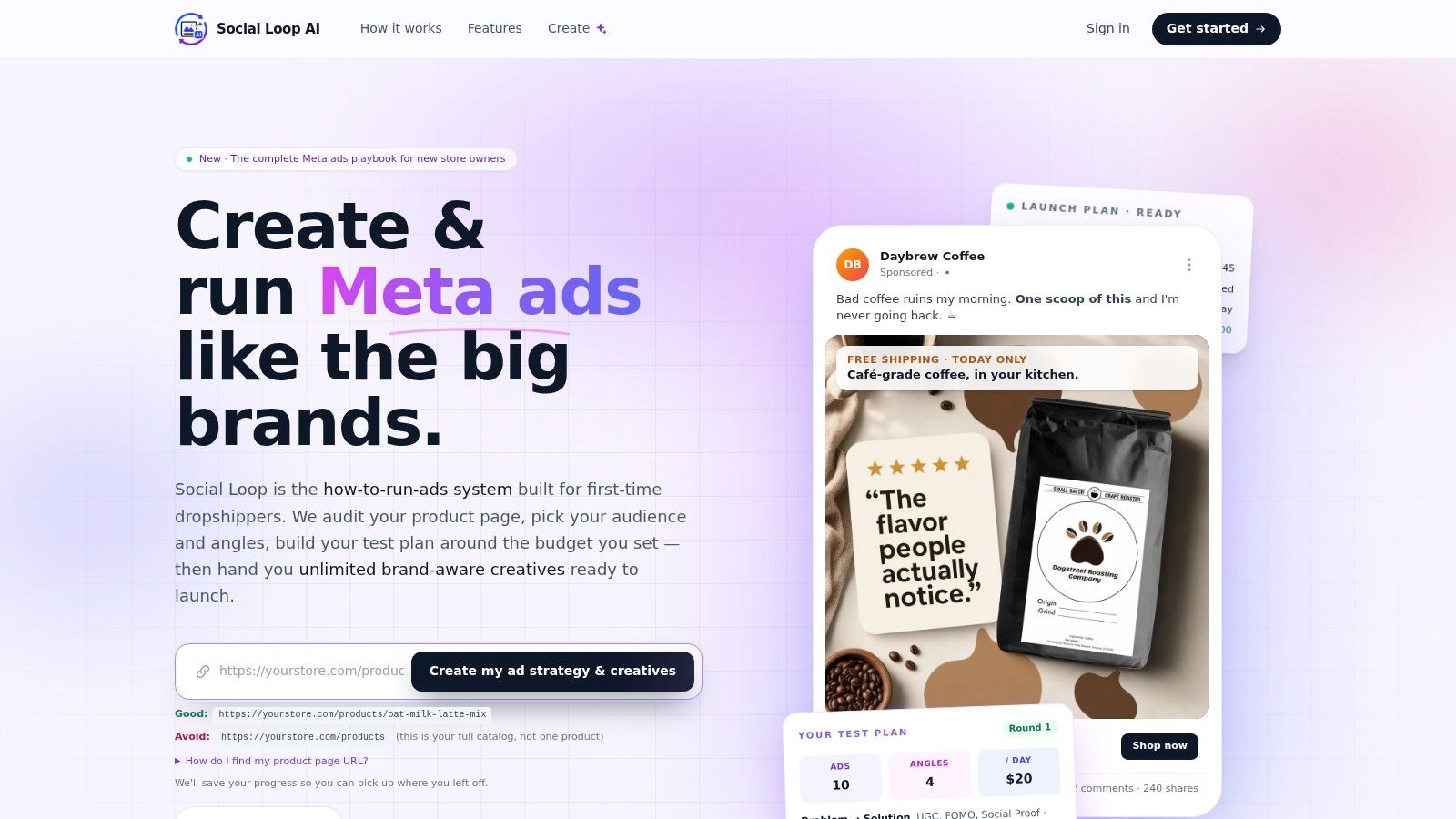
If you're launching your first product and want help turning a product URL into angle-based Meta ads, buyer-aware messaging, and a practical testing plan, Social Loop AI is built for that exact workflow. It helps new ecommerce owners move from unclear brand language to usable ad creative without hiring an agency.