Blog
Copywriting in Marketing: A Beginner's Guide to Sales
Published July 6, 2026
You've got a product page live, a few creatives ready, and enough budget to test on Meta. Then the ads go out and nothing happens. People scroll past. A few click, but they don't buy. The usual reaction is to blame the product, the targeting, or the platform.
A lot of the time, the actual problem is simpler. The words aren't doing their job.
In ecommerce, copy is the salesperson who never sleeps. It handles the first impression, frames the product, answers objections, and asks for the sale. If that salesperson is vague, boring, or disconnected from what the buyer wants, your campaign burns money fast. Good copy doesn't mean sounding clever. It means making the right promise to the right person in the right words.
Most beginner guides stop at formulas. They give you templates like PAS, AIDA, or “problem-solution” and leave you with a blank page. What new dropshippers usually need instead is a way to find a real angle. That starts with understanding not just what a product does, but why the buyer cares.
Table of Contents
- What Is Copywriting in Marketing and Why Does It Matter
- The Core Elements of Persuasive Copy
- Uncovering Your Winning Angle and Hook
- Why Your Ecom Store Needs Killer Copy
- Ad Copy Examples and Swipeable Templates
- Testing Copy and Measuring What Matters
- A Beginners Copywriting Process on a Budget
What Is Copywriting in Marketing and Why Does It Matter
Copywriting in marketing is salesmanship in print. It's the words in your Meta ad, product page, email, checkout prompt, and retargeting message that push a buyer toward one specific action.
That action might be a click, an add to cart, an email signup, or a purchase. The point is direction. Copy isn't there to “sound good.” It's there to move someone forward.
That's the biggest difference between copywriting and content writing. Content can educate, entertain, or build trust over time. Copy is more direct. It has a job to do now. If content is the conversation at the top of the funnel, copy is the closer asking for the next step.
Good copy doesn't just describe a product. It makes the buyer feel why that product matters in their life.
For a new store owner, this matters because ecommerce removes the human salesperson. No one is standing beside the buyer explaining why your kitchen gadget is easier, why your skincare tool is less frustrating, or why your organizer solves a daily annoyance. Your copy has to do that work on its own.
The market size tells you this isn't some niche creative skill. The global copywriting services market reached $25.29 billion in 2023 and is projected to reach $42.22 billion by 2030, with a 7.6% CAGR, and 85% of copywriters specifically produce marketing materials and ad copy to drive sales, according to this copywriting statistics roundup. Brands spend heavily here because words directly affect revenue.
If you're new to ecommerce, it helps to think of copywriting as a digital version of direct sales. Your hook starts the conversation. Your body copy handles hesitation. Your CTA asks for action. That's why understanding direct response copywriting in practice gives beginners such a strong foundation.
What copy has to do every time
- Win attention: Stop the scroll before the buyer ignores you.
- Create relevance: Show quickly that the product fits a real problem or desire.
- Reduce friction: Answer the silent objections people have before they buy.
- Drive action: Make the next step obvious and easy.
If your ads aren't converting, don't start by asking whether your wording is “creative enough.” Ask whether your copy is selling.
The Core Elements of Persuasive Copy
Most ads fail because they're missing one of the basic parts. Not because the writer lacked talent. Not because the algorithm was unfair. The message just wasn't assembled properly.
The easiest way to think about persuasive copy is as four working parts. Each part has a different job, and if one breaks, the whole thing gets weaker.
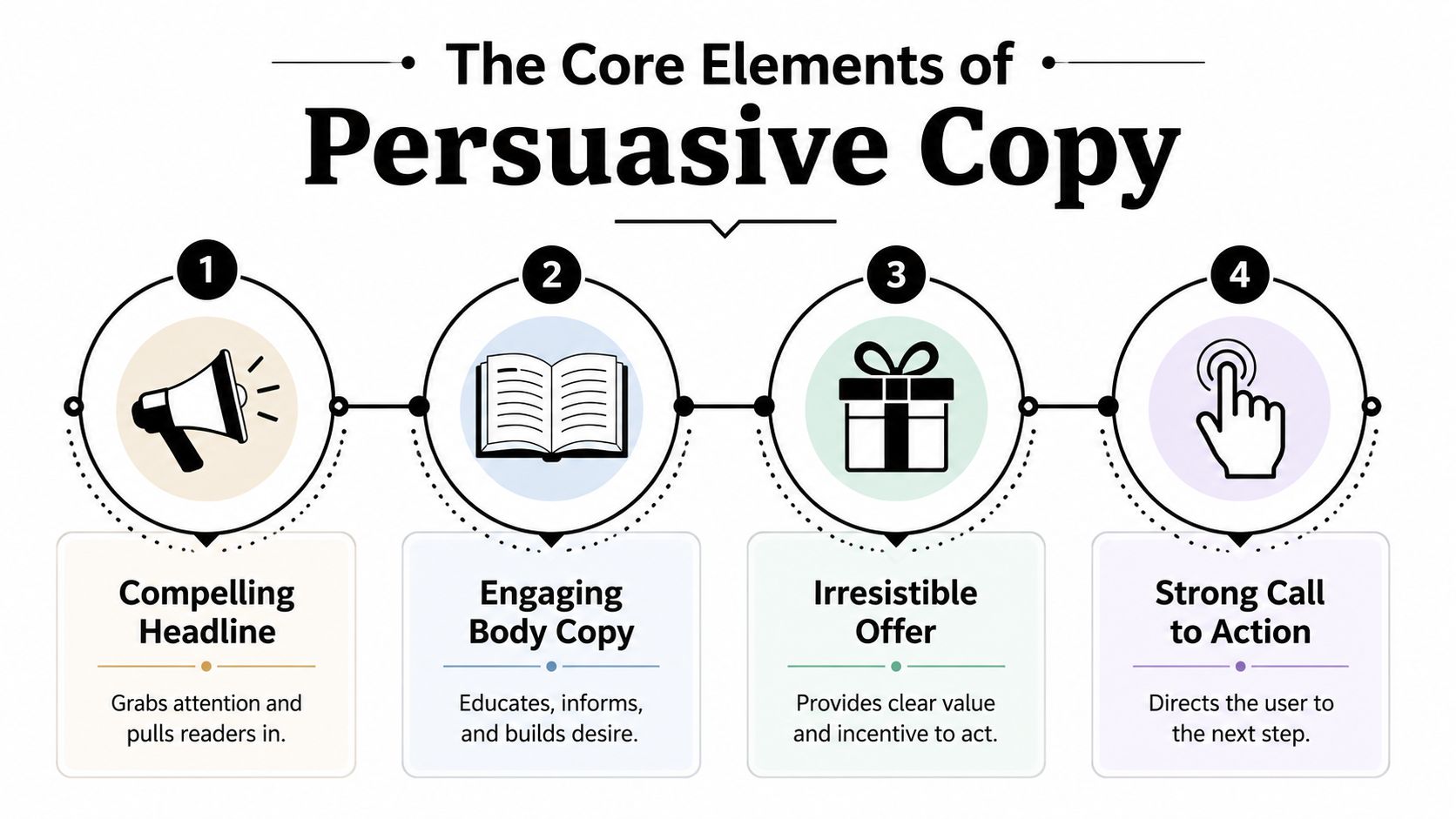
The hook
The hook is your pickup line. It earns the first second of attention.
On Meta, that usually means the first line of primary text, the visual headline, or both working together. A weak hook says what the product is. A strong hook says why the buyer should care right now.
Examples of weak hooks:
- “Introducing our new portable blender”
- “High-quality posture corrector for daily use”
Examples of stronger hooks:
- “Still skipping breakfast because mornings are chaos?”
- “Your shoulders don't hurt because you're lazy. Your setup is working against you.”
The hook is not the full sales pitch. Its job is to open the door.
The angle
The angle is the lens you use to frame the product. Same product, different angle.
A portable blender can be sold as convenience, health consistency, travel freedom, time-saving, or identity. One buyer wants “smoothies anywhere.” Another wants “stop wasting money on store-bought drinks.” Another wants “feel like the kind of person who stays on track.”
That's why angle selection matters more than wordsmithing. If the angle is wrong, polished writing won't save it.
Practical rule: Don't rewrite bad copy forever. Check whether you picked the wrong angle first.
The body
The body copy builds desire and lowers resistance. It expands the promise, explains the benefit, and handles skepticism.
Strong body copy usually does a few things well:
- Shows the payoff: It explains what gets better for the buyer.
- Makes the benefit concrete: It ties the product to an everyday situation.
- Handles doubt: It answers the “why should I trust this?” question.
- Keeps momentum: It moves logically toward action instead of wandering.
Beginners often write body copy like a feature list. That's fine for a spec sheet. It's weak for persuasion.
The CTA
The call to action tells the buyer what to do next. It should feel like a natural continuation of the promise.
A CTA gets weak when it's vague or detached from the message above it. “Learn more” can work, but only if curiosity is the goal. If the ad is already selling intent, a clearer CTA like “Shop now” or “Get yours today” usually matches the momentum better.
Here's the simple test: if someone reads your ad, do they know exactly what you want them to do next and why they should do it now? If not, the CTA needs work.
Uncovering Your Winning Angle and Hook
Most new dropshippers don't struggle because they can't write sentences. They struggle because they don't know what to say about the product. They stare at a garlic chopper, neck pillow, or LED lamp and end up writing generic copy like “high quality,” “must-have,” or “perfect for everyday use.”
That's not really a writing problem. It's an angle problem.

Why beginners get angles wrong
Beginners usually stop at the feature or the first obvious benefit.
They write:
- “Waterproof”
- “Portable”
- “Made with durable materials”
- “Helps save time”
None of those are useless. They're just shallow. Buyers rarely purchase because of a raw feature alone. They purchase because of what that feature means in their life.
Copywriting dimensionalization comes into play. Instead of stopping at the first benefit, you keep drilling down until you reach the emotional outcome underneath it. According to VeryGoodCopy's write-up on copywriting dimensionalization, 73% of top-performing Meta ads used layered benefit structures compared with 31% of average ads, based on a 2025 analysis of more than 19,000 campaigns.
That gap matters because it explains why some ads feel flat while others feel personal. One describes the tool. The other describes the transformation.
How dimensionalization works
Start with the product feature. Then ask, “So what?” repeatedly until you hit a core desire.
Take a portable blender:
| Level | Example |
|---|---|
| Feature | Portable blender |
| First benefit | Make smoothies anywhere |
| Deeper benefit | Stay consistent with healthier habits |
| Emotional outcome | Feel in control of your body and routine |
Now the copy has range.
If you stop at “portable blender,” your hook sounds like every other product listing. If you reach “feel in control of your routine,” you can write hooks that connect with a real buyer state:
- “Tired of falling off your health routine every busy week?”
- “Healthy habits get easier when breakfast travels with you.”
- “For people who want convenience without eating like garbage.”
That's the difference between description and persuasion.
A strong angle also needs to fit the brand voice. If your product is playful, aggressive copy can feel off. If your product solves an annoying daily problem, polished luxury language may weaken the message. That's why brand voice development matters after you find the emotional core, not before.
Surface benefits get clicks from curious people. Deeper benefits pull in buyers who see themselves in the message.
Here's a quick dimensionalization drill you can use on any product:
-
Write the raw feature
Example: “Heated eye massager.” -
Translate it into a direct benefit
“Relieves eye strain.” -
Push to the benefit of the benefit
“Makes it easier to wind down after screen-heavy days.” -
Name the emotional desire
“Feel calm, restored, and less fried.” -
Build hooks from that layer
“Your eyes aren't the only thing exhausted after work.”
This short video gives a useful visual way to think about angle development in practice.
A simple check before you launch
If your ad copy could work for ten unrelated products, it's probably too generic. “Upgrade your life,” “must-have solution,” and “you need this” are filler lines. They don't reveal a real angle.
A winning angle feels specific enough that the right buyer says, “That's me.” The hook then becomes easy, because it isn't trying to be clever. It's expressing the right desire in the right words.
Why Your Ecom Store Needs Killer Copy
A new dropshipping store often loses sales before the product gets a fair shot. The ad wins the click, the visitor lands on the page, and then the copy fails to answer the questions running through their head. What is this? Will it work for me? Why should I trust this store? Why buy now instead of later?
That is where stores leak money.
Design helps. Fast shipping helps. A clean product page helps. But copy does the selling. Copy works like your salesperson. It handles doubt, frames value, and moves a cold visitor one step closer to purchase.
For ecommerce, strong copy matters because buyers make fast decisions with limited trust. They are not walking into a retail store where they can touch the product or ask a staff member a question. Your headline, product description, offer stack, reviews, and call to action have to do that job on their own.
Good copy also gives your store direction. A beginner store without clear messaging usually sounds generic. It lists features, throws in a discount, and hopes the product carries the offer. Stores that convert better usually make one clear promise, back it up with specifics, and answer the objections that stop the sale.
Copy closes the gap between interest and purchase
A visitor rarely buys because a product is merely useful. They buy because the message makes the product feel relevant right now.
That matters on every part of the funnel. Ads need enough punch to earn the click. Product pages need enough clarity to keep attention. Checkout support copy needs enough reassurance to reduce hesitation. Email and SMS need enough relevance to bring people back before they forget why they cared.
This is also where dimensionalization becomes practical, not theoretical. If your product page says, "Made with soft memory foam," that is a feature. If your copy says, "Wake up without the stiff neck that ruins the first hour of your day," that is closer to the reason someone buys. One describes the product. The other describes the change the buyer wants.
New sellers miss this all the time. They write copy like a catalog entry when they need copy that reads like a sales conversation.
What bad copy usually does
Weak ecommerce copy tends to fail in a few predictable ways:
- It describes the product without building desire: The reader learns what it is, but not why it matters today.
- It skips the buyer's real hesitation: No answer for quality concerns, delivery anxiety, sizing doubts, or refund questions.
- It sounds borrowed: The wording could sit on fifty other Shopify stores without changing a line.
- It pushes the sale before earning belief: The page asks for commitment before the buyer feels understood.
One fix usually beats adding more text. Replace broad claims with lines that answer a specific doubt or connect the product to a specific desire.
For example, "Premium material and modern design" says almost nothing. "Light enough to carry every day without digging into your shoulder" gives the buyer something they can picture. Better copy lowers friction because it makes the benefit concrete.
Killer copy raises the value of everything else
Better creative performs harder when the message is sharper. Better products look stronger when the positioning is clearer. Even average stores can become profitable when the copy finally matches what the buyer cares about.
I have seen product pages improve after changing almost none of the layout. The lift came from tightening the headline, rewriting the first few bullets, adding objection-handling near the add-to-cart button, and making the offer feel specific instead of generic. Same product. Same traffic source. Different result.
That is why "killer copy" is not about sounding clever. It is about removing uncertainty and increasing desire at the same time.
For a beginner, that is good news. You do not need to write like a brand poet. You need to write like someone who understands what the buyer wants, what they fear, and what finally gets them to click "Buy Now."
Ad Copy Examples and Swipeable Templates
Templates help when you treat them like scaffolding, not magic. A swipe file won't rescue a weak angle, but it can help you turn a decent angle into usable ad copy fast.
Below is a simple Meta ad swipe file using one example product: a portable blender. The point isn't the product itself. The point is seeing how the message changes when the angle changes.
Meta Ad Copy Swipe File
| Angle | Headline (Hook) | Primary Text (Body) | CTA |
|---|---|---|---|
| Problem and solution | Skipping breakfast again? | Mornings get messy fast. This portable blender helps you make a quick smoothie at home, at work, or on the go without dragging out a full kitchen setup. | Shop Now |
| Convenience | Blend anywhere without the bulky mess | Toss it in your bag, blend in minutes, and keep your routine simple even on packed days. Great for busy commutes, office lunches, and post-gym resets. | Get Yours |
| Identity | For people who are done “starting over” every Monday | Healthy habits stick better when they're easy. This portable blender makes one small part of your routine feel manageable again. | Try It Today |
| FOMO | Your new go-to for fast smoothies | If you've been waiting for an easier way to stay consistent, this is the kind of tool that disappears fast when it catches on. | Shop Now |
| Social proof style | The small kitchen upgrade busy people actually use | Some products look useful and collect dust. This one earns a spot in the daily routine because it removes friction instead of adding it. | See Why |
A few patterns are worth stealing.
First, each hook speaks to a different buyer motive. One leads with frustration. Another leads with identity. Another leans into ease. That's useful when you're testing because it gives you different psychological doors into the same product.
Second, the body copy stays grounded. It doesn't say “game-changing” or “life-changing.” It shows where the product fits and what it makes easier.
How to adapt a template without making it generic
Use this filter before you publish:
- Replace broad adjectives: “Amazing,” “premium,” and “exceptional” rarely carry the message.
- Name a moment: Commute, school run, desk lunch, bedtime routine, gym bag. Specific moments make copy believable.
- Write to one person: Don't write for “everyone.” Write for the tired parent, the student, the office worker, or the traveler.
- Match the CTA to intent: Colder traffic may need “Learn More.” Hotter traffic can handle “Shop Now.”
You can also use the same structure on product pages. The hook becomes the hero headline. The body becomes your opening section. The CTA stays the same. Good ad copy and good landing page copy usually come from the same angle. That consistency is what keeps the click from feeling like a bait-and-switch.
Testing Copy and Measuring What Matters
Copy isn't finished when you publish it. It's finished when performance data says it works.
A lot of beginners judge copy by taste. They ask whether it sounds good, whether friends like it, or whether it feels “professional.” That's not how performance marketing works. You need two numbers that tell you what happened before and after the click.
Read CTR first
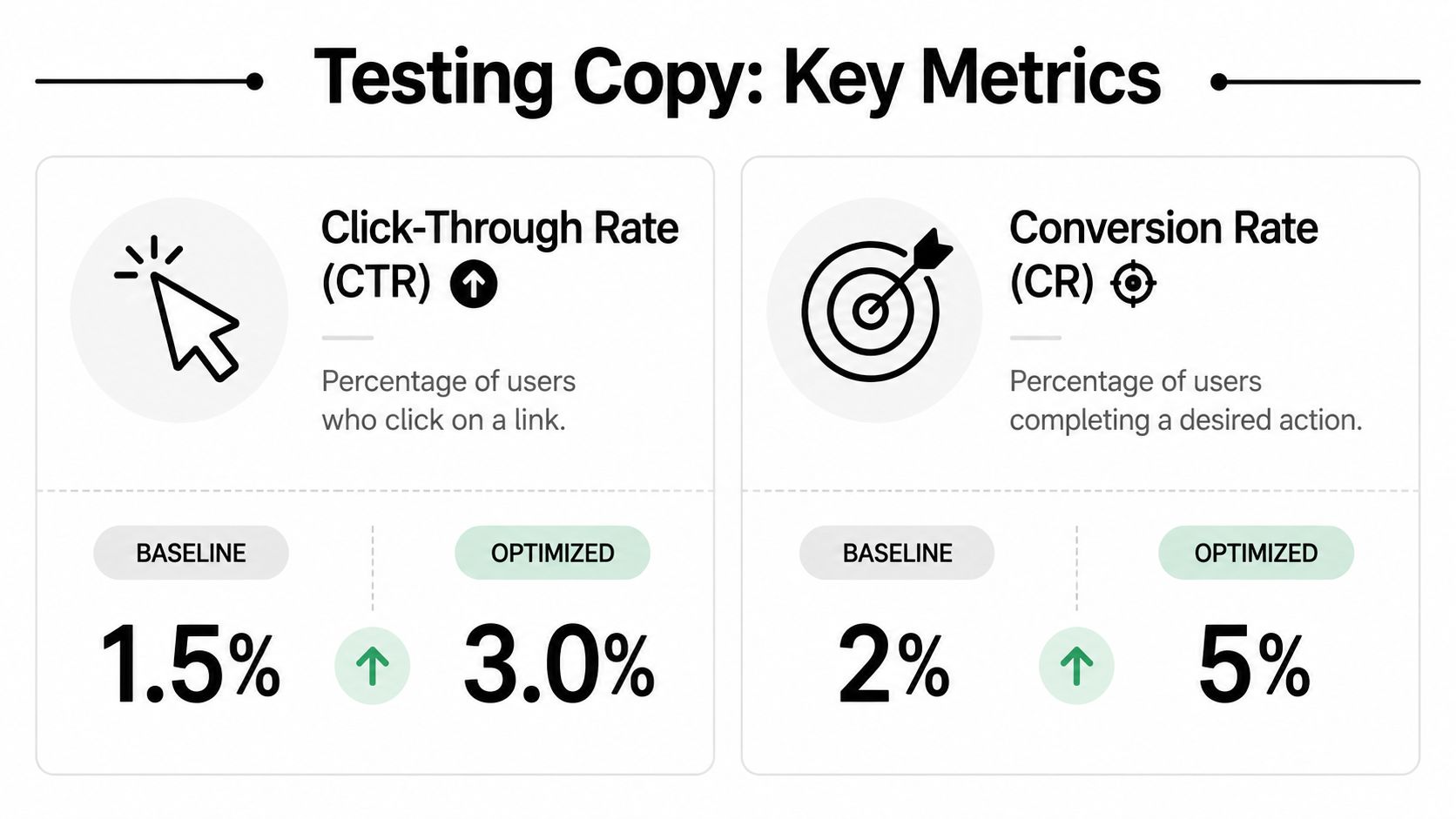
Click-Through Rate (CTR) tells you whether the ad got attention and interest. The formula is Clicks ÷ Impressions = CTR %. According to TVScientific's overview of performance marketing metrics, a CTR above 1.5% on Meta Ads signals that the hook is resonating.
That doesn't mean the campaign is profitable. It means your first job is being done well. People see the ad and enough of them want to know more.
If CTR is weak, start at the top of the ad:
- Hook
- Angle
- Creative-message fit
- Audience-message fit
Don't immediately rewrite the whole landing page if people aren't even clicking.
Use CVR to diagnose the handoff
Conversion Rate (CVR) tells you whether the click turned into the action you wanted. In this article's framework, use Conversions ÷ Clicks = CVR as your working formula for judging post-click performance. The benchmark to watch is this: if CTR is high but CVR is below 5%, that usually means there's a disconnect between the ad's promise and the landing page experience, as noted in this performance copy guidance.
That's the classic ecommerce leak. The ad says one thing. The product page says another. Or the ad creates emotional momentum and the page kills it with bland copy, missing objection handling, or unclear value.
Here's the simplest way to read the numbers:
| Pattern | What it usually means | What to fix |
|---|---|---|
| Low CTR, low CVR | The message is weak from the start | Test new hooks and angles |
| High CTR, low CVR | The ad promise and page don't match | Rewrite the landing page opening, objections, and CTA |
| High CTR, solid CVR | Message alignment is working | Consider scaling and iterating |
If you're new to testing, don't change five things at once. Change one variable, then read the result. If that sounds slow, it is. But it's still faster than guessing.
For beginners trying to avoid fake winners, learning statistical significance in plain English helps you avoid scaling a copy variant just because it had a lucky start.
A high CTR means your ad started the conversation. A low CVR means the landing page failed to close it.
A Beginners Copywriting Process on a Budget
You launch your first product, write one ad, spend for two days, and get weak results. New dropshippers often call the product a loser at that point. The actual problem is usually the process.
Cheap testing beats confident guessing.
A beginner-friendly copy process starts with angle volume, then trims based on response. According to Park University's guide to persuasive copywriting, adaptive copy frameworks that test multiple angles can improve click-through performance versus a single static message. That matters most with unknown products, where you are still figuring out what buyers care about.
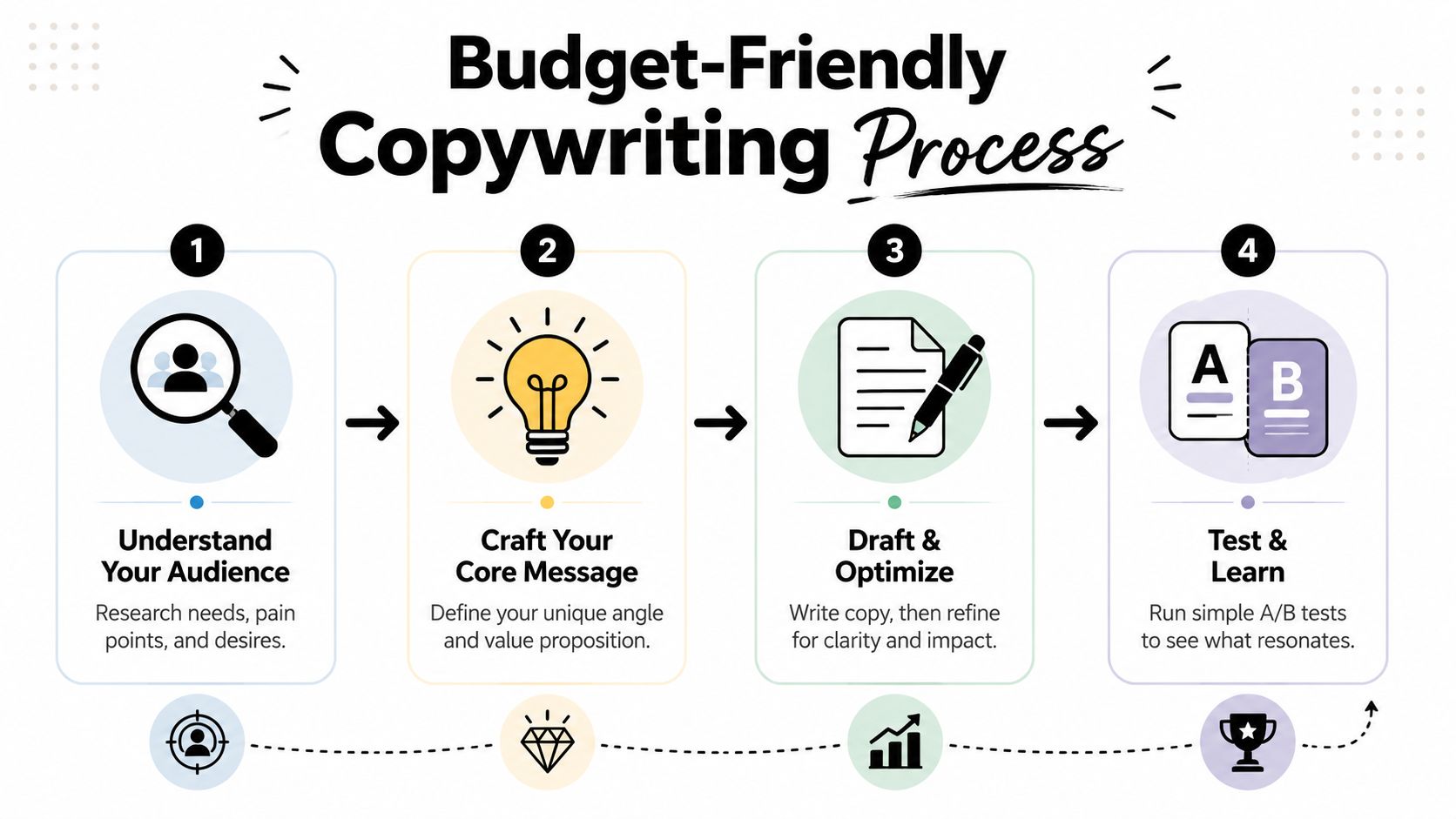
Use this six-step process:
-
Start with the feature, then dimensionalize it
Go past the surface benefit. If the product is leakproof, ask what that changes in real life. Less mess. Less embarrassment. More confidence leaving the house. That is copywriting dimensionalization. You move from feature to outcome to emotional desire, and that is where strong angles come from. -
Choose three angles you can defend
Pick three reasons someone would buy, not ten vague ideas. A posture brace might sell on pain relief, confidence in appearance, or staying comfortable through a workday. Good angles feel specific and believable. -
Write two hooks for each angle
The hook is the pickup line. Its job is to earn the next second. Write one direct hook and one curiosity-based hook for each angle so you test different entry points, not small wording tweaks. -
Draft short body copy that closes the gap
Copy is the salesperson. It needs to explain what the product does, who it is for, and why this claim should be trusted. Keep it tight. Beginners waste money when they write long copy before they know which angle deserves attention. -
Make the product page continue the same sales conversation
If the ad sells convenience, the page should open on convenience. If the ad sells relief from embarrassment, the page should not switch to sterile product specs. Message match matters because buyers notice the shift fast, even if they cannot explain it. -
Cut losers fast, then improve the winner
After the first round, keep the angle that pulls attention and rewrite around it. Do not scale the first ad that gets clicks. First make sure the hook, body copy, and landing page are selling the same promise.
This process works for a solo founder with a small budget because it controls risk. You are not trying to outspend bigger brands. You are trying to learn which emotional lane your product belongs in before you spend enough to regret the test.
If you want help turning a product URL into angles, hooks, ad creatives, and a simple test plan, Social Loop AI is built for that exact first-campaign stage. It helps new ecommerce owners move from guesswork to a practical Meta ads launch workflow without hiring an agency.