Blog
The 2026 Playbook: How to Start Dropshipping Business
Published May 26, 2026
You're probably in the same spot most first-time dropshippers hit. You've watched a few videos, browsed product ideas, maybe even opened Shopify, and now everything feels equally possible and equally risky. The hard part isn't getting started. The hard part is avoiding the beginner mistakes that burn cash before you've learned what a good store, a good supplier, and a good ad look like.
That's why a real guide to how to start dropshipping business has to be more practical than motivational. You don't need another speech about freedom and passive income. You need a launch process that helps you choose a product people already buy, vet the supplier behind it, build a store that looks trustworthy, and tighten your landing page before you send paid traffic to it.
Table of Contents
- Laying the Foundation for a Profitable Dropshipping Business
- Vetting Suppliers and Building Your Minimum Viable Store
- Optimizing Your Landing Page Before Spending on Ads
- Building a Professional Meta Ads Plan with Social Loop AI
- Launching Testing and Scaling Your First Ad Campaigns
- Frequently Asked Questions for New Dropshippers
Laying the Foundation for a Profitable Dropshipping Business
Most beginners try to answer the wrong question first. They ask, “What product should I sell?” The better question is, “What kind of demand am I entering, and can I survive the economics of that market?”
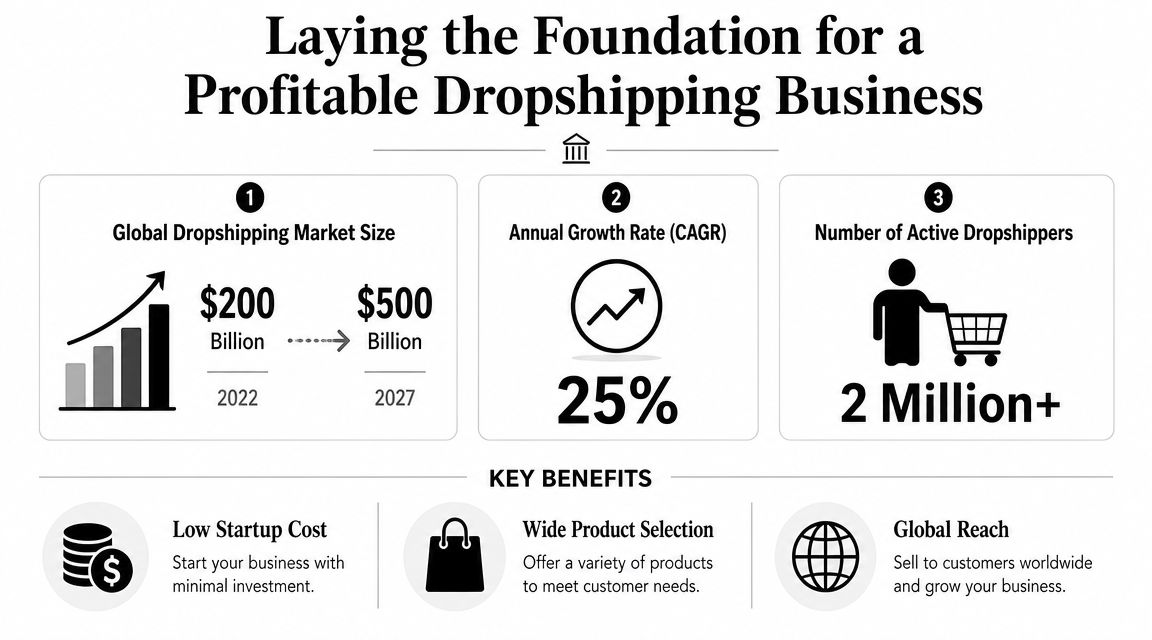
The reason dropshipping still attracts founders is simple. It's already a major ecommerce channel, not a fringe side hustle model. The global dropshipping market was valued at $290.7 billion in 2025 and is projected to reach $343 billion in 2026, according to GM Insights' dropshipping market analysis. That same analysis projects $1.84 trillion by 2035 at a 20.6% CAGR, and notes that fashion and apparel held 26.2% market share in 2025.
Read the market before you read your own excitement
That growth matters because it changes how you should think about starting. You're not inventing a business model. You're entering a crowded fulfillment channel where demand already exists, customer expectations are high, and sloppiness gets punished fast.
A lot of people hear “low startup cost” and assume the margin cushion will save them. It won't. One industry summary says the success rate is around 10 to 20% in the first year, with typical net margins in the 15 to 25% range after all costs, according to GetCarro's dropshipping statistics roundup. That same source notes many operators work inside a broader 10 to 30% margin band, and only a small share of stores reach meaningful monthly revenue.
Practical rule: If your product only works when everything goes perfectly, it's not a beginner-friendly product.
That's why “follow your passion” is weak advice. Passion helps you stay interested. It doesn't fix thin margins, unreliable shipping, or an offer nobody wants.
Build a simple founder filter
Before you choose a niche, score it against four things:
-
Demand you can verify
Stick close to categories with obvious buyer activity. Large pools like fashion, beauty, accessories, home, and problem-solving products are easier to evaluate than obscure novelty items. -
Competition you can read
Open stores that already sell similar items. Check their product pages, shipping language, bundles, reviews, and ad style. You're looking for patterns, not perfection. -
Economics that leave room for mistakes
Margin has to absorb product cost, shipping, returns, payment fees, and ad spend. If you can't map that clearly on paper, don't launch it. -
A buyer you can describe in one paragraph
Don't say “women 18 to 34” and call it done. Write a rough buyer profile. What annoys them? What do they already buy? Why would they stop scrolling for this product?
A rough buyer persona can start simple:
| Field | Example |
|---|---|
| Problem | Wants something that saves time or removes hassle |
| Trigger | Saw a demo, a before-and-after, or a relatable pain point |
| Objection | Worries the product is cheap, gimmicky, or slow to arrive |
| Buying style | Impulse-friendly if the page is clear and trust signals are strong |
If you want a smarter way to think through demand and messaging, this guide on data-driven marketing for ecommerce teams is worth reading. The key idea is simple. Start with signals, not guesses.
Vetting Suppliers and Building Your Minimum Viable Store
A bad supplier can wreck a good product faster than bad ads can. Most beginner losses come from operational problems that were visible before launch, but ignored because the listing looked profitable.
That's why supplier selection isn't a sourcing task. It's a risk-control task.
Treat supplier selection like risk control
A lot of starter advice reduces supplier research to two things: price and shipping. That's too shallow. As EasyPost's guide to starting a dropshipping business points out, a better checklist includes product quality, customer service, return policy, packaging, and mandatory sample ordering before launch.
Here's the supplier screen I'd use before adding a single product to a store:
-
Sample quality first
Order the product. Don't trust catalog photos. Check the material, finish, instructions, smell, packaging, and whether the item looks like something a real customer would keep. -
Response quality next
Send a few pre-sale questions. If replies are vague, delayed, or translated badly enough to create confusion, expect more of that after you start selling. -
Return friction matters
Read the policy like an unhappy customer would. If the process is muddy, you'll end up eating refunds just to protect the brand. -
Packaging is part of the product
Customers judge what arrives, not what the supplier promised. Generic, damaged, or messy packaging creates distrust fast. -
Fulfillment consistency beats one fast test
One good sample doesn't prove reliable operations. Ask how they handle stockouts, damaged units, and address errors.
Most new sellers think they have a product problem. Often they have a supplier problem that shows up as refunds, complaints, and bad reviews.
Shopify's guidance on how to start dropshipping also emphasizes supplier reliability, fulfillment time, packaging, and customer-service quality before scaling, along with sample ordering and margin calculation. That's the right order of operations. A weak backend always leaks into the frontend.
Build the store your supplier deserves
Your first store doesn't need to be beautiful. It needs to look competent.
A minimum viable store on Shopify or WooCommerce should do five things well:
| Store element | What “good enough” looks like |
|---|---|
| Homepage | Clear niche, simple navigation, no clutter |
| Product page | Original copy, clean media, visible shipping and returns |
| Policy pages | Refund, shipping, privacy, terms |
| Trust signals | Contact page, branded email, consistent design |
| Checkout path | Mobile-friendly, no broken links, no surprise friction |
What doesn't work is overbuilding. New founders waste days changing fonts, adding animations, and trying to make a one-product test store look like a global brand. Customers don't need cinematic design. They need clarity.
A solid minimum viable store usually includes:
- A simple theme that loads cleanly on mobile
- Product pages rewritten in your own voice instead of copied supplier text
- A realistic shipping policy that matches supplier performance
- An FAQ that answers delivery, returns, and support questions
- Basic branding such as logo, colors, and tone that stay consistent
Your store's job isn't to impress other dropshippers. Its job is to remove doubt long enough for a buyer to trust the purchase.
Optimizing Your Landing Page Before Spending on Ads
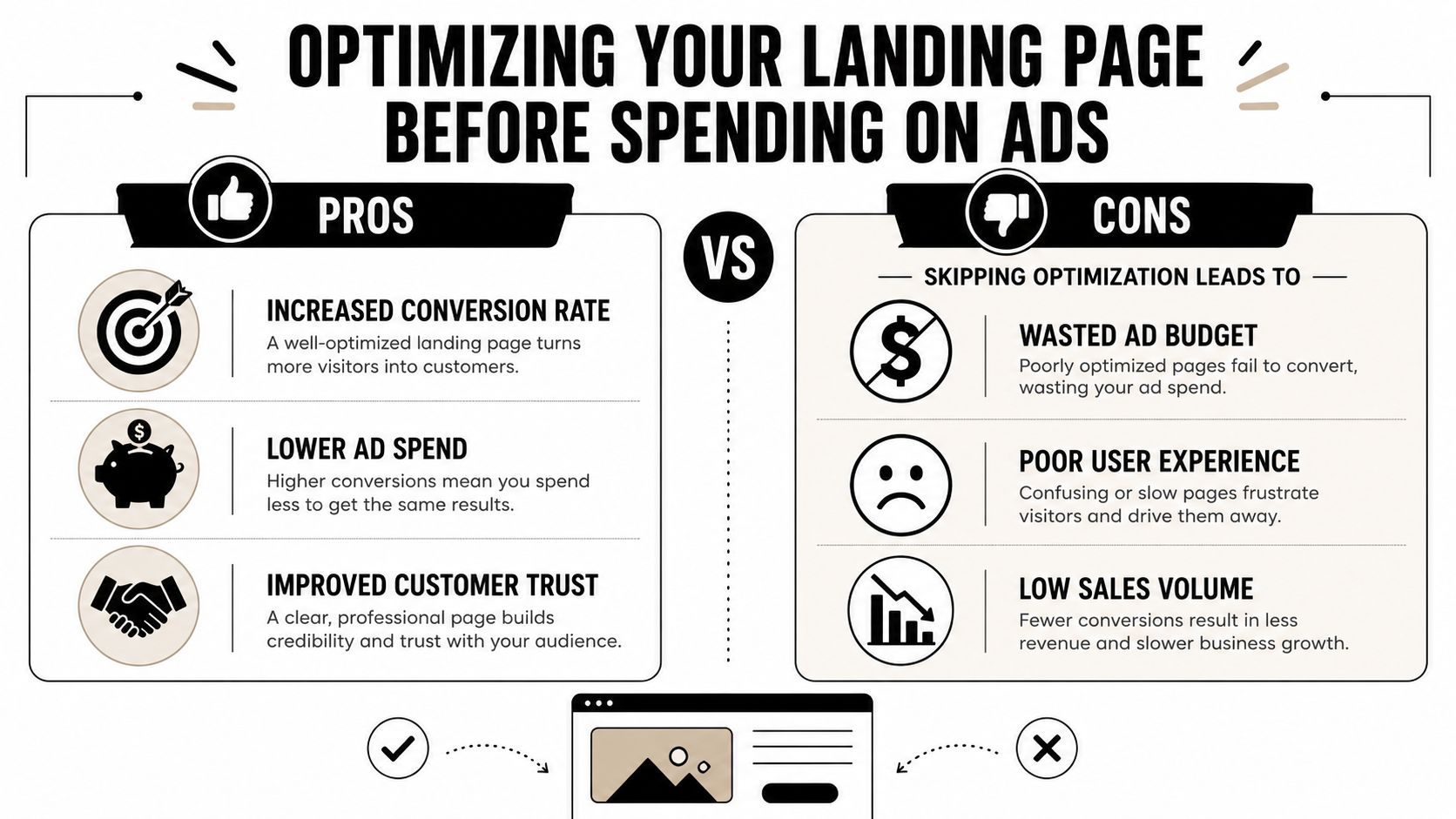
Most beginners buy traffic too early. They launch Meta ads to a page that still reads like a supplier export, then blame the ad when sales don't come in.
The product page usually tells the truth. If it's vague, cluttered, weak on benefits, or missing trust signals, paid traffic will just expose the problem faster.
Fix the page before you buy the click
A high-conviction landing page does a few jobs in a tight sequence. It stops the scroll, explains the product fast, answers the obvious objections, and makes the next click feel safe.
That means your page should have:
-
A headline with a clear promise
Not just the product name. State what problem it solves or what result it helps create. -
Benefit-led bullets
Features matter, but buyers think in outcomes. Tell them what gets easier, cleaner, faster, simpler, or more comfortable. -
Useful media
Show scale, texture, use case, and context. Supplier images on a white background rarely do enough work alone. -
Visible trust elements
Delivery expectations, return policy, customer support path, and anything that reduces perceived risk. -
One obvious call to action
Don't make buyers search for the next step.
A good companion read is this breakdown of landing page best practices for conversion-focused teams. It's especially useful if you're trying to clean up a page before your first ad test.
A landing page audit checklist that catches the usual leaks
Use this quick audit before spending on traffic:
- Can a visitor understand the offer in a few seconds?
- Does the copy focus on the buyer more than the product specs?
- Are shipping and return expectations easy to find?
- Do the images answer questions a buyer would naturally have?
- Does the page feel consistent with the brand, or pieced together from supplier assets?
A weak page doesn't always look broken. It often looks “fine” until you pay for traffic and realize nobody trusts it enough to buy.
An AI page audit offers a solution. A useful tool doesn't just call the page good or bad. It flags specific friction points and gives you copy and structure fixes you can paste in. For a first-time founder, that shortens the loop between “I think this page is okay” and “this page is ready to test.”
If your page still relies on generic claims, long feature dumps, and unclear shipping language, don't launch ads yet. Tighten the page first. Every click costs money. Your page decides whether that money taught you something or disappeared.
Building a Professional Meta Ads Plan with Social Loop AI
A first ad launch gets messy when you start from a blank page. You know the product. You don't know the audience well enough, you're unsure which angle to test, and every creative decision feels expensive because each wrong guess burns budget.
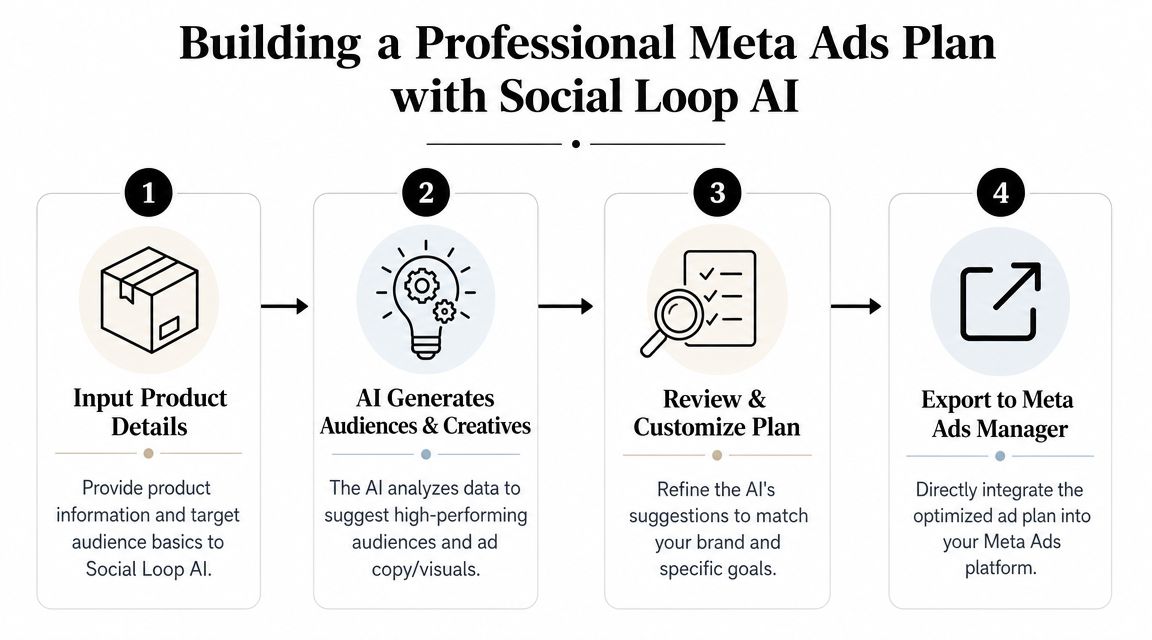
That's where a structured workflow helps. Instead of opening Meta Ads Manager and improvising, you can use Social Loop AI to turn a product URL into a guided launch plan.
What the workflow looks like in practice
The platform is built for first-time dropshippers and new ecommerce owners, so it doesn't assume you already know how to brief an agency. You start with the product URL, then move through a guided 7-step wizard that builds the ad plan in order.
The flow usually looks like this:
| Step | What you do | What the tool helps produce |
|---|---|---|
| Product input | Add the product page or offer details | Pulls core product context into the workflow |
| Buyer definition | Clarify who the likely customer is | Builds a tighter buyer profile |
| Angle selection | Choose how to frame the offer | Suggests proven angles like Problem to Solution, UGC, Social Proof, FOMO, and Identity |
| Landing page review | Check whether the page is ad-ready | Surfaces page weaknesses before launch |
| Budget planning | Enter a daily budget | Converts that into a practical round-by-round testing plan |
| Creative generation | Review ad concepts | Produces image ad batches with hooks, copy, CTAs, and layouts |
| Export and launch prep | Final review | Gives you a cleaner package to build in Meta Ads Manager |
The biggest advantage isn't speed alone. It's structure. Most beginners don't fail because they're lazy. They fail because they test random combinations of audience, message, and creative without a clear reason.
For context on campaign setup logic and execution standards, this article on Meta ads best practices for ecommerce marketers is a solid companion.
Here's the product walkthrough if you want to see the workflow in action:
How the outputs become usable fast
Social Loop AI is useful because it closes three beginner gaps at once.
First, it helps define the buyer with more precision than broad audience guesses. Second, it pushes you to pick a handful of ad angles instead of writing one generic ad. Third, it generates creatives that are organized around audience and objection, not just aesthetics.
According to the publisher information, each batch can deliver 10 image ads with copy, hooks, CTAs, layouts, and palettes, and the system is informed by insights from 19,000+ winning Meta ads. It also scores landing-page readiness from 0 to 100 and writes pasteable copy fixes. For a solo founder, that's the difference between “I made some ads” and “I built a test plan.”
If you can't explain why each ad exists, you don't have a test plan. You have a folder of guesses.
What I like about this kind of workflow is that it keeps beginners from overpersonalizing ad decisions. You don't need to invent brilliant creative from scratch. You need a disciplined first batch that tests different motivations cleanly.
Launching Testing and Scaling Your First Ad Campaigns
You launch a new campaign on Monday, check it by lunch, and one ad already has clicks. The beginner mistake is treating that as proof and raising budget before the rest of the funnel has a chance to speak. Early clicks are only one signal. Profit comes from reading the full path and making the next decision with discipline.
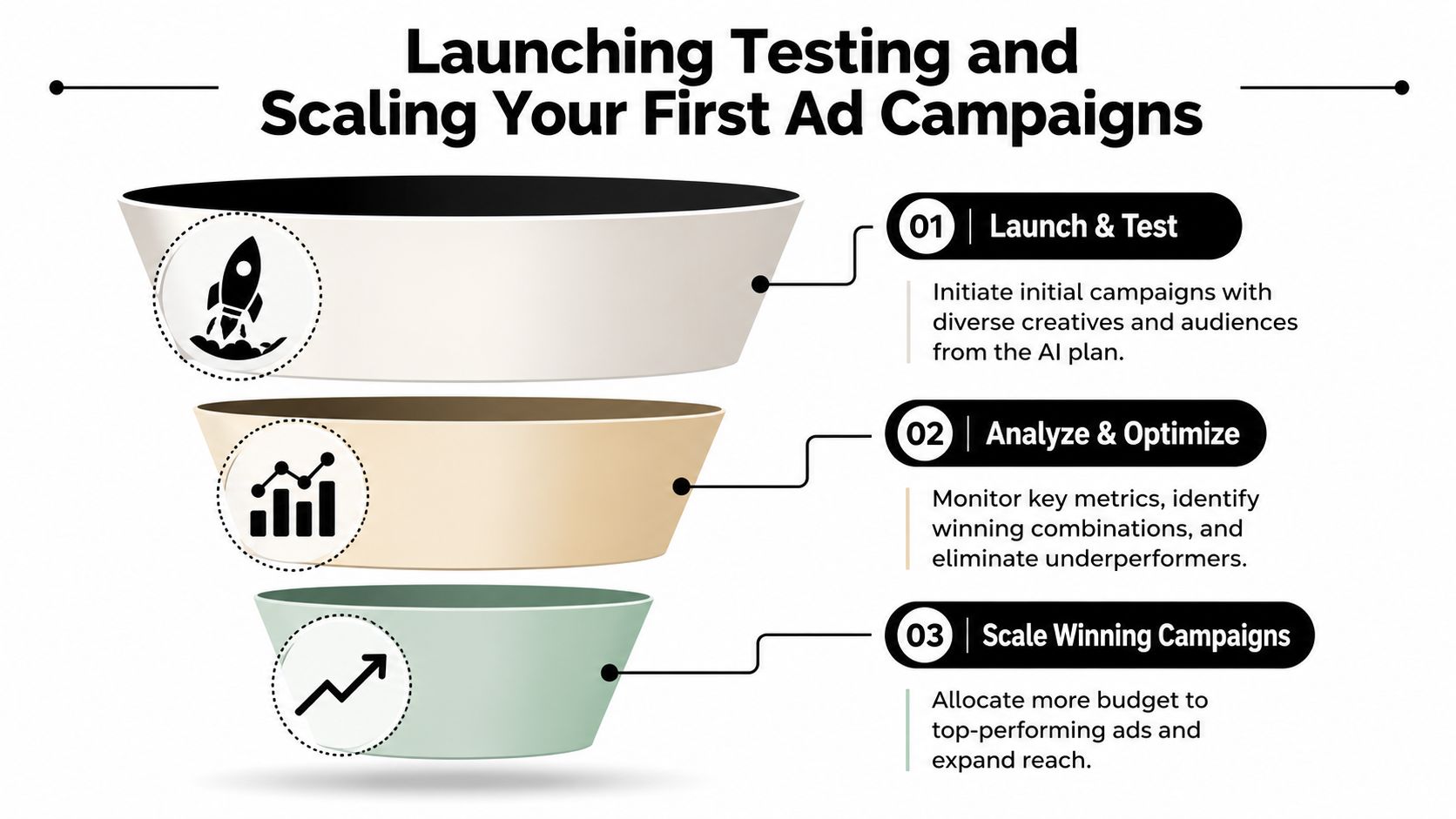
The first job is not to force a winner. It is to find out which message deserves more spend.
That is why first campaigns should run in rounds. Keep the setup simple enough that you can tell whether the problem is the creative, the audience, the offer, or the page. If everything changes at once, the data becomes noise. If you used Social Loop AI in the planning stage, this part gets easier because your ads are already grouped by angle, objection, and audience instead of being a random batch of designs.
A clean first round usually includes:
-
A small set of clearly different creatives
Test different buying motivations. Problem aware, outcome focused, trust focused, or offer focused. Tiny headline swaps are not a real test. -
One stable product page
Leave the page alone long enough to judge it fairly. Fix obvious errors, but do not rewrite the whole offer every few hours. -
A simple tracking sheet
Log the angle, creative concept, spend, clicks, add-to-carts, checkouts started, and purchases. Patterns get obvious fast when the notes are clean. -
Controlled budgets
Spend enough to get a read, not enough to create damage from one bad assumption.
I like to judge first-round ads in order. Start with click-through. Then look at landing page behavior. Then look at add-to-cart and checkout intent. That sequence shows where friction starts.
| What you see | Likely issue | Move |
|---|---|---|
| Weak click response | Hook or angle is off | Replace the creative or rewrite the headline and primary text |
| Clicks but no page engagement | Ad to page mismatch | Tighten message match between the ad promise and the landing page |
| Engagement but poor buying intent | Offer or trust issue | Clarify shipping, returns, delivery time, reviews, and product framing |
| One angle clearly outperforms others | Early message-market fit | Create more variations around that angle before raising spend |
New dropshippers often kill a product too early when the issue is messaging. I have seen products fail with generic "viral" style ads, then work once the angle changed from hype to a specific outcome the buyer cared about. That is the trade-off in testing. You need enough patience to let signals form, but not so much patience that you keep paying for a weak angle out of hope.
Early testing is a filter for bad assumptions. Treat it that way.
Scaling starts after repeated proof, not a single good afternoon. Look for consistency across multiple creatives under the same angle, a landing page that holds up after the click, and purchase behavior that still makes sense after fees and shipping. Once that happens, increase spend in measured steps, keep your winning page stable, and expand with close variations instead of starting over from scratch.
Frequently Asked Questions for New Dropshippers
Do I need a big budget to start
No, but you do need enough money to test responsibly. You'll need funds for your store platform, apps if you use them, product samples, and a controlled ad budget. Starting lean is smart. Starting underfunded usually creates bad decisions, especially when you skip samples or rush into ads with an unfinished page.
How long does it take to become profitable
There isn't a reliable fixed timeline. Some stores find traction quickly. Others need several product, page, and ad iterations before they get stable results. The wrong mindset is expecting fast profit. The better mindset is trying to reach solid unit economics before you try to grow.
Do I need to register the business before launch
In most cases, you should handle the legal basics early. That usually includes choosing a business structure, separating business finances from personal finances, and making sure your policies, taxes, and customer-facing terms are handled properly for your location. If you're unsure, speak with an accountant or lawyer in your jurisdiction.
Is dropshipping still worth it
Yes, if you treat it like an operating business instead of a shortcut. The model still works because it removes inventory risk and lets small founders test demand quickly. What doesn't work is copying a trending product, importing supplier text, and expecting ads to rescue a weak setup.
The beginners who last usually do the boring work well. They vet suppliers carefully, keep the store simple, improve the page before launch, and test ads in controlled rounds instead of chasing instant scale.
If you want help turning a product URL into a practical Meta launch plan, Social Loop AI is built for that exact stage. It helps first-time dropshippers generate audience ideas, ad angles, creatives, landing-page fixes, and a budget-aware testing workflow, so you can launch with more structure and fewer expensive guesses.