Blog
Ecommerce Marketing Funnel Blueprint for 2026
Published August 1, 2026
You can launch a Shopify store, connect Meta Ads, and still watch the dashboard sit there like it's broken. The product page looks clean, the ads are live, and you've got budget ready, but the sales notifications never arrive. That's usually not a traffic problem, it's a funnel problem, and in ecommerce the leak is often where buyers already showed intent and then slipped away.
Table of Contents
- What Most Beginners Get Wrong on Day One
- The Five Stages Every Ecommerce Funnel Needs
- Diagnose Where Your Funnel Is Actually Leaking
- Segmenting Audiences by Funnel Position
- Matching Creative Angles to Each Funnel Stage
- A Round-by-Round Test Plan on a Real Budget
- Email and Retention Loops That Fund the Next Round
What Most Beginners Get Wrong on Day One
The first launch week usually starts with confidence and ends with confusion. A founder picks a product, writes a few ad captions, opens the ad account, and assumes the ads themselves are the funnel. The result is usually a pile of clicks, a few add-to-carts, and not much else, because the journey was never measured as a sequence of decisions.
That is the first mistake. Ads are one stage, not the whole machine. A funnel only makes sense when you treat it as a chain of measurable steps, from first contact to repeat purchase, instead of a single campaign that should somehow turn strangers into customers.
New store owners also tend to fix the wrong problem first. They look at sales and decide the product is weak, or they blame the audience, when the issue may be that the product page never answered objections, the cart offer felt thin, or checkout friction was enough to stop buying intent. Cart abandonment is often concentrated at the bottom of the funnel, with average cart abandonment around 70.19% and mobile cart abandonment reaching 85.65% according to the benchmark set in the brief, which is why the first diagnosis should focus on where intent fell apart, not just whether traffic showed up. Sales funnel statistics benchmark
Practical rule: do not try to “improve the funnel” until you can say which stage is failing. Otherwise you are only shifting budget around and calling it strategy.
The useful mindset is diagnostic. Ask a simple sequence of questions. Did awareness fail to create qualified clicks, did the product page fail to convert interest, or did the checkout stop the sale? Once you think that way, the workflow becomes a budget-aware test of specific leaks instead of a generic checklist.
The Five Stages Every Ecommerce Funnel Needs
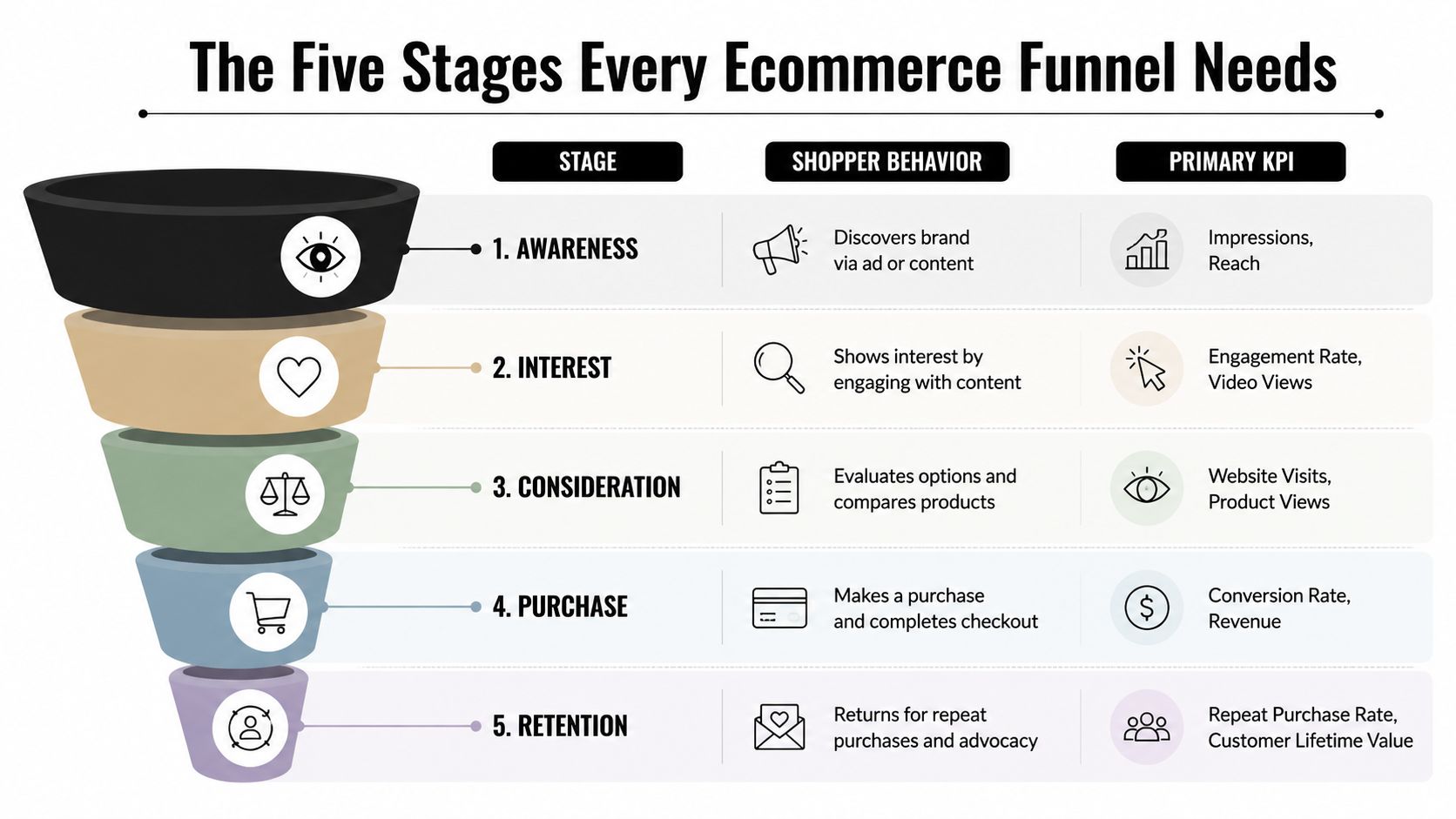
A practical ecommerce marketing funnel does not need a stack of fancy labels. Five stages are enough to run a small store with discipline, because each one maps to a shopper behavior you can see and a KPI you can track without guessing.
Awareness
A shopper notices the brand for the first time. On a small Shopify store, that might come from a TikTok ad, a Meta placement, or a search impression that leads to the first visit. The KPI here is impressions, reach, CTR, branded-search lift, and traffic quality, because early-stage demand is about whether the message earned the click, not whether the cart closed. Ecommerce funnel measurement guidance
Interest
Interest starts when someone pauses long enough to learn more. They may save the ad, browse the product page, or join the email list for a reason to come back. On a tiny store, that could be a first-time visitor reading the ingredients, watching the demo, or opening a welcome offer. The KPI here is the quality of engaged visits, because you are checking whether curiosity deepened.
Consideration
Buyers compare, question, and look for proof. A customer reading reviews, checking the FAQ, or revisiting the product page is no longer just browsing. The KPI is product-view depth and add-to-cart activity, because this stage shows whether the offer feels credible enough to move from interest to intent. If bounce is high here, how to reduce bounce rate is usually a better starting point than adding more spend.
Purchase
Purchase is the checkout stretch. On a Shopify store, this includes the cart, shipping step, payment step, and final click. The KPI is checkout completion, because even a strong product page still fails if the handoff breaks. That is the point where small leaks turn into lost orders, and the fix is usually clearer checkout copy, fewer surprises, or fewer steps rather than a bigger top-of-funnel push.
Retention
Retention is the post-purchase loop. The shopper already bought once, and now the store has to earn a second order, a review, a referral, or a subscription. The KPI is repeat purchase behavior, because that is what funds the next round of acquisition instead of forcing every dollar into cold traffic.
These stages are checkpoints, not deadlines. Shoppers move through them at different speeds, and the right budget decision depends on which step is leaking revenue.
Diagnose Where Your Funnel Is Actually Leaking
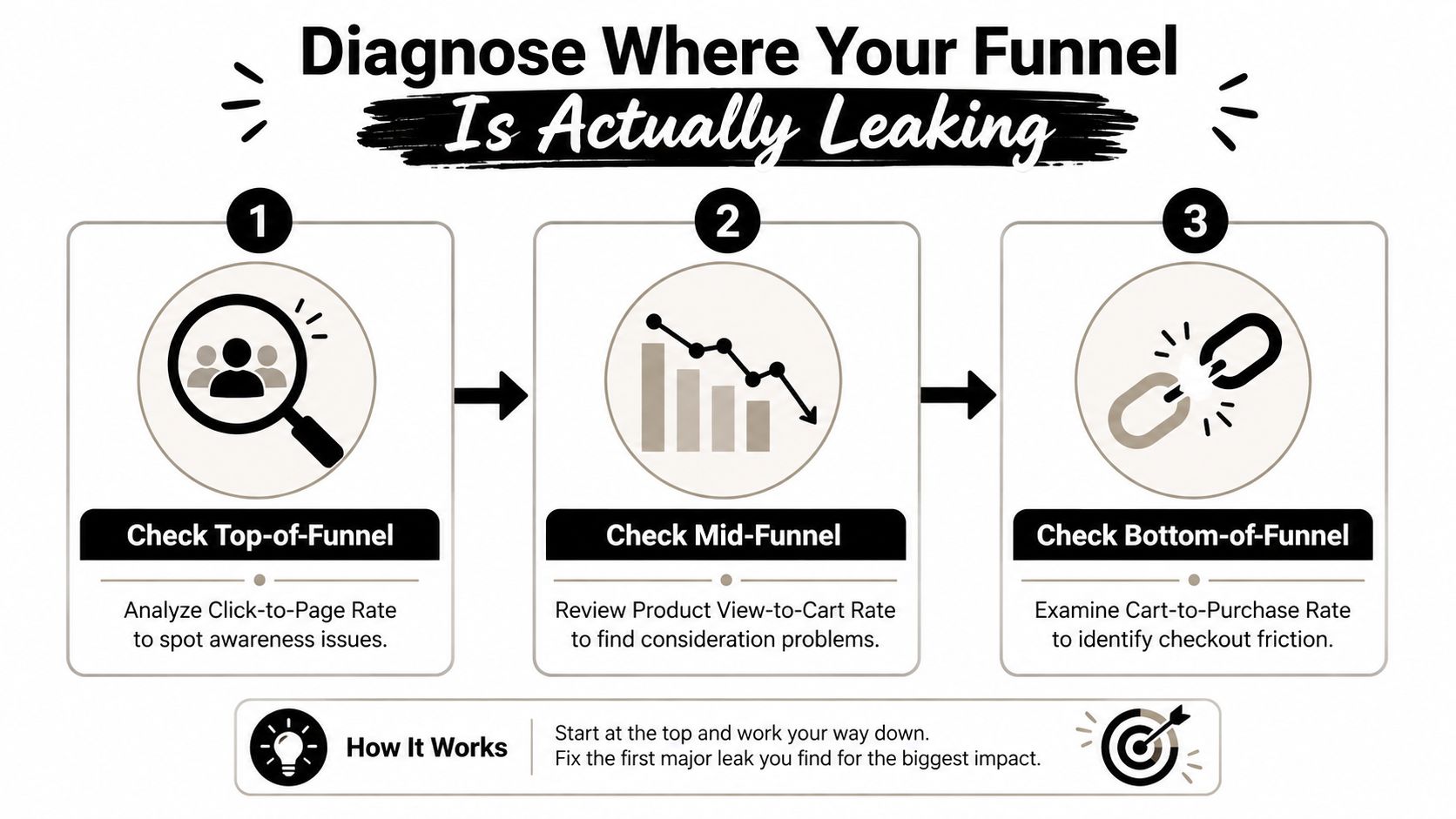
The fastest way to waste money is to treat every weak result like a traffic problem. A store can get decent ad clicks and still lose most of its revenue because the page does not answer the promise, the cart does not build enough confidence, or checkout creates friction at the last step.
Start by asking where the drop starts.
Check top of funnel first
If people click an ad and leave almost immediately, the problem is usually message mismatch, weak creative, or a landing page that fails to carry the same promise. Look at the event path first, then the drop-off between stages, then form a test around the biggest break, which is the practical way to read an ecommerce funnel. How to read an ecommerce funnel
If this stage is leaking, how to reduce bounce rate becomes the first fix, because the page has to hold attention before anything else can happen.
Check mid funnel next
If visitors land, browse, and still do not add to cart, the leak is usually on the product page. The offer may feel unclear, the images may leave objections unanswered, or the risk may still feel too high for a first purchase.
That is where clarity matters more than extra spend. Tighten the product story, show what the item solves, and remove anything that makes the buyer hesitate.
Check bottom of funnel last
If carts are active but purchases stall, the checkout is the leak. Missing payment options, surprise costs, and mobile friction are common culprits, and the brief's benchmark on Sales funnel statistics benchmark points to why this stage deserves close attention. Sales funnel statistics benchmark
A simple rule helps here.
If the traffic is real but the conversion rate is weak, do not buy more traffic. Fix the stage that is already leaking.
The point is diagnosis, not guessing. A weak click-to-page rate calls for awareness fixes. A weak add-to-cart rate calls for product-page fixes. A weak checkout completion rate calls for checkout fixes. Changing all three at once usually creates noise, not progress.
Segmenting Audiences by Funnel Position
Audience segmentation gets more useful when you stop sorting people by age bracket alone. Funnel position is usually more actionable, because a cold visitor needs a different message than someone who already viewed the product three times.
Cold, warm, and hot audiences
A cold audience hasn't interacted with the brand yet. They need a simple promise, a clear problem, and low-friction creative. A warm audience has engaged in some way, maybe a video view, profile visit, or site visit, and now needs more explanation and proof. A hot audience has shown purchase intent, which means cart activity, checkout starts, or repeated product-page visits.
For a first-time Shopify seller, a workable structure looks like this:
- Cold prospecting: people who have never visited the site. Use broad interest or lookalike-style targeting, but keep the creative focused on the problem the product solves.
- Warm retargeting: visitors who viewed the product or engaged with content. Use proof, reviews, UGC, or a clearer product demonstration.
- Hot retargeting: cart viewers and checkout abandoners. Use direct reminders, a tighter offer, or reassurance on shipping and returns.
The message should match the stage. Cold audiences usually need relevance first, not urgency. Warm audiences need confidence. Hot audiences need a reason to finish.
One simple Shopify example
A seller launching a posture corrector doesn't need ten personas on day one. One cold ad can speak to back discomfort during desk work, a warm ad can show how the product fits and feels, and a hot ad can answer the last objection with a clean checkout reminder. The same product, three different levels of intent.
Useful shortcut: don't build new audiences before you've built new messages. Most early campaigns fail because the same creative gets shown to people with different levels of awareness.
A tool like Social Loop AI can fit naturally for some founders, because it turns a product URL into ad angles, audience framing, landing-page notes, and a test plan. That matters most when the store owner doesn't have time to write the whole matrix from scratch.
Matching Creative Angles to Each Funnel Stage
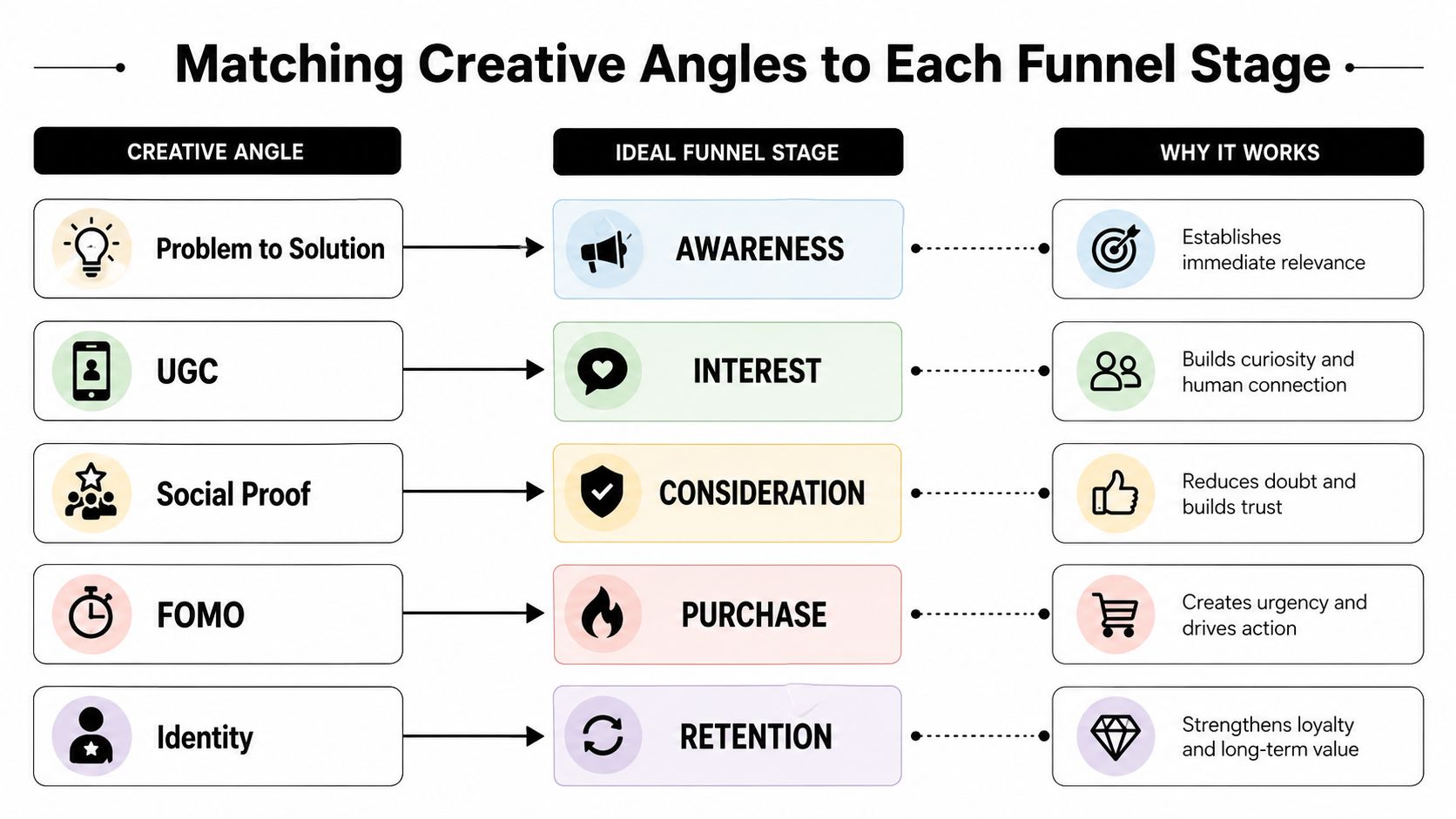
Creative works when the message fits the stage. A strong hook in the wrong place can still waste spend, because someone who is just discovering the brand does not need the same proof as someone who is seconds from buying.
Problem to solution and UGC
Problem to Solution belongs near the top of the funnel. It names the pain fast and shows why the product exists in the first place. A line like “Desk work shouldn't wreck your posture by noon” works because it makes the offer relevant before the shopper has time to tune it out. UGC fits the interest stage, where a real person using the product makes the brand feel closer to a recommendation than a polished ad.
Social proof and FOMO
Social Proof does the heavy lifting once shoppers are comparing options. Reviews, testimonials, and customer footage reduce doubt, so they make more sense when the buyer already understands the category and is deciding which product to trust. FOMO belongs nearest to purchase, where urgency can help move someone who already wants the product but has not finished checkout. The trust-building guidance in Ecommerce funnel and trust-building guidance points in the same direction, shoppers usually need more than one signal before they feel safe enough to buy, which is why proof-heavy creative tends to work better in the middle and lower funnel.
Identity for retention
Identity works best after the first sale. The creative should do more than say “buy again.” It should reinforce who the customer is becoming, a runner, a minimalist, a better sleeper, a cleaner kitchen owner. That tone brings retention-stage buyers back without making every message feel like another pitch.
The job is not to pick one angle and stick with it. The job is to give each angle a clear role.
| Angle | Best fit | Why it works |
|---|---|---|
| Problem to Solution | Awareness | Establishes relevance quickly |
| UGC | Interest | Makes the brand feel familiar |
| Social Proof | Consideration | Reduces risk |
| FOMO | Purchase | Pushes action |
| Identity | Retention | Reinforces repeat behavior |
A Round-by-Round Test Plan on a Real Budget
A tight budget needs structure more than optimism. With a sample $45 daily budget, the goal isn't to test everything at once. It's to learn which message, audience, or offer deserves the next round of spend.
Round 1, discover what gets attention
Use the first round to test audience and angle pairs. Keep the budget small and the creative batch simple, then protect click quality and landing-page behavior before you care about purchases. The internal round-robin testing guide at round-robin testing is relevant here because early-stage learning depends on controlled rotation, not random duplication.
Round 2, refine the winners
Take the strongest angle and tighten the creative. If the problem-solution ad earned the best clicks, keep the core message and improve the visual or the proof layer. Don't switch the whole strategy just because one ad underperformed, because the data is usually telling you which variable to improve, not which business to abandon.
Round 3, decide whether to scale or pause
At this point, only spend more if the stage you care about is holding up. If the audience is clicking but not adding to cart, don't scale the ad. If the cart is working but checkout is weak, don't add more spend until the path is cleaner. The kill criterion is simple, weaker stage performance means stop the round and fix the leak before adding budget.
| Round | Daily Budget | Primary Goal | Metric to Protect | Kill Criterion |
|---|---|---|---|---|
| Round 1 | $45 | Find a viable angle and audience | Click quality | Poor post-click engagement |
| Round 2 | $45 | Tighten the best concept | Add-to-cart behavior | No improvement after refinement |
| Round 3 | $45 | Scale or pause with discipline | Checkout completion | Weak bottom-funnel conversion |
A small budget can still produce clean decisions if the test is structured. The mistake is treating every underperformer as a final verdict when it may only be a weak creative, a weak page, or a weak offer.
Email and Retention Loops That Fund the Next Round
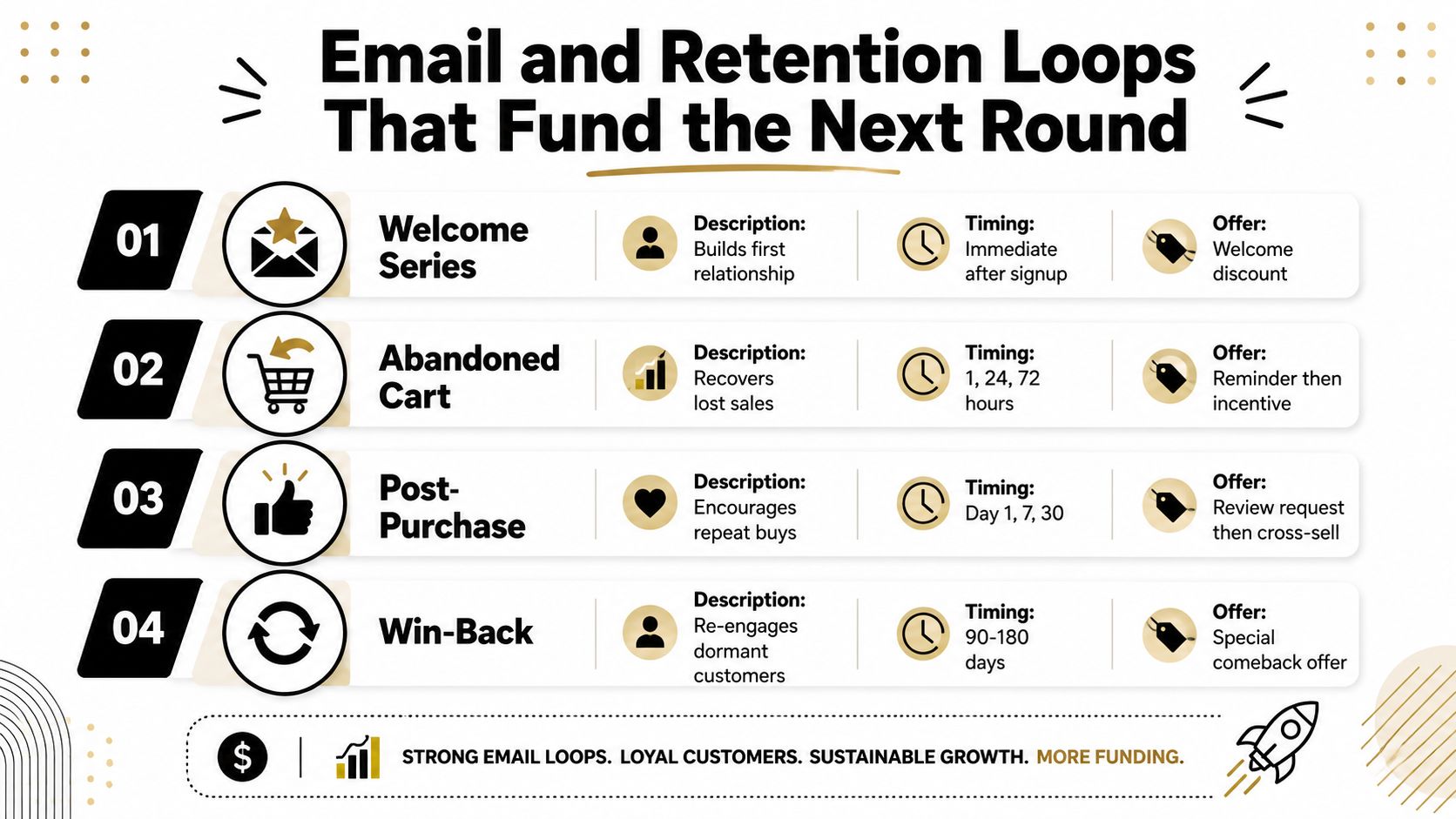
The funnel does not stop at purchase. For a small Shopify store, the first order only matters if it creates enough repeat revenue to pay for the next round of acquisition.
The four flows that matter
The welcome series should start right after signup and remove early friction by setting expectations clearly. Abandoned cart recovers intent that would otherwise disappear before checkout, and it usually does more revenue work than a founder expects until the numbers are watched closely. Post-purchase confirms the buyer made the right call, asks for feedback, and sets up the next order. Win-back brings dormant customers back into play so you are not forced to keep paying for the same audience over and over.
A guided automation setup like the one described in our ecommerce marketing automation guide can help you build these flows without piling on manual work. That matters when you are running the store yourself and every extra hour spent rebuilding flows is an hour not spent on offers, creative, or the product page.
The timing in the infographic is practical. Welcome begins immediately. Abandoned cart often works as a sequence over 1, 24, and 72 hours. Post-purchase can stretch across Day 1, 7, and 30. Win-back belongs farther out, once a buyer has gone quiet.
Why retention changes acquisition math
Retention changes the numbers in a way that shows up fast. Better repeat purchase behavior lifts customer lifetime value, which gives you more room to test cold traffic without running the account too hot. Analysts at the brief's cited source note the imbalance clearly, because businesses spend about $92 on acquisition for every $1 spent on converting that traffic, while structured CRO programs show an average ROI of 223%. Funnel optimization statistics
That is why email and SMS matter for lean operators. They are the budget cushion. A stronger abandoned-cart flow, a cleaner post-purchase sequence, and a sensible win-back offer can create enough repeat value to support the next ad test without pretending every first click should pay for itself right away.
Retention rule: if you cannot recover buyers, every new campaign has to work harder than the last one.
Pre-launch checklist and 30-day cadence
- Product page: confirm the offer, images, FAQ, and CTA answer the main objection.
- Tracking: make sure the key events are visible so you can identify where the drop happens.
- Creative batch: prepare multiple angles so you can test message fit instead of betting on one ad.
- Audience build: separate cold, warm, and hot groups so the message matches the intent level.
- Budget pacing: set the first round so you can learn without burning through the whole month.
Day 1 is for launch and event validation. Day 7 is for finding the weakest stage. Day 14 is for refining the best angle and cutting obvious losers. Day 30 is for deciding whether the funnel has earned a scale-up, or whether the next dollar should fix the leak first.
If you want a faster way to turn a product page into a launch plan, Social Loop AI maps the page, suggests ad angles, and turns a daily budget into a round-by-round testing sequence for early-stage ecommerce teams. Visit Social Loop AI and use it to build your next Meta launch around the stage that is leaking revenue.