Blog
AI for Social Media Marketing: A Beginner's Playbook
Published August 9, 2026
You've got a product, a Shopify store, and maybe a small daily budget, but no strategist, no designer, and no copywriter. The tabs are open, Meta Ads Manager is staring back, and every “easy” AI tip online seems to assume you already know what good looks like. That's the primary reason ai for social media marketing matters for first-time founders, it can turn a messy launch into a guided workflow instead of another tool you have to babysit.
The shift is bigger than “AI writes captions.” In practice, the useful version of AI compresses the agency trio into one repeatable system. It helps you choose an angle, build a buyer profile, generate brand-aware creatives, and test them with enough discipline to learn something useful, which is what new ecommerce stores need.
Table of Contents
- Why AI Changes the Game for First-Time Advertisers
- Define Your Goals and Build a Precise Buyer Profile
- Pick Proven Angles and Generate Brand-Aware Creatives
- Design Budget-Aware Tests That Teach You Something
- Protect Your Brand Voice and Audience Trust at Scale
- Measure Results and Build a Repeatable Optimization Loop
Why AI Changes the Game for First-Time Advertisers
The first time a store owner opens Ads Manager, it usually feels like walking into a warehouse with no labels. There are audiences, placements, creatives, objectives, and a long list of settings that all seem important, while the product page still needs work and the first ad has not even been written. AI earns its keep by acting like a launch co-pilot that keeps the work moving, instead of just pushing out more content.
From blank page to launch path
For first-time dropshippers, the launch problem is usually not a shortage of ideas. It is a shortage of sequence. One tab says write the copy, another says make the design, another says pick an angle, and the whole project gets delayed until the store looks “ready.”
AI fixes that by connecting the steps. Instead of hiring a strategist to define the angle, a designer to create the ad, and a copywriter to write the hooks, you can run one guided workflow that handles all three in order. That matters because social media production is already mainstream inside marketing teams, with 89.7% of social media marketers using AI daily or several times a week, and 78.4% still editing AI output before publishing, which shows the actual pattern is assisted execution, according to Sociality.io's 2026 report.
Practical rule: AI should reduce friction between launch decisions and execution, while judgment stays with the founder.
Why the workflow matters more than the tool
A solo founder does not need ten disconnected apps that each solve one small piece of the puzzle. A stronger setup is a single workflow that starts with the product page, pulls out the likely buyer, drafts creative directions, and turns a small budget into a structured test. That is the difference between “AI makes posts” and “AI runs the launch loop.”
The category has also matured quickly. The AI-in-social-media market is projected across multiple industry estimates to keep scaling from multi-billion-dollar levels, including Grand View Research's 2024 estimate and 2033 projection and the broader projections cited in the same roundup. For a beginner, that does not mean enterprise software. It means the core tasks of strategy, copy, and creative production are no longer limited to teams with agency budgets.
A tool like Social Loop AI fits that logic because it is built around the full path from product URL to launch plan, rather than a single caption generator. That is the shift beginners should care about. You are not looking for more content, you are looking for a way to make the first test coherent enough to teach you something.
Define Your Goals and Build a Precise Buyer Profile
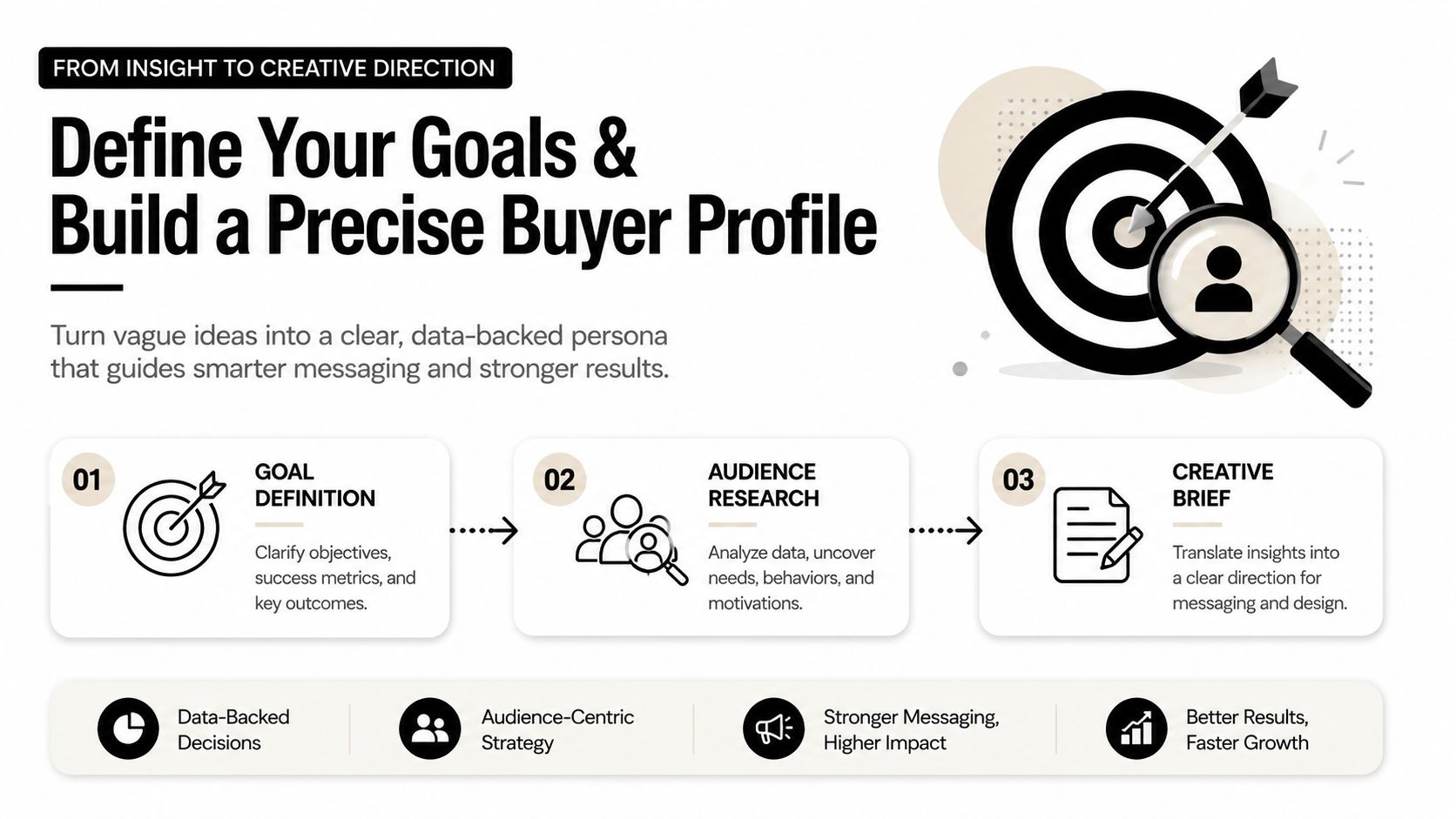
A first-time store can run clean creative and still waste budget if the goal is fuzzy. If the team only says “get sales,” AI has no real target, and the result is usually polished copy aimed at a vague audience. A stronger launch starts with two things, a clear business outcome and a buyer profile specific enough to shape the creative, the offer, and the page.
Start with the outcome you want
A first-time ecommerce founder often says they want “sales,” but that is too broad to guide a test. The better version names the action that matters most right now, such as purchases, add-to-carts, or landing page views. That choice gives the ad copy, creative angle, and call to action a single job instead of three competing ones.
Social Loop AI's guided 7-step wizard pulls that direction from a product URL. It audits the page, extracts audience signals, and builds a buyer profile you can use instead of a loose guess. For a posture corrector, the audience is rarely just “people with back pain.” It can surface different segments with different objections, such as office workers worried about comfort, gym-goers focused on support, and buyers who want something discreet enough to wear at work.
Turn product data into audience logic
Each segment responds to a different promise. One buyer wants relief. Another wants posture awareness. A third wants something lightweight enough to wear all day without feeling obvious. If you write one generic ad for all three, the test loses clarity before it starts.
A useful buyer profile should include:
- Who they are: age range, lifestyle, and the context in which they'd use the product.
- What hurts: the pain point or frustration that makes the product relevant.
- Why now: the trigger that pushes them from “maybe later” to “I need this.”
- What they fear: the objection that stops the click, like comfort, quality, or credibility.
That work belongs at the start, not after the first ad underperforms. Social Loop AI also scores landing-page readiness and writes copy fixes before spend goes live, which matters because weak alignment between ad promise and page content kills momentum fast.
Use the persona as your creative anchor
Once the buyer profile exists, the next decisions get easier. The angle list is clearer. The copy sounds less generic. The test plan is easier to read because you know who each variation is trying to reach.
If the persona is fuzzy, every creative looks like a guess. If the persona is sharp, even a simple ad can feel relevant.
A beginner does not need a dozen personas. One precise profile per product, built from the product URL and the objections around it, is enough to keep the launch grounded. That is the part most AI tutorials skip, and it is the part that keeps you from running random content at random people.
Pick Proven Angles and Generate Brand-Aware Creatives
AI content tools usually fall short where ad spend starts. They can spit out endless captions, yet the result often sounds generic, which does little for a first store trying to win trust fast. The stronger workflow starts with proven ad angles, then uses AI to generate creative variations that stay tied to one product, one audience, and one objection. That matters for solo founders and first-time dropshippers because it replaces the strategist, designer, and copywriter with one guided process instead of a pile of disconnected assets.
Use angles before style
Five angles show up again and again in ecommerce ads because they map cleanly to buyer psychology, Problem→Solution, UGC, Social Proof, FOMO, and Identity. A posture corrector might use Problem→Solution for office pain, UGC for a casual wearable-demo feel, and Identity for buyers who see themselves as active or health-conscious. A novelty gadget might lean harder on FOMO or Social Proof if the product is visually immediate.
Choose the angles that match the buyer profile you already defined, rather than using all five at once. If your audience is skeptical, proof-based angles usually do more work than cute copy. If the product is easy to understand, a direct problem-solution frame can be enough.
Social Loop AI turns that logic into a batch of 10 image ads, each with copy, hooks, CTAs, layouts, and color palettes trained on insights from 19,000+ winning Meta ads. That matters because the creative stays attached to the angle and objection it is meant to test, instead of drifting into random variations that look polished but say nothing new.
Generate batches, not one-off posts
A lot of beginners stop after the first “good” ad. That leaves too little to learn from. A stronger approach is to build a small set of distinct directions that show which message resonates. One product can produce five creative lanes, each with two variations, and that gives you a real read on whether the issue is the hook, the visual, or the audience fit.
Landing-page readiness matters at the same time. If the page is weak, the problem may not be the ad at all. Social Loop AI scores that readiness on a 0–100 scale and writes pasteable fixes, which helps you clean up friction before you send traffic into a page that leaks intent.
The UGC angle deserves special attention because a lot of founders misunderstand it. UGC works when it feels like believable usage, not when it looks like a template pretending to be a testimonial. For a practical look at that format, this UGC ads guide is a useful companion.
Keep the creative brand-aware
Brand-aware does not mean fancy. It means the ad looks like it belongs to the store, not like it was pulled from a random prompt bank. A founder can get decent output from AI, but if the layouts, palettes, and wording do not match the product and the store promise, the result feels off.
Good creative is specific enough to be remembered and simple enough to scale.
For first-time advertisers, the best use of AI is to generate a batch you can choose from. That is how you replace the strategist, the designer, and the copywriter with one guided process, while still keeping human control over what goes live.
Design Budget-Aware Tests That Teach You Something
Generating creatives is the easy part. Learning from them is where most small-budget campaigns fall apart. If you do not set up the test properly, you end up with impressions, clicks, and opinions, but no clear answer about what to do next.
Build the test around a hypothesis
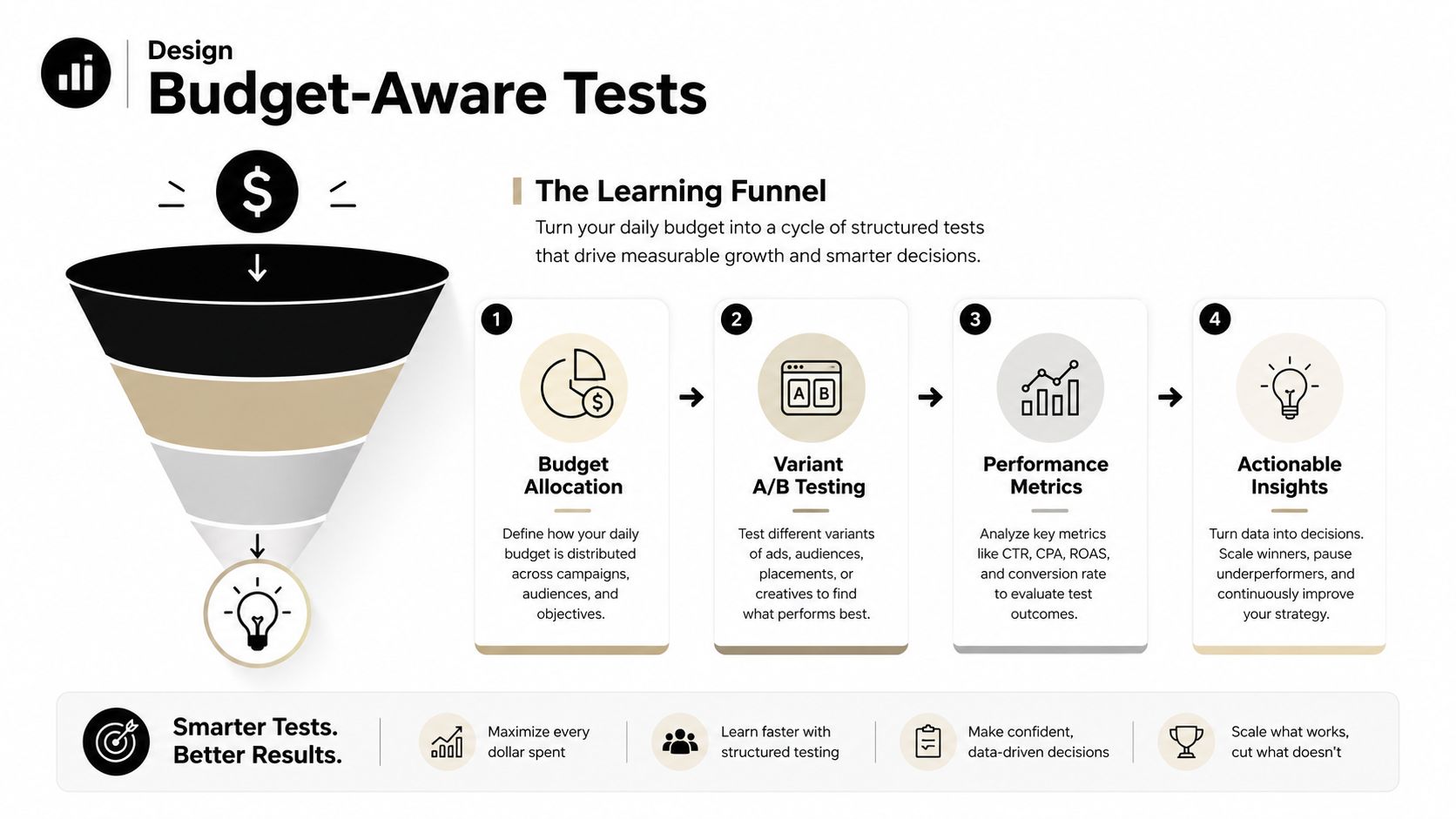
A good test starts with a statement, not a guess. “The pain-point angle will outperform the lifestyle angle for cold traffic” is a hypothesis. “Let's try a few ads and see” is not. When you begin with a hypothesis, you know what each result means, which keeps you from treating noise like a signal.
The testing discipline that works best is simple. Set the hypothesis before launch, test multiple variables with intention, and match your attribution window to the purchase cycle. The industry guidance in this paid social testing methodology recommends 7-day windows for impulse buys and 28-day windows for longer-consideration products. It also recommends scaling budgets gradually by 15–20% at a time so performance does not reset.
For a first-time dropshipper, that means you do not throw the whole budget at one creative. You structure the spend so each round has a job. One round reveals whether the angle resonates. Another shows whether the audience is compatible. Another tests whether a new creative variation improves the result.
Use budget as a learning sequence
A small daily budget still works if the sequence is disciplined. The mistake is thinking a tiny budget means you cannot test properly. It means you need fewer variables and cleaner decisions. If you have a product with low familiarity, use the first round to identify the message that creates interest. Then use the next round to narrow the audience or refine the creative.
Social Loop AI's workflow turns a daily budget into a structured plan with ad sets, audiences, and creative rotations. That matters because beginners usually waste time changing too many things at once. If the creative changes, the audience changes, and the objective changes all together, you cannot tell what caused the lift or the drop.
A practical way to think about the rounds:
- Round one, message discovery. Test the strongest angles against each other.
- Round two, audience fit. Keep the winner and compare audience segments.
- Round three, creative refinement. Improve the best hook, visual, or CTA.
The point of each round is narrowing the field, not winning immediately. That is how a budget learns instead of just disappearing.
Match the test to the product cycle
Impulse products can move faster, which is why shorter attribution windows make more sense there. Higher-consideration products need more room before you judge the result. Beginners often cut a good ad too early because they are looking too soon or scaling too hard.
The fastest way to waste a budget is to treat every product like it buys itself on the first click.
For a fuller breakdown of how to set up tests before launch, this Facebook ads testing strategy guide pairs well with a launch plan. The lesson is simple. Budget-aware testing does not mean spending less, it means spending in a way that creates usable next steps.
Protect Your Brand Voice and Audience Trust at Scale
A store can move faster with AI and still lose the room if every post starts sounding generic. That risk shows up quickly for first-time founders. The copy may be polished, but if it does not sound like your brand, does not feel credible, or clashes with the store's visual style, it starts to weaken trust instead of building it.
Draft with AI, decide with humans
The best workflow is still draft, review, then publish. AI can produce caption variants, sketch out hooks, and speed up ideation, but a person needs to check the tone, the claim, and the context before anything goes live. That matters even more for content that is supposed to feel direct and human.
The trust issue is not abstract. Buffer's analysis of 1.2 million posts found AI-assisted posts had a 5.87% median engagement rate versus 4.82% for human-only posts, a 22% lift, but it also found that AI images underperform human images by around 60%, and engagement drops sharply once audiences know content is AI, according to Buffer's performance analysis. Keep AI in the draft-and-optimization layer while humans own voice and visual direction.
Audit the output before it publishes
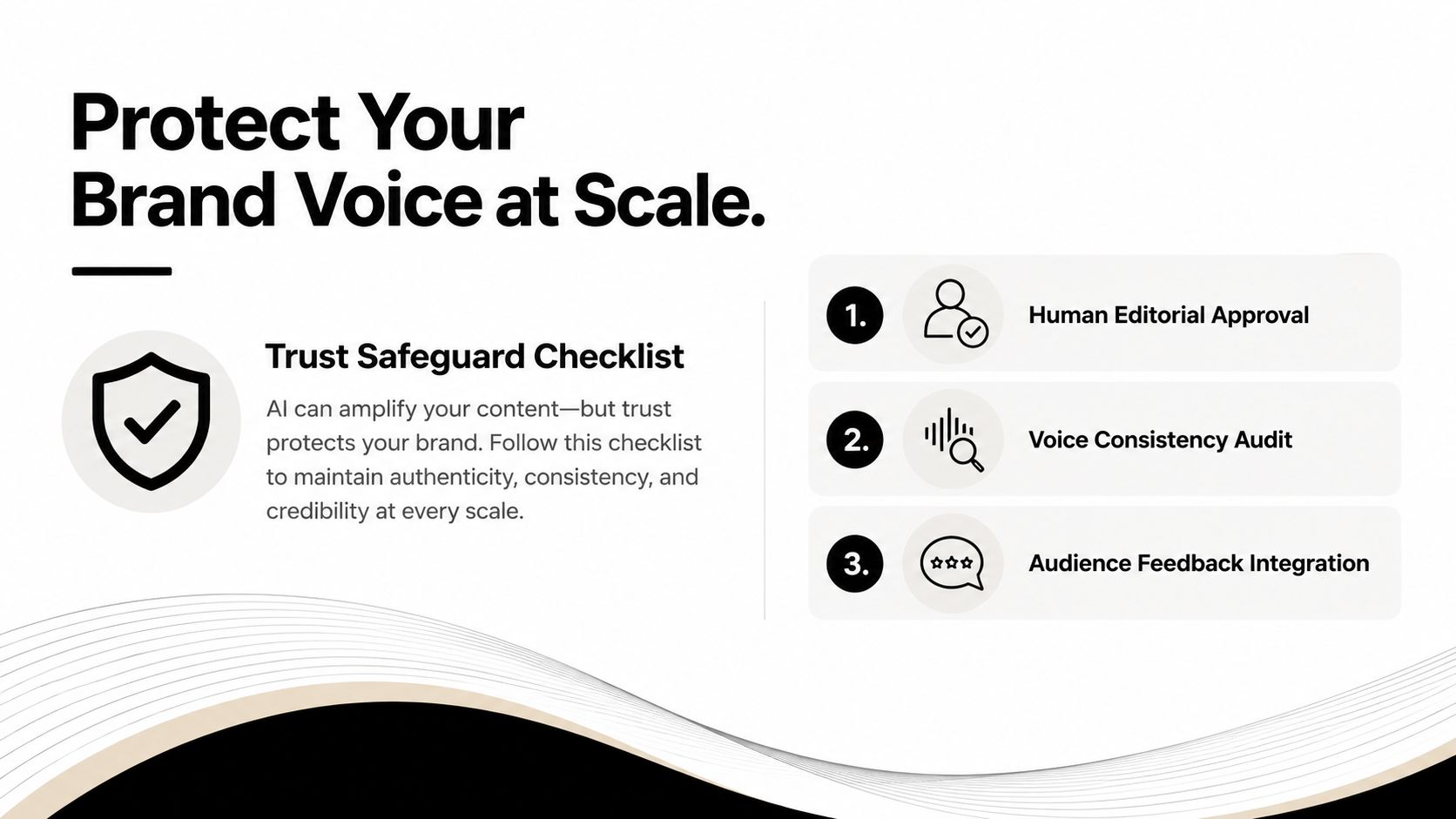
A simple review process prevents generic output from going live:
- Human Editorial Approval. Does someone who knows the brand sign off on the final version?
- Voice Consistency Audit. Does this sound like your store, or like a prompt that could belong to anyone?
- Audience Feedback Integration. Are you using comments, DMs, and post reactions to improve the next draft?
For a deeper look at establishing tone standards, see our guide to brand voice development.
That checklist sounds basic because it is basic. Basic is what keeps beginners from posting content that feels fake. If you are selling something new, trust is fragile. One sloppy claim or off-brand visual can make the whole account feel less credible.
Personalization needs restraint
AI personalization can improve targeting and engagement, but the promise gets fragile when data quality is poor or the automation gets too aggressive. A 2025 systematic review noted that AI can improve targeting and engagement through personalization, while also leaving unresolved issues around ethics, transparency, and data quality, which is why this guidance on AI agents for social media is worth reading before you automate too much. Use AI to tailor the message, while keeping the human judgment that makes the brand recognizable.
If you need a working standard, treat AI like a fast junior drafter and the team like the editor-in-chief. That keeps content moving without turning every post into something generic.
Measure Results and Build a Repeatable Optimization Loop
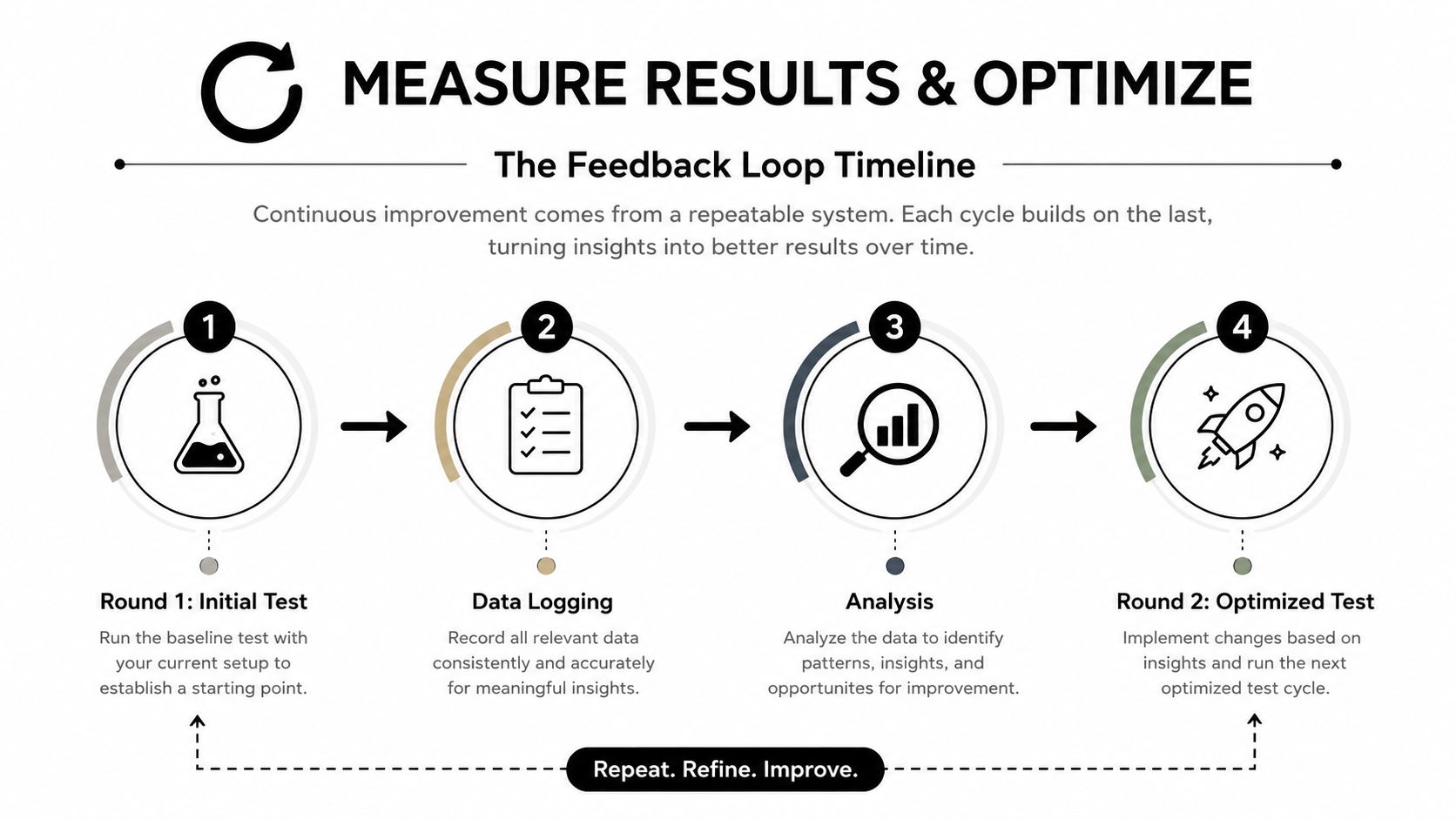
The value of AI shows up after the first launch round. Log what happened, feed it into the next creative batch, and each cycle gets sharper. Skip that step, and you keep repeating the same mistakes with cleaner graphics.
Track the metrics that change decisions
For beginner ecommerce stores, the numbers that matter are the ones that show whether people moved closer to buying. That usually means cost per purchase, return on ad spend, click-through rate, and landing page conversion rate. Anything else stays secondary unless it helps explain those numbers.
The social side of AI is moving the same way. The 2026 Sociality.io report shows that marketers are already using AI for analytics, reporting, chatbots, and conversational tools, which means the workflow is no longer just about producing content. It is about reading signals and acting on them faster, according to the 2026 Sociality.io report. That matters because the founder's job is not to stare at dashboards. It is to decide what to scale, what to pause, and what to retest.
Turn results into the next creative decision
Once a round ends, write the result in plain language. Which angle got the strongest response? Which audience showed intent? Which creative visual dragged the click-through rate down? The useful part is the decision that follows the raw number.
Social Loop AI's post-launch workflow is built for that handoff. You log the result, and the system points you toward what to scale, what to pause, and what to retest. That is the missing piece in most beginner setups, because the launch itself is easier than the discipline of turning data into the next batch of ads.
A simple 30-day rhythm works well for first-time advertisers:
- Week 1: Launch the first test and record baseline performance.
- Week 2: Remove the weakest creative and keep the strongest angle.
- Week 3: Retest the best audience with a tighter variation.
- Week 4: Expand only what has earned a second look.
That kind of loop builds memory. Over time, you stop asking, “What should I post?” and start asking, “Which angle, objection, and page experience is blocking the purchase?”
Use AI for the full funnel, not just more impressions
The better question is, “What is stopping the click or the buy?” AI can help you diagnose weak angles, muddled objections, and landing-page friction, which is where beginners usually lose the sale. Content-first guides usually stop before that point, even though it is the part that affects revenue.
A good optimization loop makes each new round cheaper to understand, even if it is not cheaper to run.
That is why the launch-to-scale loop matters so much for solo founders. It gives you a repeatable system instead of a pile of disconnected posts. Once that system is in place, the work gets calmer, because every new test has a job.
If you are trying to launch your first product without hiring an agency, Social Loop AI can turn your product URL into a buyer profile, brand-aware creatives, and a budget-aware test plan in one workflow. It also helps you log results so the next round is smarter than the last. Visit Social Loop AI and see how the launch loop fits your store before you spend another dollar on guesswork.