Blog
Lookalike Audiences for Ecommerce: Build Them Right
Published August 14, 2026
Most lookalike audience advice starts in the wrong place. It tells new store owners to pick 1%, upload a seed, and let Meta do the rest, as if audience percentage matters more than the customer data underneath it. That's backwards, because a lookalike is a statistical expansion of a seed, not a magic audience type, and if the seed is thin, noisy, or polluted with low-quality orders, the model just scales that mess. Meta's lookalike system has long been built around 1% to 10% similarity bands, where the tighter band is the closest match and broader bands trade similarity for reach, but the band only works as well as the source data you feed it as described in Meta-style lookalike guidance.
For ecommerce, the key question isn't “Should I use lookalikes?” It's “Have I earned the right to use one yet?” On newer accounts, the better mental model is customer data hygiene first, audience expansion second. That means the first job is not to flip a targeting toggle, it's to build a clean buyer signal that Meta can learn from.

Table of Contents
- Why Most Lookalike Audiences Underperform for New Stores
- Choosing the Right Seed Source for Your Store Stage
- Preparing Clean Seed Data That Actually Performs
- Sizing, Country Selection and the 1% Trap
- Launching a Round-by-Round Test Plan on a Small Budget
- Tracking Performance and Troubleshooting Common Issues
- Your 30-Day Lookalike Launch Checklist
Why Most Lookalike Audiences Underperform for New Stores
New stores usually fail with lookalikes for one simple reason, the seed isn't strong enough yet. Meta's model isn't reading your intent, it's reading your past customers and events, then finding people who statistically resemble them. If the source is too small, too recent in the wrong way, or stuffed with refunded or low-intent conversions, the algorithm learns the wrong lesson and faithfully repeats it at scale as outlined in lookalike audience guidance.
The platform can only amplify what you give it
A lot of first-time advertisers treat lookalikes like an entry-level hack for bypassing manual interest research. That's the exact mindset that leads to weak CPA. The model expands from a seed audience built from signals like purchase behavior, engagement, demographics, and online activity, so the output depends on the quality of those signals, not on wishful thinking about the audience name.
Practical rule: if the seed is full of bad buyers, bad leads, or one-off discount hunters, a lookalike will often scale that same pattern, just with better packaging.
This is why lookalikes can feel worse than interest targeting on a fresh account. Interest targeting sometimes appears to “work” because it's broad enough to stumble onto demand, while the lookalike is constrained by the exact behavior you fed it. That's not a flaw in the model, it's a reminder that the model is only as useful as your data layer.
The seed-size guidance reflects that reality. Common recommendations call for a minimum of 100 people in the same country, with 1,000 to 10,000 often described as a stronger operating range for similarity modeling per seed guidance. In practice, that means a new store shouldn't obsess over the percentage slider before the store has earned a decent source pool.
Why the default rookie setup breaks
The usual beginner setup is simple, and usually wrong. They build a lookalike from pixel purchases too early, mix in all customer types, and then judge the whole strategy on a few days of unstable spend. They end up blaming lookalikes when the issue is seed hygiene and account maturity.
If you want the learning phase to mean anything, the seed has to represent your best buyers, not just your latest buyers. That's the shift most guides skip. A lookalike audience is not a standalone targeting tactic, it's the downstream output of disciplined first-party data.
Choosing the Right Seed Source for Your Store Stage
The right seed source depends on what the store has collected so far, not on what sounds appealing in Ads Manager. A brand-new ecommerce brand doesn't need every seed type at once. It needs one source that can produce a stable signal, then it can graduate into a better source once the business has enough purchase history or engagement depth.
Start with the strongest real signal you have
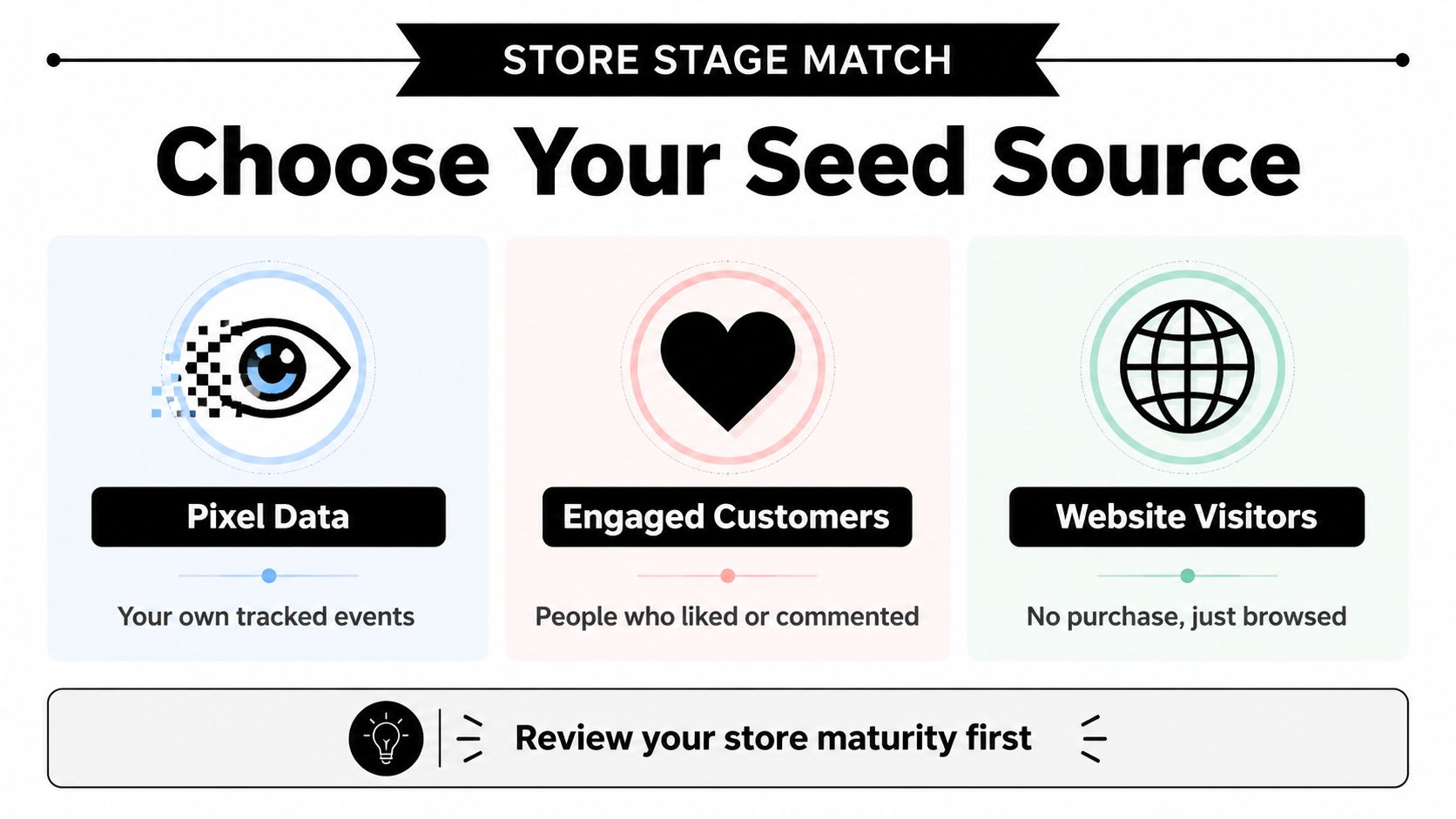
If purchases exist in enough volume, Pixel Purchases are the cleanest starting point because they represent completed buyer behavior rather than passive browsing. Meta-style guidance commonly treats a source list as viable once it reaches at least 500 people, while more thorough seed construction is often associated with 1,000 to 10,000 records per operational benchmarks. For a new store, that means purchases are usually the first serious seed if they exist in meaningful volume from one country.
If the purchase count is still thin, a Customer List is the next best option, but only if the list is clean and buyer-heavy. Uploading everyone who ever subscribed is not the same as uploading buyers. The second option becomes materially better when the list includes your best customers, not just site signups and discount hunters.
If you don't yet have enough buyers, an Engagement Audience can buy time. Video viewers, Instagram engagers, and site visitors can all produce a seed, but they're weaker because they include more curiosity than purchase intent. That's useful only when the content engine is active enough to create a steady behavioral trail.
The decision rule is straightforward. Use purchases first when they exist in sufficient volume, use a cleaned customer list when you can isolate strong buyers, and use engagement only when you're still building the purchase layer.
Match the seed to the store stage
A simple way to understand it is
- Very early store: use the cleanest purchase data you can access, even if the list is small, because it's still stronger than broad engagement noise.
- Early traction store: move to a customer list built from real buyers, especially if you can isolate higher-value customers.
- Content-led store: use engagement only when the content is already generating meaningful, consistent interaction.
The common mistake is stacking all three sources into one campaign and hoping the machine “figures it out.” That usually muddies the signal. Pick the best source you can defend, then improve it later.
Preparing Clean Seed Data That Actually Performs
Most lookalike problems start in the customer file, not in the ad account. If the source data includes refunds, cancelled orders, wholesale buyers, duplicate records, or low-intent conversions, the lookalike model gets trained on a distorted version of your business. Cleaning the seed is boring work, but it's the part that protects CPA later.
Build the seed around buyer quality, not raw volume
A clean list usually starts by removing refunded and cancelled orders. Those buyers didn't behave like profitable customers, so they shouldn't shape the audience model. Wholesale and B2B buyers also belong in a separate bucket, because their buying patterns are often nothing like DTC customers.
Duplicate emails need to go as well. A messy list makes the seed look bigger than it really is, and inflated volume doesn't improve similarity if it's just the same person repeated. Recency matters too, so a 90-day segment is often a better operating slice than a stale lifetime file when the store has enough recent orders to support it as recommended in seed-quality guidance.
Clean seed, better match. Dirty seed, cleaner illusion.
Use value-based structure when volume is thin
If the store only has a small pool of buyers, don't wait for a mythical giant list. Build from the top LTV segment you can isolate, and exclude the obvious low-quality converters. Value-based custom audiences are useful here because they tell the algorithm to optimize toward purchase value instead of simple conversion count in line with first-party lookalike guidance.
That matters more than people admit. A list of 200 buyers isn't automatically too small if those 200 are the right 200. A smaller, cleaner seed can outperform a bigger, noisier one because the model sees a more consistent pattern.
A practical cleanup routine looks like this:
- remove refunded and cancelled orders,
- separate wholesale or B2B buyers,
- delete duplicate contacts,
- isolate recent buyers where possible,
- build a high-LTV subset if the full list is still thin,
- keep the seed focused on actual customers, not every touched lead.
The goal isn't perfection. The goal is to give Meta a source audience that looks like the customers you want more of, not the customers you regret acquiring.
Sizing, Country Selection and the 1% Trap
The 1% to 10% slider is often misunderstood as a quality knob, when it's really a reach band inside a country's population as documented in lookalike audience sizing guidance. The tighter the band, the closer the statistical match. The broader the band, the more reach you get, but similarity loosens as you move outward.
Read the band in real audience terms
In the U.S., the 1% segment has been estimated at about 2.1 to 2.5 million people, while a 10% audience can reach roughly 23 to 28.8 million people per Meta-style audience sizing references. That spread explains why the same lookalike can feel very different depending on budget and product price point. A tight audience can work well for precise prospecting, but it can also choke delivery if the campaign needs more spend than the pool can absorb.
For a new ecommerce brand, the sizing choice should follow budget, not superstition. A smaller daily budget usually belongs in tighter bands, because the account doesn't need a giant pool to absorb spend. Broader bands matter more once the brand has enough budget to justify scale tests.
| Lookalike Size Bands for a New Ecommerce Brand | Reach (US example) | Best use case | Minimum daily budget |
|---|---|---|---|
| 1% | 2.1 to 2.5 million | Precision prospecting, strongest similarity | Lower budget, early testing |
| 3% | Broader than 1% | Balanced testing after a winner emerges | Moderate budget |
| 5% to 10% | 23 to 28.8 million at the top end | Scale testing, wider acquisition | Higher budget |
Country choice matters more than people think
Country mixing too early can dilute the seed signal, especially if buyer behavior varies by market. Keep the first tests tied to one country whenever possible. If the first country is already proving delivery and CPA stability, then expansion can come later.
Rule of thumb: don't widen geography just to make the audience look bigger on paper. Widen it only when the current country has already told you what the model can do.
The simplest sanity check is this, if the audience size looks huge but the store is still young, the issue isn't that you need more countries. It's that you need a cleaner seed and a tighter first test band.
Launching a Round-by-Round Test Plan on a Small Budget
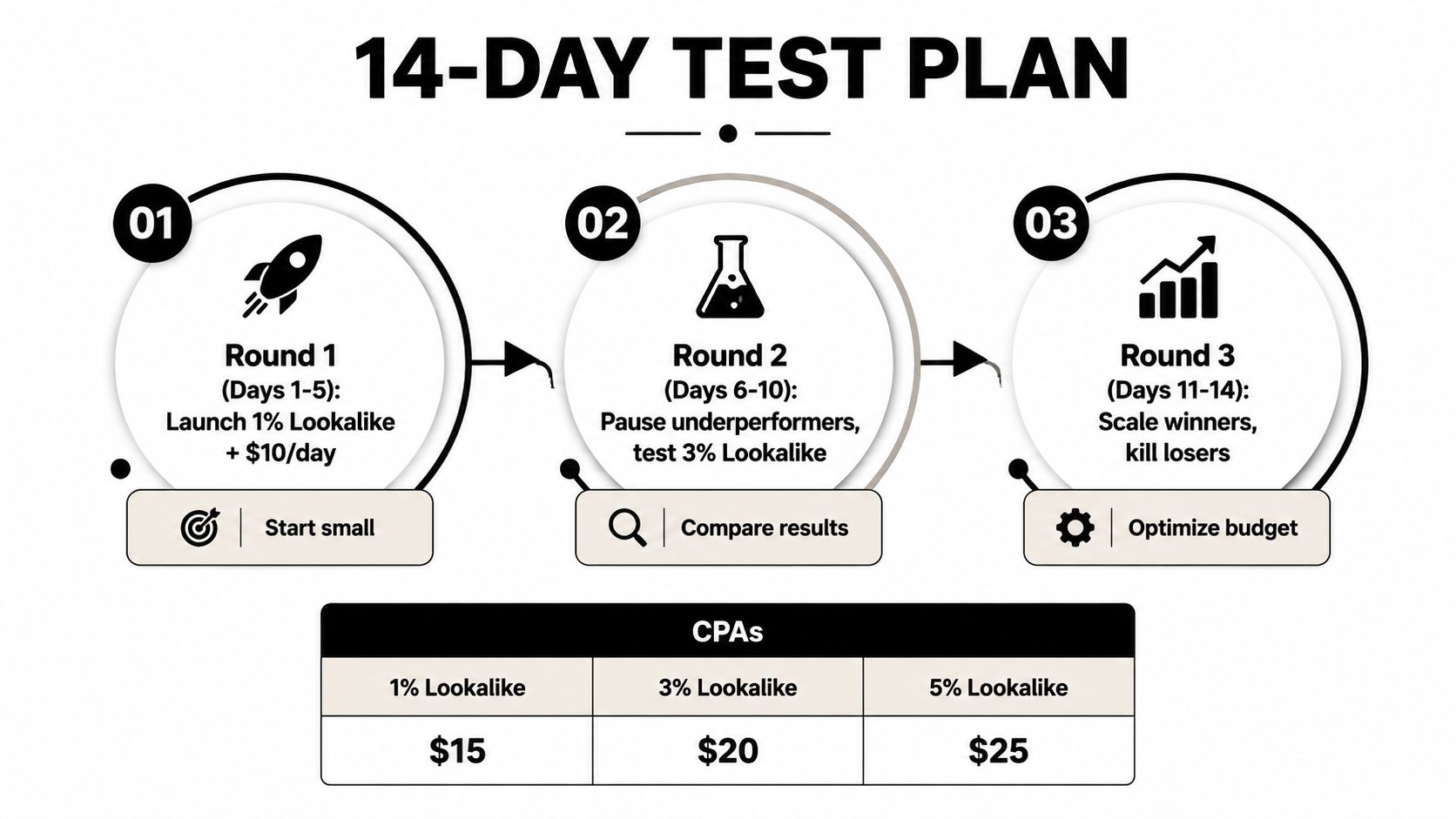
A lookalike test should behave like an experiment, not like a permanent campaign structure. The goal is to isolate what the model can do with a clean seed, then widen only after the account gives you a clear signal. A small-budget launch works best when each round has one job and one comparison point.
Round one should establish a baseline, not chase scale
Start with a 1% lookalike and a small set of creative variants. The point of the first round is to learn whether the seed can produce a CPA that's worth scaling, not to prove that the audience can carry the whole account. Recent industry reporting says well-optimized lookalikes built on top customer value can deliver 38% lower CPA than interest-based targeting, but that advantage only shows up when the seed is clean and the test is controlled as reported in industry guidance.
The best way to control the test is to keep the creative batch small and consistent. If the ad set changes every few days, you won't know whether the audience improved or the creative carried the result.
Round two should widen carefully
Once you have a baseline, widen into a second band and compare it against the first. Keep the seed the same. Keep the objective the same. Change only the audience band or the structure you're testing. That's how you learn whether the broader pool still holds efficiency.
The round-robin testing approach works well here because it prevents the account from overcommitting to the first audience that merely looks promising. The winning move is often not “more lookalike.” It's “better comparison.”
Round three should prune and promote
By the final round, cut the weaker spend and push budget toward the audience and creative pair that held the best cost quality. A campaign that spends evenly on every variant is not learning, it's drifting. The winner should earn the next dollar, and the loser should stop getting charity.
Tracking Performance and Troubleshooting Common Issues
The wrong metrics make lookalikes look random. CTR and CPM matter, but they don't tell you whether the audience is buying efficiently. What matters more is whether the audience produces acceptable CPA, whether it converts over 30 days, whether the first order has enough value to justify spend, and whether buyers come back with repeat purchase behavior. Those are the numbers that tell you if the seed and the audience band are healthy as emphasized in audience-quality guidance.
Read the campaign by failure mode
If delivery is weak, the audience may be too narrow. You'll usually see high CPMs and limited spend absorption. The fix is either to loosen the band or stop starving the campaign with an audience that's too tiny for the budget.
If CPM looks cheap but purchases don't follow, the audience is probably too broad for the seed quality or the creative is too generic. Cheap traffic is not the same as good traffic. A broad band can work, but only when the seed and offer are strong enough to support it.
If the ROAS looks unstable and refund behavior creeps in, the seed itself may be contaminated. That usually means the customer list was built from the wrong buyers, or it mixed profitable orders with low-value ones. Clean the source, then rebuild the model.
If thumbstop is fine but add-to-cart is weak, the creative and audience are mismatched. The ad is getting attention, but the promise doesn't line up with the buyer the seed is finding. That's a creative problem before it's an audience problem.
The best troubleshooting question is simple, did the audience fail, or did the seed teach the model the wrong customer?
Compare the metrics that actually matter
Use a short comparison checklist:
- CPA: tells you whether the model is buying efficiently.
- 30-day conversion rate: shows whether the traffic quality holds beyond the click.
- First-order value: helps you see whether the audience is buying enough to sustain acquisition.
- Repeat purchase rate: reveals whether the seed is attracting one-time bargain hunters or durable customers.
Google's Display & Video 360 now supports lookalike audiences with as few as 100 active users in combined seed lists, plus narrow, balanced, and broad reach settings per Google's DV360 support. That doesn't change how Meta works, but it does show where the market is heading. Audience expansion is becoming more automated across platforms, so advertisers who understand seed quality will adapt faster than those still treating lookalikes like a static toggle.
Channel attribution matters here too, because a lookalike can look weak in a dashboard that credits the wrong touchpoint. Don't judge the audience in isolation if your reporting system is already blurring source quality.
Your 30-Day Lookalike Launch Checklist
The first month should be about building a clean system, not squeezing every last impression out of a half-ready seed. Week 1 is data prep, Week 2 is the first build, and Weeks 3 to 4 are about controlled expansion. If you skip the prep, you're not launching faster, you're just making the diagnosis harder later.
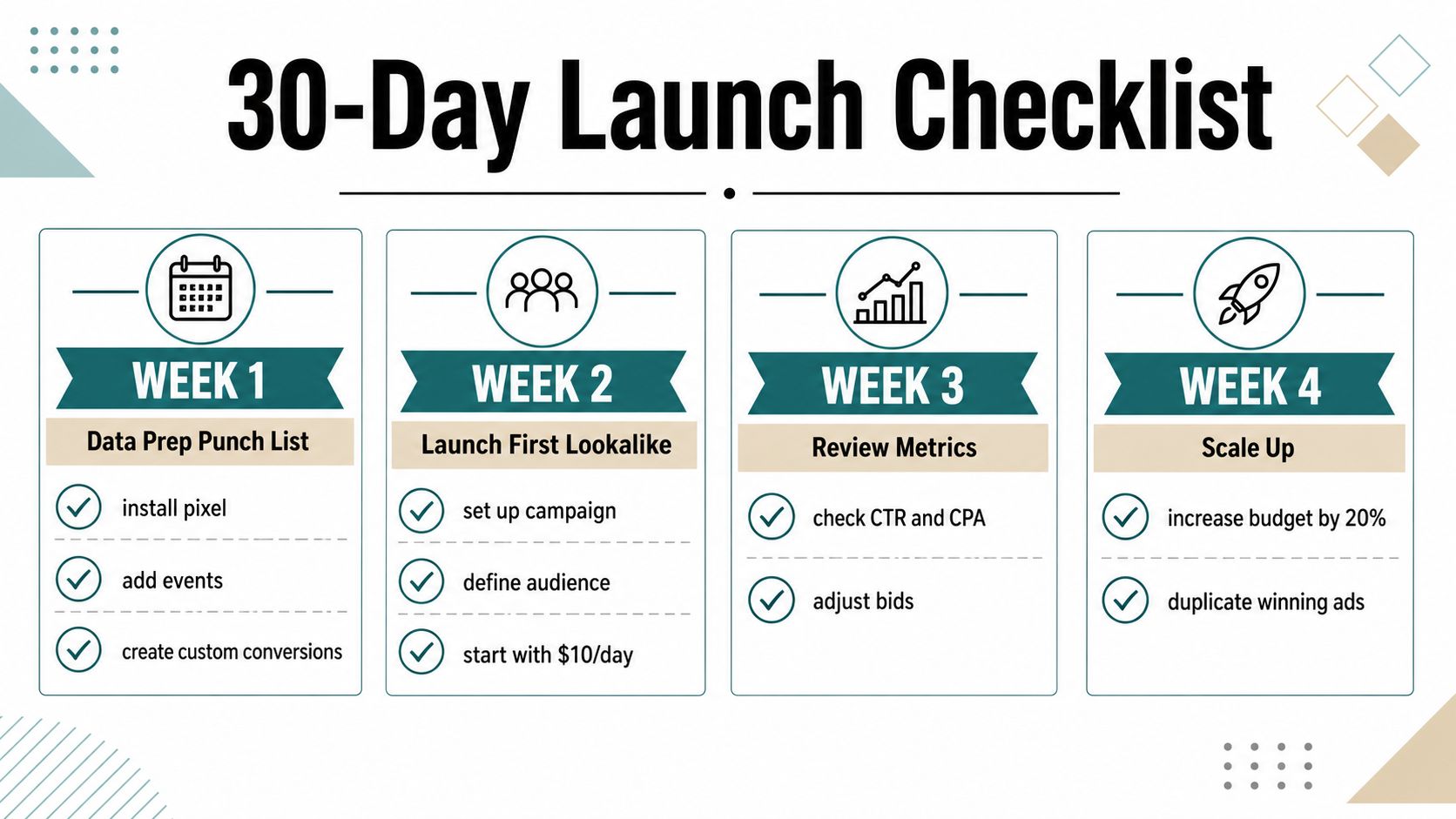
Week 1
- Pixel QA: confirm events are firing correctly.
- Refund filter: remove cancelled and refunded orders from your source list.
- Customer list rebuild: isolate buyer-heavy records and strip duplicates.
Week 2
- First lookalike build: launch one source, one country, 1% only.
- Audience check: make sure the seed is clean enough to represent real buyers.
- Exit criterion: proceed only if the source is stable enough to support testing.
Week 3
- Add a wider band: test a second similarity tier.
- Introduce value-based seed: shift toward high-LTV customers if volume allows.
- Creative review: keep winners, cut obvious mismatches.
Week 4
- Scale the winner: move budget toward the best-performing audience and creative pair.
- Duplicate the strongest ads: keep the message consistent while you widen cautiously.
- Exit criterion: keep only what can hold acceptable CPA against your baseline.
If you want a lookalike system that compounds, build it from disciplined buyer data and then let the model expand what's already working. Social Loop AI helps new ecommerce owners turn a product URL into a practical Meta ads launch plan, then pairs that with brand-aware creatives and round-by-round testing guidance, so you can stop guessing at audiences and start using the customer data you already have.