Blog
Female Voice Emulator: How to Pick and Use One for Ads
Published August 3, 2026
You're in the dashboard with a product ready to test, the visual is fine, and the ad draft still feels flat because the audio is missing. That's usually the moment people start treating a female voice emulator like a garnish instead of a performance lever. They pick a voice that sounds “nice,” ship it, and then wonder why the hook dies in the first few seconds.
The better move is harsher and more practical. In Meta ads, the voice isn't decoration, it sits beside the hook, the visual, and the first line as one of the few things that decides whether someone stops scrolling or keeps going. If the voice feels off, the ad reads like a template. If the voice fits the angle, the creative feels native fast.
Table of Contents
- What a Female Voice Emulator Actually Does in an Ad
- Choosing the Right Tool for Your Ad Stack
- Writing a Script and Prompt That the Emulator Will Actually Deliver
- Recording, Editing, and Cleaning the Output
- Legal and Ethical Guardrails You Cannot Skip
- Plugging the Voiceover Into a Meta Ads A/B Test
- A Weekly Voice Workflow You Can Paste Into Notion
What a Female Voice Emulator Actually Does in an Ad
You upload a product URL, the creative comes back without a voice, and now you're making a decision that affects whether the ad feels like a real person talking or another bland asset. That's the job of a female voice emulator in a Meta ads workflow. It gives your creative a spoken identity, which matters because the first job of the ad is not persuasion, it's getting attention long enough for persuasion to happen.
The best way to think about it is simple. A TTS preset gives you speed and consistency, a pitch-shifted recording keeps your own voice but changes its perceived gendered tone, and a true voice clone aims for a personalized voice that sounds like a specific speaker. Those are not cosmetic variations. They change how fast you can test, what rights you need to clear, and how much the voice feels like a brand asset instead of a generic layer.
Why the voice sits next to the hook
On Reels, people decide fast whether the ad feels worth their attention. In Feed, they scroll past anything that sounds too polished, too robotic, or too disconnected from the visual. A female voice that sounds natural can make a UGC-style read feel like a recommendation instead of a script, which is exactly what you want when the creative is trying to earn a click, not just an impression.
That's also why the voice belongs in the creative brief. Don't leave it to the last pass. If your angle is founder credibility, a plain, direct voice usually beats something overstyled. If your angle is social proof or problem-solution, the voice should sound conversational and immediate, not like an ad narrator trying too hard.
Practical rule: treat voice choice like hook choice. If you wouldn't approve the opening line, don't approve the voice either.
The technical lineage matters too, because this didn't start as a marketing toy. The arc runs from early speech machines in the 18th and 19th centuries to Bell Labs' VODER in 1937, then to later female synthesis milestones like Ann Syrdal's work at AT&T Bell Laboratories, which helped make female-sounding synthetic speech practical for assistants and consumer systems Smithsonian Magazine and the history of AI assistants and voice choices. That history matters because the modern ad use case is built on a mature technical stack, not a novelty filter.
Choosing the Right Tool for Your Ad Stack
The right tool depends on what you're trying to learn, not what sounds coolest on a product page. If you're testing five angles a week, you need speed and volume. If you're locking a winning creative into a founder-led brand, you can afford to slow down and polish the voice more aggressively.
The three paths that actually make sense
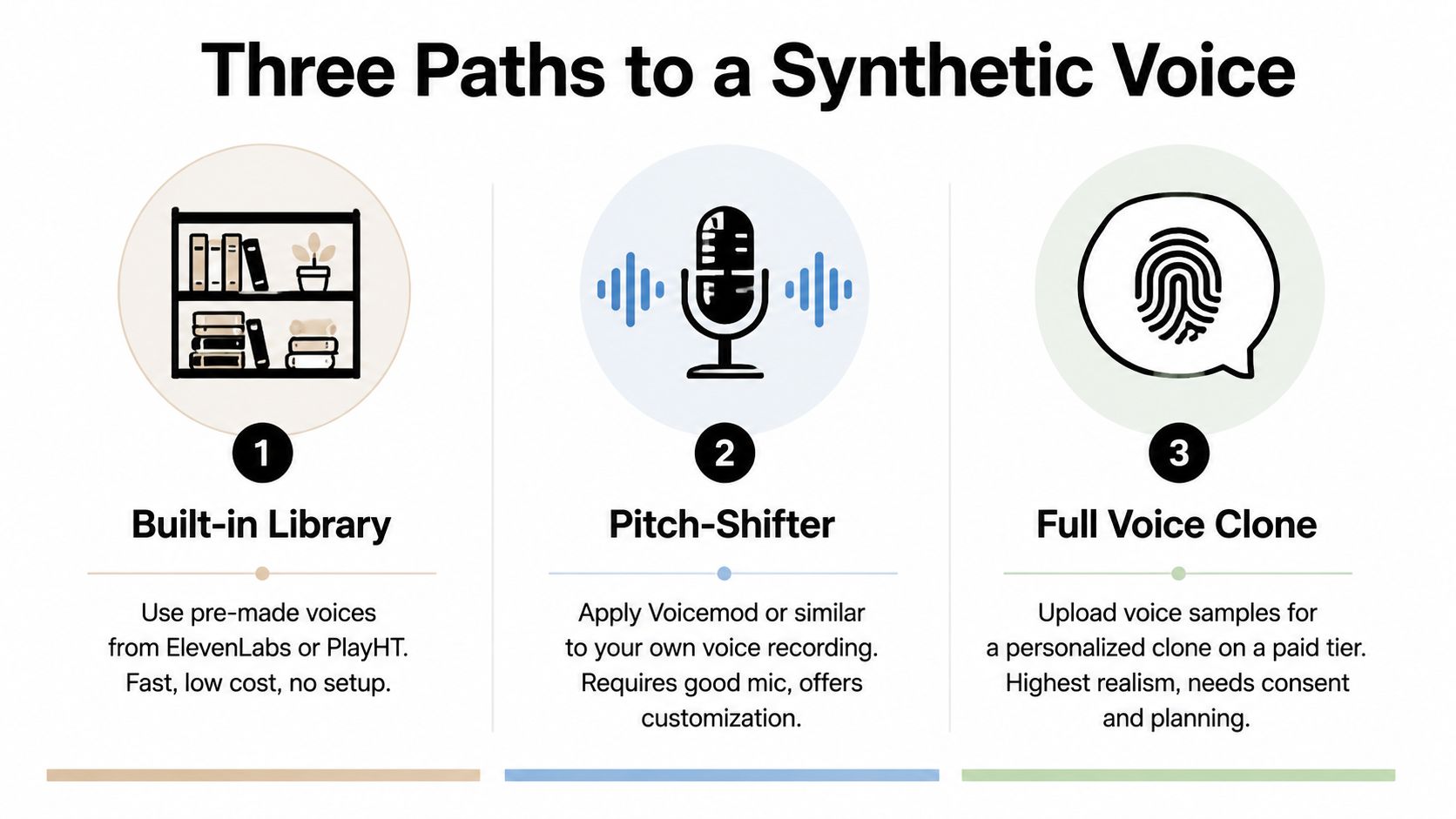
A built-in library is the fastest option. You pick a voice from a platform such as ElevenLabs or PlayHT, type the script, and export. That's the right move for rapid testing because the output is ready fast and doesn't require you to collect samples or manage consent paperwork for a personal clone.
A pitch-shifter such as Voicemod sits in the middle. You record your own voice, then shift it toward a more feminine sound. This is best when you want the ad to feel like the founder is still speaking, but the tonal character needs to move. The downside is obvious, it depends heavily on the quality of the original recording, so a bad mic or sloppy delivery will still sound bad after processing.
A full voice clone is the most personalized path. You upload samples, build a voice that mirrors a real speaker, and then reuse it across scripts. That works best once you already know the ad angle is strong and you want a repeatable brand voice. It's the least forgiving option for beginners because it takes planning, and it raises the consent and impersonation issues covered later.
The cheaper choice at the testing stage is usually the smarter choice. When the goal is learning, not polishing, library voices beat clones more often than people want to admit.
| Female Voice Emulator Paths Compared | Best for | Main trade-off |
|---|---|---|
| Built-in Library | Fast angle testing, dropshippers, short UGC reads | Less personal, can sound familiar if overused |
| Pitch-Shifter | Founder voice edits, quick experiments | Depends on recording quality |
| Full Voice Clone | Brand voice consistency, repeat use, premium creative | Requires consent, planning, and more setup |
The historical path toward believable female synthesis also explains why the market feels so fragmented. Modern systems can produce convincing output, but consumer products still vary a lot in how they handle pitch, speech rhythm, and naturalness. That's why you should choose based on campaign stage. Early stage, go library. Late stage, go clone if the rights are clean and the creative already works.
Writing a Script and Prompt That the Emulator Will Actually Deliver
Most weak voiceovers don't fail because the engine is weak. They fail because the script is clumsy. If the read is too long, too wordy, or too soft at the start, the model can't rescue it. A good female voice emulator performs best when the script is tight enough to fit the ad format and structured enough to tell the engine where to breathe.
Build for a short ad, not a brand film
Keep the read short. For a Meta ad, you want a script that gets to the point immediately, uses plain language, and lands the value in one clean pass. The first three words need to matter. If the opening sounds like an essay, the viewer has already gone.
Use the prompt like a director's note, not a paragraph dump. Mark pauses with ellipses, add emphasis to the exact words you care about, and break lines where a human would naturally breathe. That gives the output a better shot at sounding like a spoken ad instead of a text file read aloud.
Practical rule: write the hook first, then the offer, then the proof. If you can't say the hook cleanly in one breath, the script is too busy.
For tuning the read, the standard academic voice-conversion pipeline starts by splitting speech into frames, aligning them with dynamic time warping, then using LPC to separate excitation and filter components before learning mapping parameters for spectral-envelope and pitch conversion Columbia University project report. You don't need to run that pipeline yourself, but it explains why the same script can sound different depending on how the voice engine interprets pitch, contour, and timing.
What the sliders should do for ads
Use higher stability when you want a flatter, clearer explainer read. Use lower stability and higher style when you want a more emotional UGC feel. Similarity matters if you're cloning a specific voice, because it keeps the output close to the source identity. Speaker boost is useful when the read needs to punch through a busy edit, but it can make the result feel overprocessed if you push it too hard.
A recent engineering discussion notes that pitch shifting alone is not enough for convincing gender transformation, because prosody, spectral envelope, and duration all matter together, and one approach describes moving male speech upward by about 300 Hz for gender transformation while another notes shifting samples 3 to 4 semitones toward the male-female boundary to increase ambiguity Engineering Proceedings article. The practical lesson is blunt. Don't obsess over pitch as if it solves everything. It's one control, not the whole voice.
A simple way to understand this is:
- Explainer ad: higher stability, moderate similarity, low style.
- UGC-style hook: lower stability, higher style, enough speaker boost to stay present.
- Founder voice clone: high similarity, controlled style, careful pacing.
This script-writing guide is useful if you're tightening the copy before you feed it into the voice engine, because the cleanest audio still can't fix a weak opening line.
Recording, Editing, and Cleaning the Output
Raw output is almost never upload-ready. The creator who ignores cleanup usually blames the voice engine when the problem is the file sitting in the timeline. One of the fastest ways to make a female voice emulator sound more expensive is to treat the audio like ad inventory, not like a draft.
I watched a creator test the same 15-second script across three voices, and the result was obvious inside the first line. The cleanest read won because it sounded like someone talking to the camera, while the roughest export felt detached even though the words were identical. Same offer, same visual, different retention.
Clean it like it's going live
Trim silence at the head and tail. Remove dead air between sentences if it feels clunky. Add light de-essing if the sibilance gets sharp, then normalize loudness so the voice sits consistently in the edit. For Reels, aim around -16 LUFS, and for Feed, aim around -14 LUFS. Those targets help the read sit comfortably against the rest of the creative without forcing viewers to crank their volume.
Music should support the voice, not fight it. Duck the track by 6 to 8 dB when the voice comes in, and keep the bed dry if the environment is already noisy. If the ad is meant for silent scrolling with captions, clarity matters more than atmosphere. If it's a social-proof montage, a little room texture can help the voice feel less sterile.
What kills performance fast
- Clipping from over-compressed exports makes the read harsh and fatiguing.
- Mono files uploaded as stereo can create pointless file handling issues and sometimes inconsistent playback.
- Mismatched sample rates between voice and music can leave the mix sounding smeared or off.
The safest workflow is boring and effective. Export a clean voice stem, listen once on mobile speakers, then make one final pass for harshness and spacing before it touches the ad account. If it sounds good in headphones but falls apart on a phone, it's not ready.
Legal and Ethical Guardrails You Cannot Skip
This is the part most guides duck, and it's the part that can damage both trust and ad accounts. If you clone a real person, you need written consent. If you create a voice that could be mistaken for a public figure, you're inviting problems you don't need. And if the platform asks for disclosure around AI-generated content, don't try to game it.
The broader issue is bigger than compliance. Research on the femininization of AI-powered voice assistants shows that AI voice systems can reinforce gendered assumptions about what a “female” voice should sound like ScienceDirect paper. That matters in ads because the voice isn't just an audio choice, it's part of how your brand signals authority, warmth, and identity.
The rule set I'd use
Get consent first. If the voice belongs to a real speaker, don't improvise your way around permission. That includes founders, creators, contractors, and anyone else whose voice you plan to reuse.
Disclose AI when the platform requires it. Meta's ad policies and review process can change, but the basic principle is stable. If the system wants synthetic media labeled, label it. Trying to hide it only creates friction later.
Don't mimic celebrities, influencers, or recognizable creators. Even if the result is technically “original,” the intent can still be deceptive. The brand risk is bad enough before you get to legal trouble.
If the listener could reasonably think the voice belongs to a known person, don't use it.
The privacy gap in current product pages is real. Many tools talk about libraries, cloning, and output quality, but they rarely explain provenance, watermarking, or misuse prevention. That gap matters because buyers need to know whether they're creating a usable brand asset or a liability. For a deeper look at the commercial side of synthetic media, see this overview of AI-generated commercials.
Plugging the Voiceover Into a Meta Ads A/B Test
The cleanest test is the one that isolates voice from everything else. Same script. Same visual. Same audience. Only the voice changes. That's how you find out whether the voice is helping the ad or just making the creative feel different without moving the numbers.
Set up the test the right way
Run three versions as separate ad sets. One gets the library preset, one gets the pitch-shifted founder voice, and one gets the cloned brand voice if you have it. Keep the daily budget equal. Don't mix in new copy, new thumbnails, or a different audience, because that muddies the read.
Watch the metrics that matter for voice. Thumbstop rate tells you whether the opening is stopping motion. Hook rate shows whether the first few seconds hold attention. Hold rate tells you whether the ad keeps people engaged after the initial stop. Cost per qualified click helps you judge whether the voice is attracting useful attention or just curiosity clicks.
The decision rule should be blunt. If no variant lifts hook rate meaningfully after enough impressions to be fair, the voice is not the issue. The angle is weak. Fix the promise, the opening line, or the visual rhythm before you burn more budget on voice tweaks.
Read the result like a buyer, not a hobbyist
A better voice doesn't always mean a more dramatic voice. Sometimes the winner is the one that sounds less produced and more believable. That's especially true in problem-solution ads, where the viewer wants fast clarity, not a performance. In founder-on-camera ads, a voice that feels too synthetic can break trust even if the pacing is good.
If you're already using a structured creative workflow, voice variants should sit beside the rest of the batch. That means one script, multiple voice treatments, and the same systematic evaluation you'd use for visual swaps. If you want a clean framework for testing cadence, this Facebook ads testing strategy guide is worth keeping open while you review results.
A Weekly Voice Workflow You Can Paste Into Notion
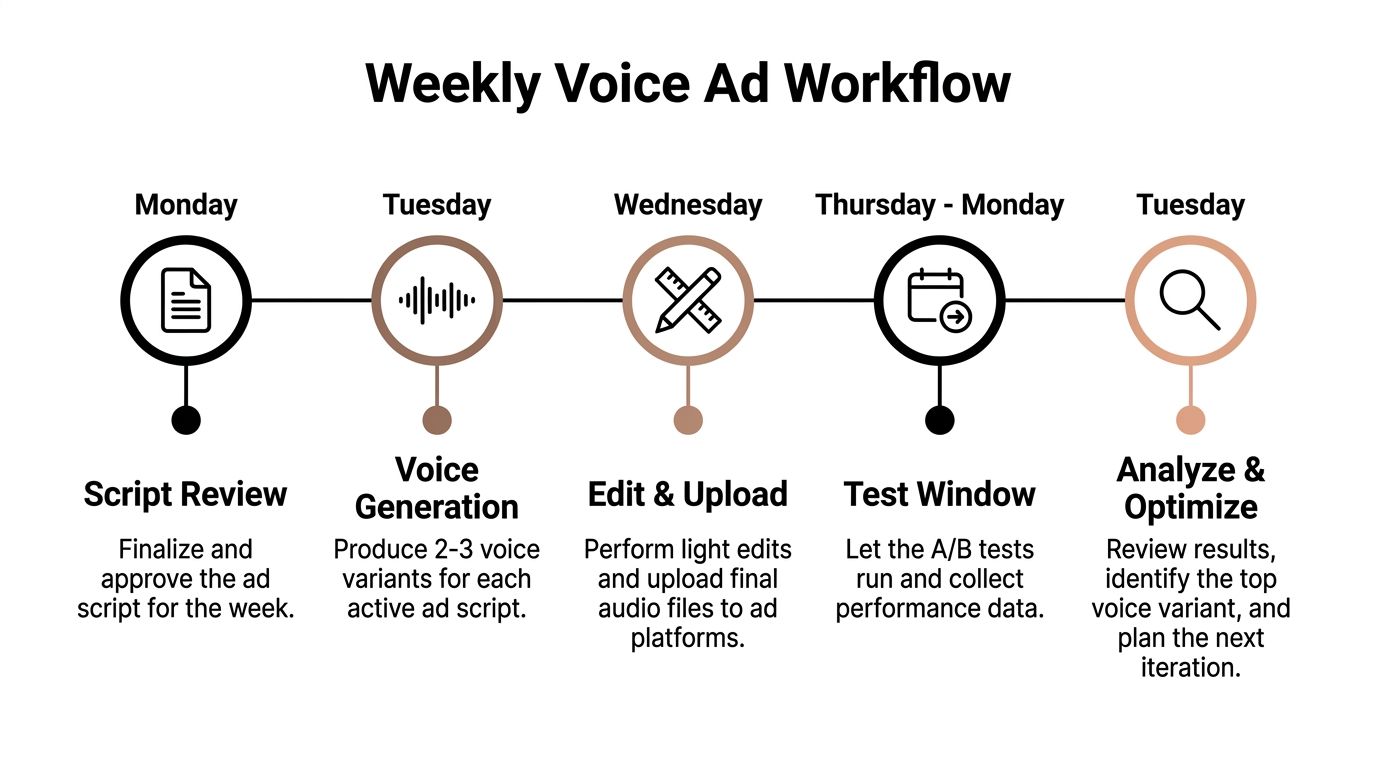
The fastest teams don't treat voice like a special project. They slot it into the same weekly rotation as the rest of creative testing. Monday is for script review. Tuesday is for generating two or three voice variants per ad. Wednesday is for edits and upload. Then you let the test run, read the results, and cut the losers without getting sentimental.
The routine that keeps testing honest
Monday, script review. Tighten the hook, trim the fluff, and choose the angle you're testing.
Tuesday, voice generation. Produce the variants and export them in the same format.
Wednesday, edit and upload. Clean the audio, pair it with the visual, and schedule the ad sets.
Thursday through Monday, test window. Let the ads collect clean data without changing the variables mid-flight.
Tuesday, analyze and optimize. Keep the winner, retire the bottom half, and brief the next round.
If you run your voice testing this way, the emulator stops being a novelty tool and becomes a repeatable input in the ad system. That's the mindset shift most beginners miss. Voice is just another variable, and the only way it pays off is when you treat it like one.
If you want a faster way to turn a product URL into a testable Meta ad plan with creative variants, Social Loop AI can help you do that without building the workflow from scratch. Visit Social Loop AI if you want a structured way to test voice, hooks, and creative angles together instead of guessing which piece is hurting your CPA.