Blog
Ecommerce Social Media Strategy: A 2026 Starter Guide
Published August 10, 2026
You've got the product live, a few posts drafted, and maybe one ad account sitting there with no real plan behind it. The pressure is familiar, because you don't need a brand theater strategy right now, you need a system that can help people discover the product, trust it fast, and buy without friction.
An effective ecommerce social media strategy isn't about being everywhere. It's about being precise in the places where your buyer already scrolls, compares, and decides. That matters more now that social media has become a measurable commerce engine, with about 5.66 billion global users in 2026, roughly 2 hours and 40 minutes per day spent on social platforms, and about 17% of all online sales in 2025 coming through social platforms (Sprout Social social media statistics).
Table of Contents
- The Foundation Your Platform and People
- Your Content Angle and Creative Playbook
- The Paid and Organic Social Partnership
- Your First Launch and Learn Ad Plan
- Measuring What Matters and Scaling Smart
- Your 30-Day Ecommerce Social Rollout Calendar
The Foundation Your Platform and People
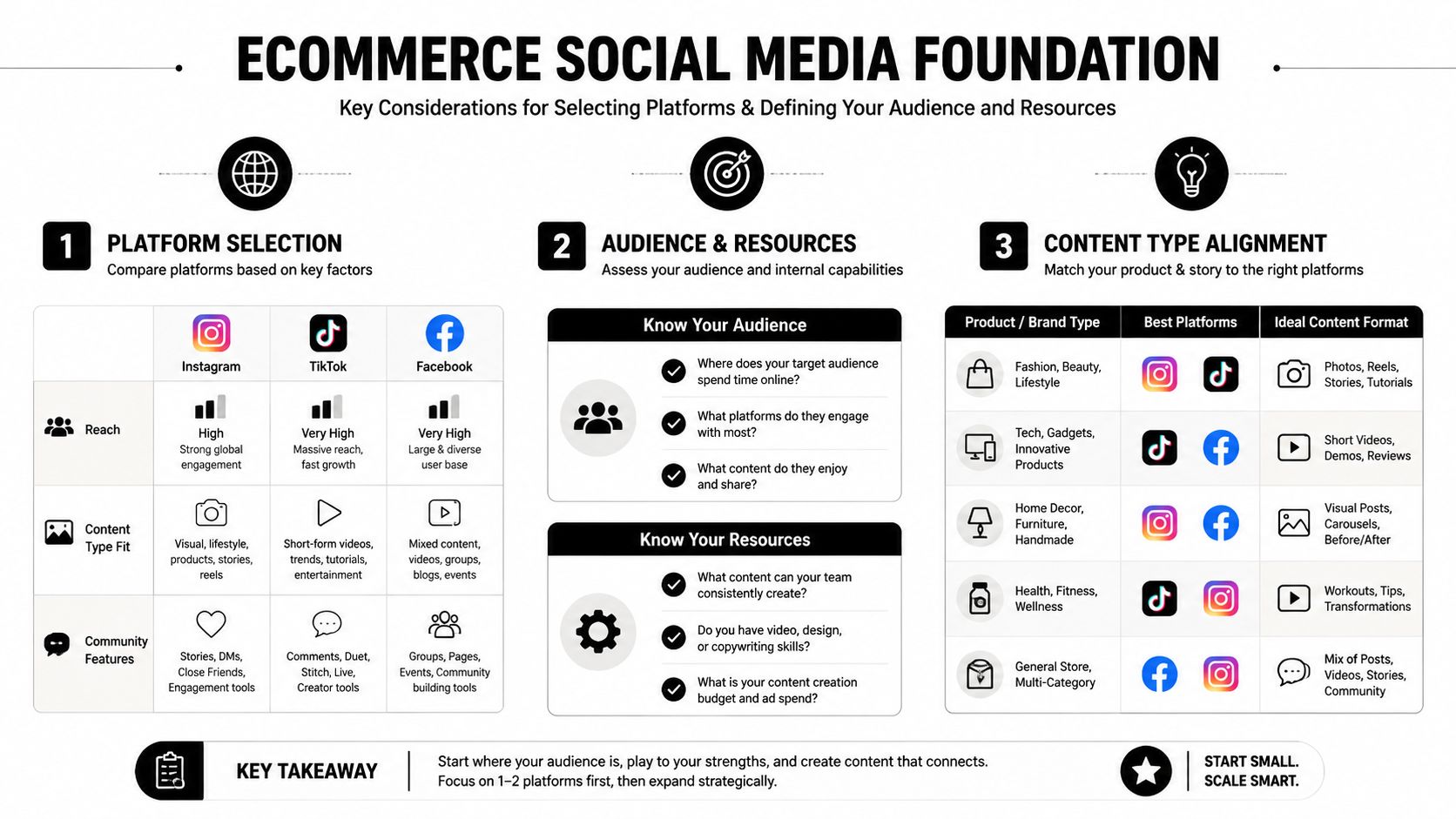
A strong ecommerce social media strategy starts with a hard choice. You do not need to be everywhere, you need to be effective somewhere, because every platform asks for a different format, a different buying mindset, and a different level of content production.
Pick one primary platform before you spread thin
Start with the platform where your product naturally fits the user intent. TikTok is strong when you can show discovery, transformation, or a quick emotional hook. Pinterest works better when the buyer is planning, saving, or collecting ideas. Instagram sits between the two, which is why it often works when your product is visual, brand-led, and easy to understand in a single frame.
The decision should come down to what the platform rewards, not what feels popular. If your product is highly visual and can be understood instantly, Instagram or TikTok may deserve the first test. If the purchase is more considered, like home decor, accessories, or a giftable item, Pinterest can be a better early fit because users are already in a planning mindset. The broader point is simple, platform choice should match customer purchase behavior and product fit, not follower envy (Blaze.ai ecommerce social media strategy guide for 2026).
Practical rule: choose one primary platform and one backup platform. If you can't explain why each one fits a buyer stage, you're probably overextending.
The commercial stakes are real. U.S. social commerce sales are projected to surpass $100 billion in 2026, and TikTok Shop is reported to lead platform conversion rates at 3.8% versus 2.1% for Instagram Shopping (WebTonic social media marketing statistics). That doesn't mean everyone should rush to TikTok first. It means your platform decision should be tied to where your audience buys, not where your brand looks nicest.
Define the buyer profile beyond demographics
Age, gender, and location are too blunt for launch decisions. You need to know what the buyer is trying to solve, what they're afraid of, and what they need to believe before they click. A founder selling a posture corrector, for example, is not just targeting “women 25 to 44.” That buyer might be a desk worker who is skeptical of gimmicks, wants visible relief, and needs proof the product won't feel awkward to wear.
Build the profile around problem, motivation, objection, and trigger. Problem is the pain point. Motivation is the desired outcome. Objection is the reason they hesitate. Trigger is the moment they become ready to buy. Once you write those four things clearly, every caption, ad, and landing page headline gets easier.
A useful shortcut is to write one sentence that begins with, “She buys because…” and one sentence that begins with, “She doesn't buy unless…”. That sounds basic, but it forces clarity. Clarity is what keeps your content from becoming generic product noise.
If you want a structured way to use AI for that kind of planning, AI for social media marketing can help speed up the research and idea generation stage without replacing the judgment you still need as the founder.
Your Content Angle and Creative Playbook
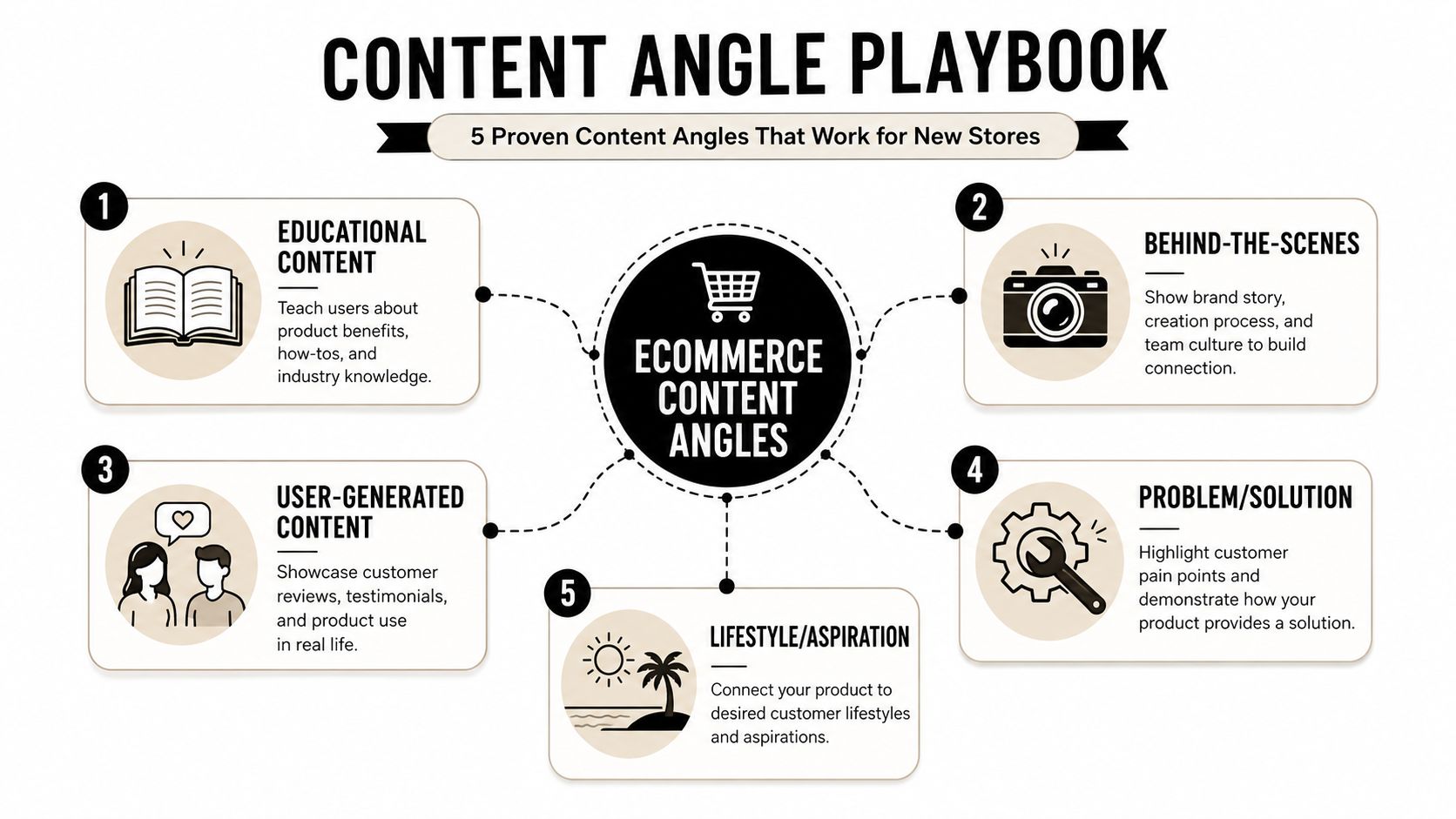
A lot of new founders post whatever they have on hand, then wonder why nothing compounds. The better move is to build content around repeatable angles, because angles turn a random product into a story buyers can understand quickly. For a first-time store, that story usually has to do one of five jobs, teach, prove, reassure, create urgency, or help the customer see themselves in the brand.
Use one product, five angles
Take a smart water bottle. The product is simple, which is useful, because it forces the angle to do the work.
UGC and social proof could look like a customer clip with the hook, “I didn't think a water bottle could change my routine.” The visual idea is a phone-shot video from a desk, gym bag, or car cup holder. The body copy should be short and direct, showing real usage instead of polished claims. If you need a deeper system for turning customer content into repeatable assets, user-generated content strategy is worth keeping in your workflow.
FOMO can be as simple as, “The bottle color everyone asked for is back.” The visual should show the limited shade in a clean setting, then cut to a quick packing shot or shelf line. This works when your product or offer has a real constraint, not a fake countdown timer.
Problem → Solution is the easiest angle for a new store. Hook: “If you forget to drink water all day, this bottle does the reminder for you.” Show the frustration first, then the product fixing it. The contrast matters more than a fancy edit.
Identity works when the buyer wants the product to say something about who they are. Hook: “For people who keep a planner, a tote, and a water bottle within reach.” This angle sells belonging, not features.
Educational content might be, “Why hydration reminders matter more than you think.” Use a simple demo, maybe the bottle glows on a desk when it's time to drink. Education builds trust because it gives the buyer a reason to care before you ask for the sale.
Write hooks like a storefront conversation
The best hooks sound like the first sentence a real buyer would say to a friend.
That's why your opening line should do one of three things, stop the scroll, surface a problem, or create a clear curiosity gap. Don't write like a brand deck. Write like you're answering an objection in the first three seconds.
The same product can produce very different results depending on the angle. A smart water bottle can be wellness content, gift content, desk setup content, or gym content. Your job is to test which version gets the right response, then reuse that structure across formats instead of inventing new ideas from scratch every day.
The Paid and Organic Social Partnership
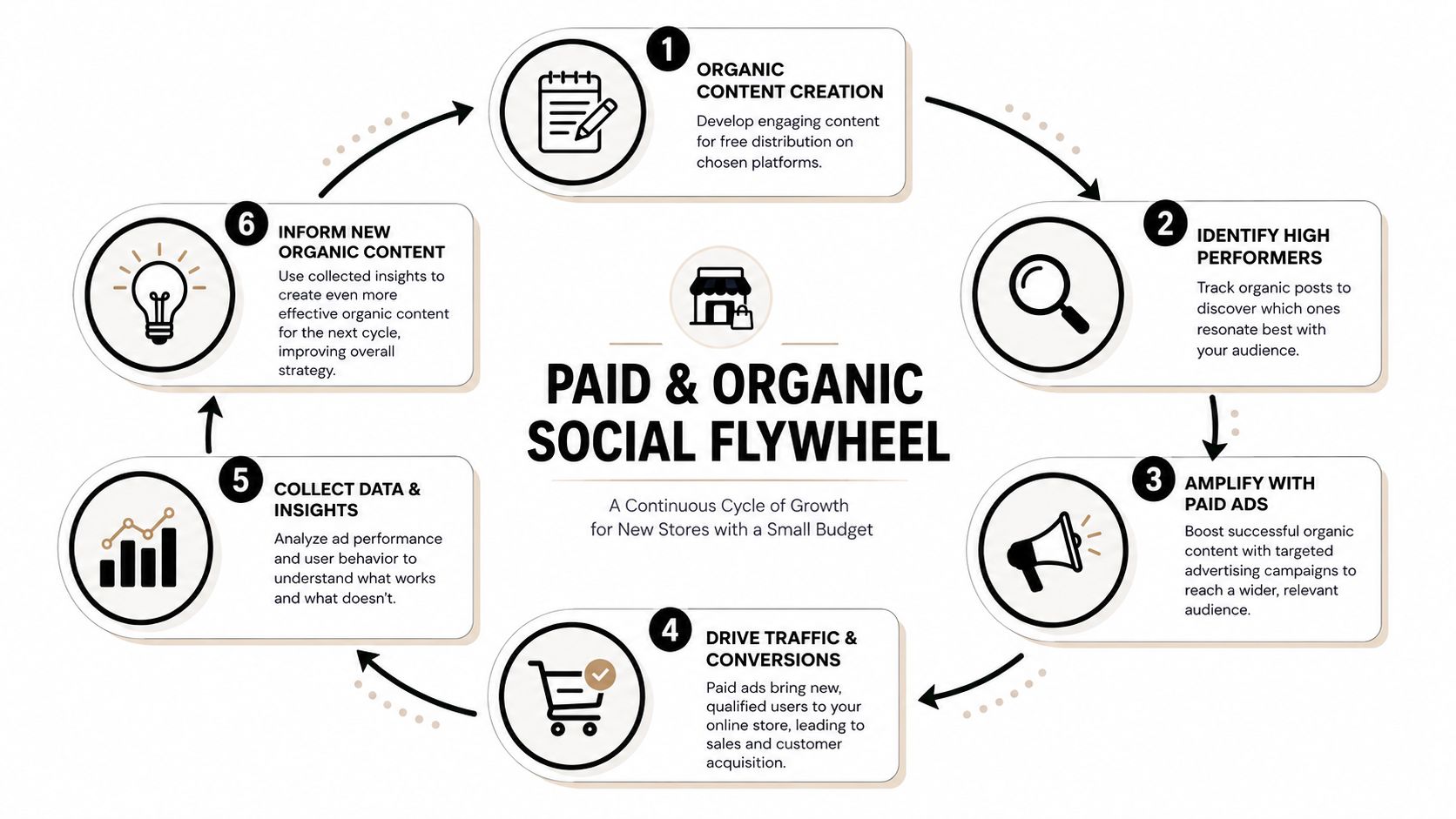
Organic and paid social are too often treated like separate departments. That's a mistake for a small store, because organic is your test lab and paid is your amplifier. Together, they form a flywheel, one side gives you signal, the other side gives you reach.
Let organic content prove what deserves spend
Post your angles organically first. You're not trying to win the internet on day one, you're looking for signs of resonance. A post that gets saves, comments, profile taps, or direct messages is giving you a clue about message-market fit, even if the reach is modest.
That makes organic your cheapest creative research channel. If one hook consistently gets replies while another one gets ignored, you've learned something valuable before paying to push it. While many public guides stop at posting cadence, the better approach is to use organic output as a proof point before you put budget behind it.
Use paid to widen the audience, not just sell harder
Paid ads are not only for immediate purchases. They can also expose your brand to people who would never have found you organically. For a new store, that matters because a small organic audience can take months to build, and your content needs a wider test pool to learn quickly.
Effective strategy involves retargeting and prospecting working together. Prospecting brings new people in. Retargeting catches the ones who watched, clicked, or visited but didn't buy yet. The creative job stays consistent, though. If the organic post worked because it felt honest and clear, don't turn it into a loud ad that loses the original message.
The budget-aware mindset is simple. Organic tells you what the market notices. Paid tells you what the market will act on at scale. Use both, and your content library becomes a real asset instead of a pile of disconnected posts.
Your First Launch and Learn Ad Plan
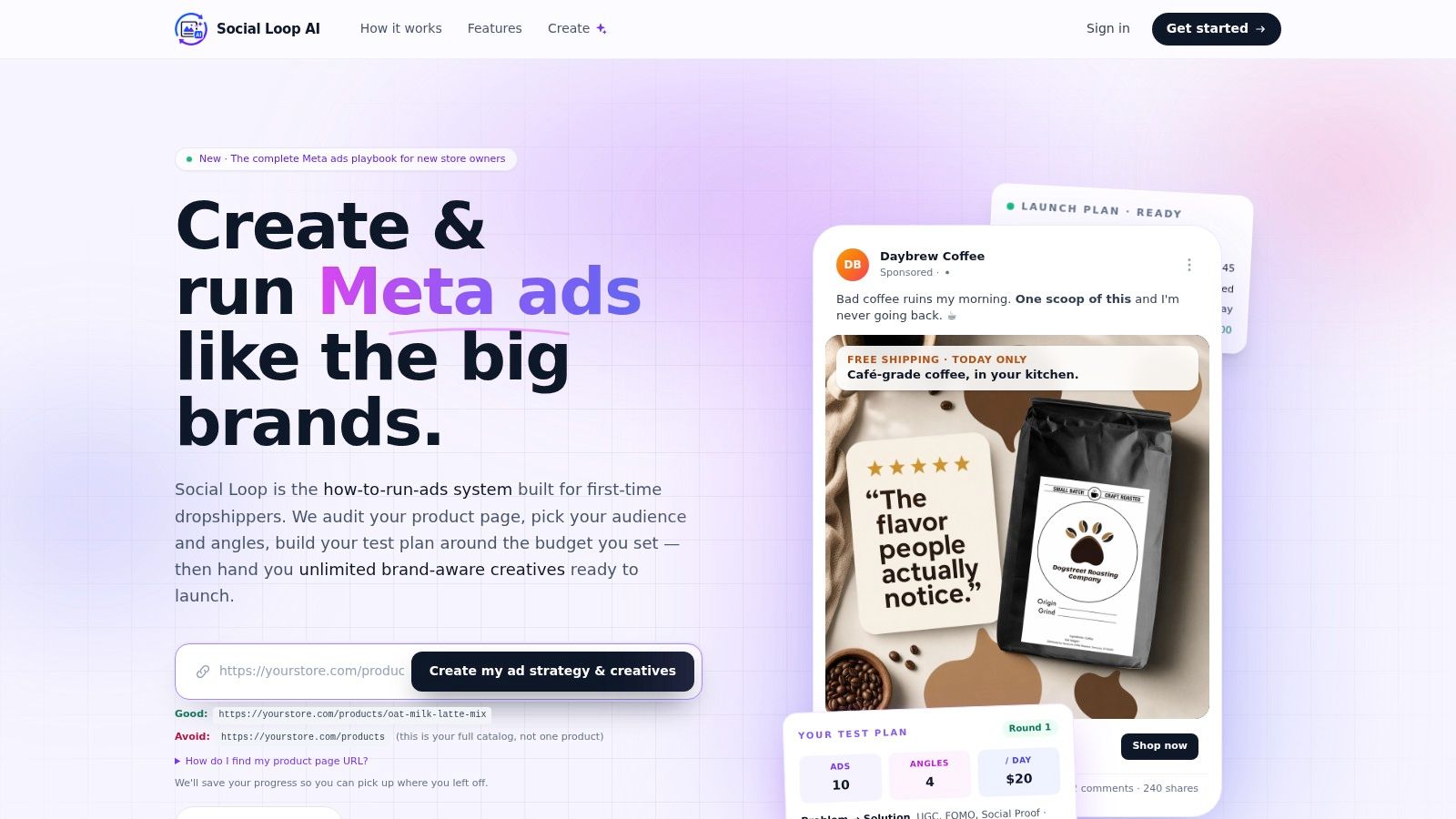
Your first campaign should feel controlled, not dramatic. Small budgets break when founders try to test too many things at once, so the goal is to isolate variables in a way that tells you something useful. The cleanest beginner setup is a three-round test, with each round answering one question before you move to the next.
Round one tests creative, not everything else
Start with your strongest two or three angles, not ten. Use the same audience and the same landing page so the only meaningful difference is the creative. That gives you a cleaner read on which message is doing the work.
A simple daily budget like $20/day can still teach you plenty if you keep the structure tight. The point isn't to chase scale immediately. The point is to find out whether your product story is strong enough to make strangers care.
Before launch, check the landing page against a basic readiness list:
- Clear product promise: the headline should say what the product does without forcing the visitor to decode it.
- Strong trust signals: visible reviews, policies, shipping details, and contact clarity.
- One main call to action: avoid competing buttons that pull the visitor in different directions.
- Mobile-first layout: most ad traffic will land on a phone, so the page can't feel cramped or slow to scan.
- Offer consistency: the ad promise and the landing page promise need to match.
Round two finds the audience fit
After creative, test audience clusters. Keep the winning creative from round one and compare the buyers by interest, behavior, or similar customer group, depending on the platform. The goal is to see who reacts with intent, not just clicks.
The data quality issue matters. Many 2026 guides talk about attribution and content performance, but the practical challenge is separating a high-click creative from one that sells. That distinction is critical for a low-budget test because clicks alone can burn your budget while making the ad look healthier than it is (Insense social media marketing for ecommerce).
Round three pairs the winner with the right audience
At this stage, you already know which creative angle has the best signal and which audience segment is worth more attention. Now combine them and make only small changes, maybe one new caption variant or one different thumbnail. If you start over here, you lose the learning from the first two rounds.
The cleanest test is the one that changes one thing at a time.
For founders who want a repeatable way to structure that process, Facebook ads testing strategy is a useful reference point because it keeps the focus on sequence, not guesswork.
Measuring What Matters and Scaling Smart
Likes feel good. Followers look nice. Neither one tells you whether your store is moving in the right direction. If you're serious about an ecommerce social media strategy, measure the outputs tied to revenue quality, not the signals tied to ego.
Use business metrics, not vanity metrics
Track the numbers that show whether social is helping people buy. That means click-through behavior, purchase efficiency, and the economics of each campaign. When a post gets attention but no sales, it's not a win. When a smaller post sends fewer people but more qualified buyers, it may be the better asset.
The key is to judge the ad by what happens after the click. A creative can look strong on the surface and still fail at the landing page. That's why content, paid media, and page optimization need to be reviewed together instead of in separate silos.
Apply a simple scale, kill, retest rule
Use a decision tree that keeps you from waiting too long on weak campaigns.
- Scale: if a campaign is producing purchases at a pace that fits your economics, increase spend gradually and keep the same core message.
- Retest: if people click but don't buy, keep the angle and adjust the landing page or offer.
- Kill: if the creative, audience, and page all fail to produce meaningful movement after a fair test, stop spending and move on.
That rule protects cash. It also stops founders from confusing motion with progress. When you only have a few campaigns in play, the fastest way to waste money is to keep a polite underperformer alive because it “almost” works.
One more practical point. Your best-performing post is not always your best ad, and your best ad is not always your best landing page headline. Separate those layers during review so you can improve the right part of the system.
Your 30-Day Ecommerce Social Rollout Calendar
A good rollout removes the guesswork from launch. It gives you a sequence, a feedback loop, and a way to keep momentum without trying to build the whole machine in one weekend. The calendar below turns the system into a simple monthly workflow.
30-day plan
| Week | Focus | Actions |
|---|---|---|
| Week 1 | Foundation | Define your buyer profile, pick one primary platform, and map two backup content angles. Write the problem, motivation, objection, and trigger in plain language. |
| Week 2 | Creative build | Produce organic posts for the best angles, then turn the strongest ideas into ad-ready variations. Keep the visuals and messaging aligned across posts and ads. |
| Week 3 | First test launch | Run your first paid test with a tight creative setup, a single landing page, and a clear budget limit. Watch for early signal, not just traffic volume. |
| Week 4 | Review and optimize | Compare the posts and ads that drove actual purchases versus the ones that only drove clicks. Keep what worked, cut what didn't, and write the next test from those findings. |
A few habits make the calendar work better:
- Keep one notebook for insights: write down which hook, visual, and objection angle got the best response.
- Reuse winners across formats: a post that works on organic can become an ad, a story, or a landing page headline.
- Review the page before the ad: if the page is weak, don't blame the creative for the conversion gap.
- Make the next test smaller, not bigger: precision beats volume when the budget is tight.
The point of this rollout is repeatability. Once the sequence is working, you can keep cycling through the same steps with new products, new angles, or new audiences without rebuilding your process every time.
Social Loop AI gives first-time founders a way to turn a product URL into a launch plan, brand-aware creative, and landing-page fixes without starting from a blank page. If you want a more structured way to connect social content, paid testing, and page readiness in one workflow, visit Social Loop AI.