Blog
Advertisements with Loaded Words: A High-CTR Guide
Published July 10, 2026
You launch your first Meta campaign, spend money fast, and get one of two outcomes. The ad gets ignored, or it gets flagged. That's the beginner dropshipper trap.
Most new store owners don't have a targeting problem first. They have a language problem. Their copy is either too flat to earn the click, or so aggressive that it reads like a scam. Advertisements with loaded words sit right in the middle of that tension. Used well, they can lift attention and make a product feel urgent, useful, or desirable. Used badly, they can tank trust and put your account under pressure.
If you're selling a posture corrector, a skincare tool, a pet hair remover, or a kitchen gadget, the words you choose in the first line matter almost as much as the offer. On Meta, people don't stop for technical accuracy alone. They stop for emotion, relevance, and clarity. But Meta also doesn't reward copy that sounds manipulative, exaggerated, or deceptive.
Table of Contents
- What Are Loaded Words and Why Do They Matter
- The Psychology Behind High-CTR Loaded Language
- How to Write Advertisements with Loaded Words
- The Dropshippers Guide to Meta Ad Policy and Compliance
- Testing and Measuring Your Loaded Word Ads
- Conclusion Balancing Persuasion with Responsibility
What Are Loaded Words and Why Do They Matter
Loaded words are words with emotional weight. They do more than describe a product. They shape how the buyer feels about it.
A neutral word tells. A loaded word nudges. “Good lotion” is bland. “Revitalizing lotion” suggests a feeling. “Compact lamp” describes size. “Space-saving lamp” frames a benefit. “Water bottle” is a thing. “Leak-proof bottle” starts to reduce anxiety. That emotional layer is what makes advertisements with loaded words so effective when the product itself is simple.
For dropshippers, this matters because most first ads fail for boring reasons. The creative looks generic, the hook sounds interchangeable, and the copy reads like a supplier listing. Buyers scroll past products that feel ordinary. Loaded language helps a product claim a position in the feed.
The difference between description and persuasion
A product feature says what it is. A loaded phrase says why the buyer should care.
Consider a facial cleansing brush:
- Flat description: Silicone brush with adjustable speed
- Persuasive version: Gentle cleansing brush for a fresher-looking routine
Consider a car phone holder:
- Flat description: Dashboard mount with strong grip
- Persuasive version: Secure dashboard mount for stress-free driving
Neither rewrite promises a miracle. Neither sounds clinical. Both add emotional direction.
Practical rule: If your copy could describe ten other products in the same niche, it isn't doing enough.
Why beginners misuse them
New advertisers usually make one of two mistakes.
- They stay too safe: The copy is technically fine but emotionally dead. Words like “nice,” “useful,” and “quality” don't create much response.
- They go too hard: They jump to words like “guaranteed,” “instant,” “miracle,” or “life-changing,” even when the product page can't support those claims.
That's the core issue. Loaded words are not just stronger adjectives. They're positioning tools. They can create desire, urgency, trust, relief, or fear. But on Meta, especially for a new store, emotional language has to stay grounded in what the product can reasonably suggest.
The best ads don't sound hyped up. They sound specific, emotionally sharp, and believable. If your ad says a neck massager offers a “relaxing way to unwind after long workdays,” that's usable. If it says it “instantly erases pain forever,” you're asking for trouble.
The Psychology Behind High-CTR Loaded Language
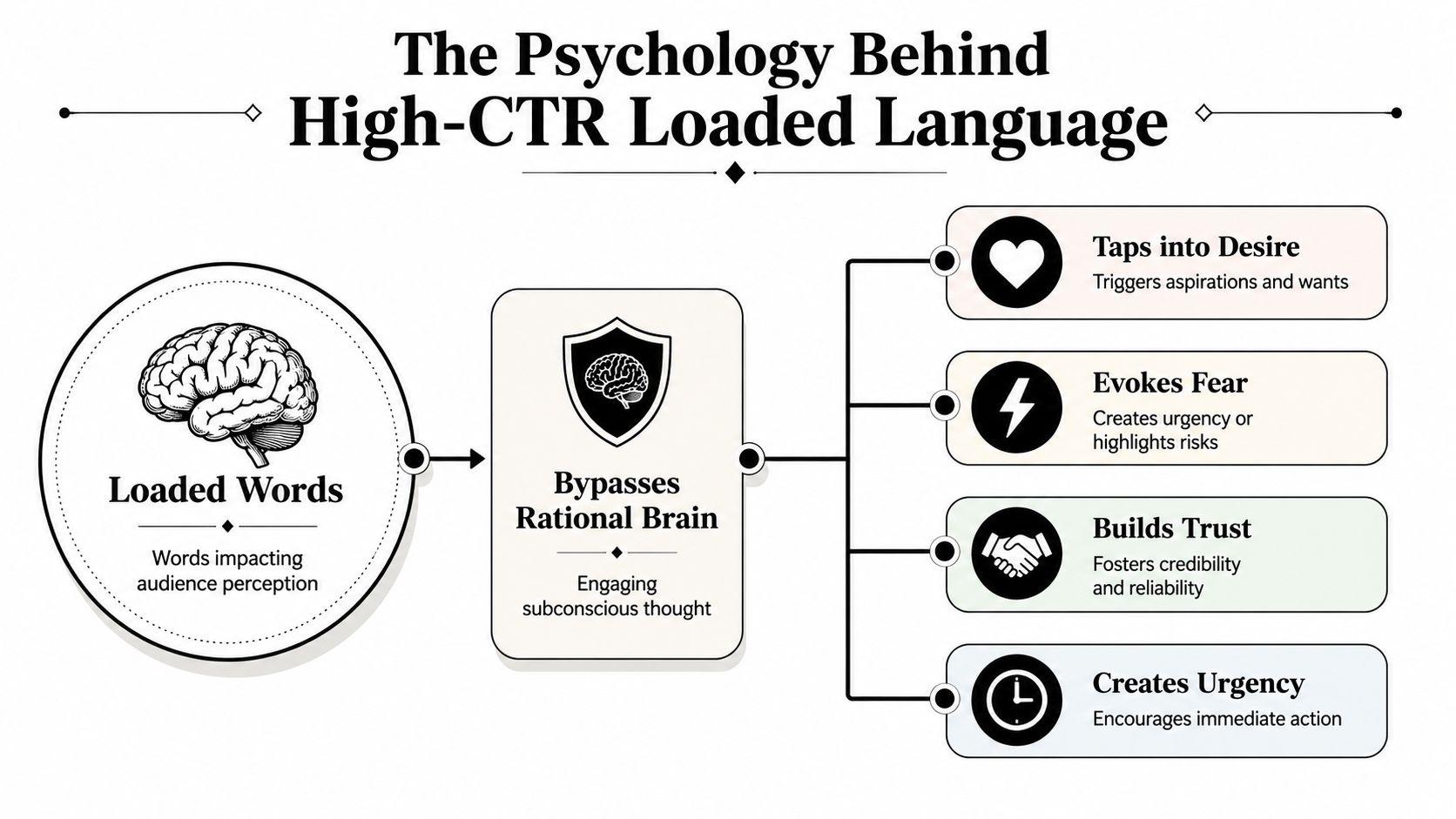
People don't scroll Meta in a calm, analytical state. They scroll fast, distracted, and emotionally open to simple cues. That's why loaded words matter. They compress meaning into a few words and trigger associations before the buyer fully thinks through the offer.
Why emotion beats explanation
The technical function of loaded words is to influence the reader by triggering emotion beyond literal meaning. That's why they're more persuasive than plain factual wording. Data from major advertising campaigns found that ads using emotional pull reached a 31% success rate, compared with 16% for ads focused on rational content, making emotional response the strongest predictor of sales increase, according to this advertising performance summary.
That doesn't mean rational information is useless. It means emotion gets attention first. Logic usually justifies the click after.
A buyer rarely clicks a cleaning tool because they admire the materials list. They click because the ad taps a feeling:
- relief from a recurring annoyance
- pride in looking put together
- fear of missing out
- trust that the product will make life easier
If you want a practical breakdown of persuasion styles that pair well with emotional hooks, this guide on ad persuasion techniques for social ads is a useful companion.
Connotation is the real lever
Connotation matters more than synonym choice. “Cheap” and “affordable” may point to price, but they create very different reactions. “Bold” and “aggressive” can describe similar energy, but one feels aspirational and the other can feel abrasive.
That's why strong copy starts with the audience's emotional state, not the product catalog. Someone buying an under-desk walking pad may want discipline, convenience, or momentum. Someone buying a baby bottle warmer may want reassurance and ease. Someone buying an acne patch may want control, privacy, or confidence.
The loaded word should match that inner motivation.
A few examples:
- Desire: sleek, flattering, premium, polished
- Relief: easier, calmer, mess-free, hassle-free
- Urgency: now, today, limited, last chance
- Trust: reliable, proven, secure, consistent
Later in the section, watch how these emotional cues show up in real ad language.
Buyers don't respond to loaded words because they're dramatic. They respond because the words help them feel the outcome before they own the product.
That's the psychological edge. A loaded word is a shortcut to meaning. In a crowded feed, shortcuts win attention.
How to Write Advertisements with Loaded Words
Writing better ad copy starts with restraint, not hype. The goal isn't to stuff your ad with dramatic language. The goal is to pick a few emotionally charged words that sharpen the offer without making it sound false or risky.
A simple workflow works better than chasing “viral” phrasing. Start with the product. Then move to the buyer. Then tighten the wording.
Turn product features into emotional outcomes
Most beginners write from the supplier sheet. That's why their ads sound generic. Buyers don't care that your blender has a USB charge port until you connect it to convenience.
Translate features into outcomes people feel.
-
Feature: Portable blender
Outcome: Easier smoothie prep on busy mornings
Loaded phrasing: Fresh blends anywhere -
Feature: Blackhead remover tool
Outcome: More confidence in close-up situations
Loaded phrasing: Clearer-looking skin without the mess -
Feature: Closet organizer
Outcome: Less chaos when getting dressed
Loaded phrasing: A cleaner, calmer start to the day
Once you have the emotional outcome, choose your angle.
Problem/Solution angle works for products tied to a recurring irritation.
Example: “Tired of tangled cables in your car? This compact organizer keeps your essentials neat and within reach.”
FOMO angle works when the product is trend-led or style-led.
Example: “The everyday tote that makes simple outfits feel pulled together.”
Identity angle works when buyers want the product to say something about them.
Example: “For pet owners who like a cleaner home without the daily struggle.”
For extra help tightening raw ideas into ad-ready lines, this guide on how to write ad copy that converts is worth bookmarking.
Write short and cut hard
Long copy doesn't automatically mean persuasive copy. In audio ads, adding 24 extra words to a 30-second spot lowered response by 27%, while removing words improved standout scores and web traffic, according to this analysis of ad word count and effectiveness. The same source also notes that negative appeals on Facebook often outperform positive ones.
That has two practical implications for Meta ads.
First, keep your hook tight. One emotional claim is stronger than three vague ones.
Second, negative framing can work when it names a real annoyance without becoming manipulative.
Compare these:
-
Bloated: “This amazing, revolutionary, premium tool is designed to completely transform your daily kitchen experience and save you lots of time.”
-
Tighter: “Cut the mess and speed up prep with one compact kitchen tool.”
-
Weak positive: “Feel good about organizing.”
-
Sharper negative: “Stop wasting time digging through cluttered drawers.”
Loaded Words High-Risk vs. Safer Alternatives for Meta Ads
| Emotion/Goal | High-Risk Loaded Word (Use with Caution) | Safer, High-CTR Alternative | Example Use Case |
|---|---|---|---|
| Certainty | Guaranteed | Reliable | “A reliable grip for your daily commute” |
| Transformation | Miracle | Helpful | “A helpful tool for quicker cleanup” |
| Speed | Instant | Fast, quick | “Quick setup for busy mornings” |
| Status | Luxury | Premium-inspired, polished | “A polished look without overcomplicating your routine” |
| Fear | Dangerous | Risky, frustrating, stressful | “Reduce the stress of loose cords on the go” |
| Urgency | Last chance | Limited release, limited drop | “Limited drop for this seasonal colorway” |
| Health-adjacent improvement | Cure | Support, comfort, soothing | “A soothing addition to your evening routine” |
| Dominance | Best ever | Standout, popular, go-to | “A standout organizer for smaller spaces” |
A few writing habits separate strong advertisements with loaded words from weak ones:
- Lead with the payoff: “Get a cleaner desk in minutes” beats “Our desk organizer is designed with a modular structure.”
- Use one emotional lane: Don't mix fear, luxury, humor, and urgency in one short ad.
- Match the landing page: If the product page sounds cautious and plain, your ad can't sound wild and exaggerated.
- Read the copy out loud: If it sounds like a late-night infomercial, cut it.
The best loaded language feels natural in the mouth. If you'd be embarrassed saying it to a customer in a real conversation, don't run it.
The Dropshippers Guide to Meta Ad Policy and Compliance
Most beginners worry about CTR first. They should worry about account survival first.
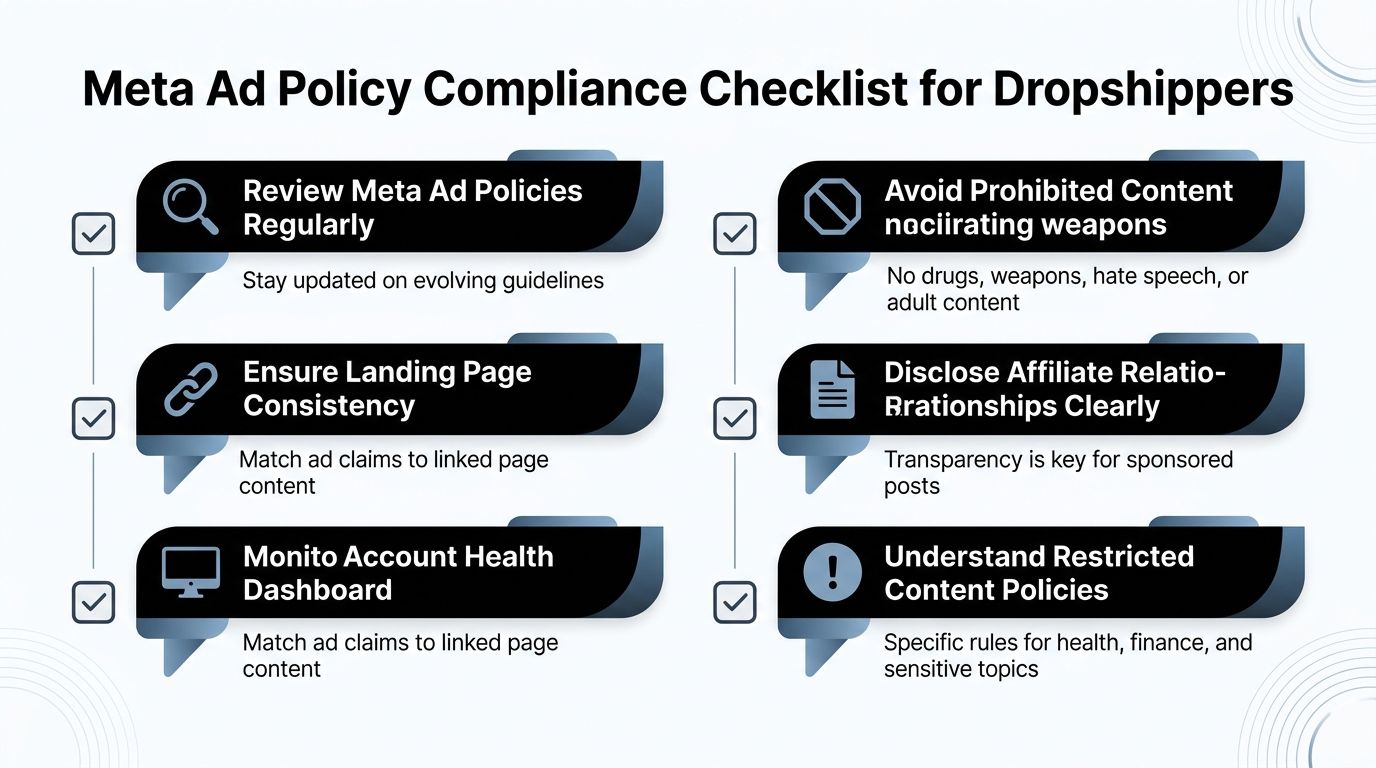
Meta doesn't just review your image and headline. It reviews the pattern your ad creates. If your language feels exaggerated, manipulative, misleading, or too aggressively personal, you can get rejected before you learn anything from the test. For a new store, that slows momentum and adds risk immediately.
Why beginners get flagged faster
A 2025 Meta internal report analysis found that 34% of new ad accounts face initial rejection because of “overly persuasive or emotionally exaggerated language,” with loaded claims named as the top reason, according to this summary of the report analysis.
That should change how you write from day one.
New accounts don't have much trust history. If you combine aggressive copy with a weak product page, a broad claim, and a sketchy-looking creative, the ad review process has more reasons to push back. This is why beginner dropshippers can't copy every flashy ad they see in the wild.
If you're building campaigns for a store that's still proving itself, this broader guide to dropshipping advertising on Meta helps frame the bigger picture.
Compliance mindset: Write to persuade a skeptical buyer and a skeptical platform reviewer at the same time.
What compliant persuasion looks like
Meta-safe copy usually has four traits. It's emotionally sharp, but it avoids overclaiming. It speaks to a problem, but it doesn't accuse the user. It creates urgency, but not fake scarcity. And it stays consistent with the landing page.
Use these do's and don'ts as a filter before launch:
- Do ground claims in product reality: Say “designed for easier storage” instead of “solves your storage problems forever.”
- Don't make absolute promises: Words like “guaranteed,” “never fails,” and “instant results” invite scrutiny fast.
- Do describe the user's situation broadly: “Built for long commutes” is safer than “Are you tired of your embarrassing car mess?”
- Don't call out personal attributes: Avoid language that implies you know someone's health condition, financial stress, appearance insecurity, or private struggle.
- Do use urgency: “Seasonal drop” or “limited release” can work if it's real.
- Don't fake pressure: If stock isn't constrained, don't imply a countdown panic.
A few common rewrites make a big difference:
| Risky Version | Safer Version |
|---|---|
| “Erase wrinkles instantly” | “A smoothing addition to your skincare routine” |
| “Fix your ugly posture now” | “Support a more comfortable desk setup” |
| “Guaranteed fat loss results” | “Designed for active lifestyles” |
| “Only desperate pet owners buy this” | “A simple tool for managing pet hair at home” |
One more rule matters. Your ad and product page must sound like they belong together. If the ad says “premium,” “trusted,” and “results-driven,” but the landing page is full of broken English, missing policies, and weak photos, the ad won't just convert worse. It can also undermine credibility during review.
Good compliance is good business. It forces you to write cleaner, clearer, and more believable ads.
Testing and Measuring Your Loaded Word Ads
No one knows in advance which emotional trigger will work best for your product. You can make a smart guess. You still need to test.
This matters even more if you sell into multiple markets. A 2025 cross-cultural study found that 41% of global dropshipping campaigns failed to adapt ad copy for regional emotional resonance, leading to a 22% lower average CTR in non-English markets, according to this summary of the cross-cultural finding. The lesson is simple. A loaded word that feels exciting in one audience can feel exaggerated, awkward, or irrelevant in another.
Test one emotional variable at a time
Beginners often ruin copy tests by changing too much at once. If you swap the image, hook, headline, CTA, and audience all in one move, you won't know what caused the result.
Keep the product, visual style, and audience stable. Then test one emotional framing change.
For example, for the same portable garment steamer:
- Relief hook: “A quicker way to smooth out last-minute outfit wrinkles”
- Confidence hook: “Look more put together before work, dinner, or travel”
- Urgency hook: “Stop leaving wrinkled outfits hanging in the closet”
That's a clean test. Same offer. Same product. Different emotional cue.
Use a simple structure:
- Write three hook variations.
- Keep the body copy nearly identical.
- Run them to the same audience.
- Compare the response before editing again.
Don't test adjectives randomly. Test emotional promises deliberately.
What to watch before you scale
CTR gets the attention, but it shouldn't make the decision alone. Some loaded words earn cheap clicks and weak buying intent. Others pull fewer clicks but better traffic.
For a beginner test, watch the full chain:
- Hook response: Which variation attracts the strongest initial click behavior?
- Post-click quality: Which ad brings visitors who stay engaged on the product page?
- Commercial intent: Which variation leads to more add-to-carts or stronger purchase signals?
- Comment quality: Are buyers curious, skeptical, or calling the ad misleading?
A healthy pattern usually looks like this: the copy earns attention, the product page confirms the promise, and the emotional language doesn't create backlash in comments.
If a loaded word drives clicks but also attracts confused comments, policy friction, or low-intent traffic, it isn't a winner. It's just loud.
For international campaigns, test localized phrasing instead of translating line for line. “Bold” may work in one market. “Reliable” may work better in another. Emotional fit is rarely universal.
Conclusion Balancing Persuasion with Responsibility
The best advertisements with loaded words don't manipulate people. They clarify desire. They help the right buyer understand why a product matters in a language that feels immediate, relevant, and human.
That's why loaded words are worth learning. They turn flat product copy into persuasive messaging. They can make a basic item feel useful, timely, stylish, calming, or confidence-building. But they only work long term when they stay believable.
For beginner dropshippers on Meta, that balance matters more than clever phrasing. If your copy is weak, nobody clicks. If your copy is reckless, Meta may reject it or buyers may distrust it. Strong ad writing lives in the middle. It's emotional without being inflated. Specific without sounding robotic. Persuasive without crossing into deception.
A solid approach looks like this:
- Choose the emotion first: desire, relief, urgency, trust, or frustration
- Tie it to a real product outcome: not a fantasy promise
- Keep the language tight: fewer words, stronger signal
- Check compliance before launch: especially if the wording feels bold
- Test the framing: because audience response is the final judge
Trust is the real compounding asset in paid ads. Loaded language should support it, not burn it.
If you treat copy as a shortcut to easy clicks, you'll eventually write ads that overpromise. If you treat copy as a way to match the right product with the right emotional trigger, you'll build stronger campaigns and a healthier ad account.
That's a key skill. Not sounding louder than everyone else. Sounding sharper, cleaner, and more credible.
If you want a faster way to turn a product page into Meta-ready angles, ad copy, creative concepts, and a practical test plan, Social Loop AI is built for first-time dropshippers who need structure without hiring an agency. It helps you go from product URL to launch plan quickly, while keeping your messaging clearer, more strategic, and easier to test.