Blog
What Is Testimonial Advertising? Your 2026 Guide
Published June 29, 2026
Testimonial advertising is a marketing method that uses real customer endorsements to build trust and prove a product's value, and it has the highest effectiveness rating at 89%. For a new store owner, that matters because authentic customer stories can outperform traditional ads by generating 5x more sales.
Most beginners think testimonials are something you add after the store is “established.” In practice, they're one of the fastest ways to make a new product feel safer to buy. If you're running Meta ads on a small budget, that trust gap is usually the main problem, not your button color or headline font.
The part most guides skip is the jump from collecting nice feedback to turning it into ads that match what a cold shopper cares about. That's where testimonial advertising stops being a website decoration and starts becoming a working acquisition channel.
Table of Contents
- What Is Testimonial Advertising Exactly
- Why Your Customers Trust Other Customers More Than You
- The Main Types of Testimonials and Their Impact
- How to Turn Customer Praise into High-Converting Meta Ads
- The Rules of Testimonials Keeping It Legal and Ethical
- Start Turning Customer Voice into Your Best Asset
What Is Testimonial Advertising Exactly
What is testimonial advertising? It's advertising built around real customer feedback instead of brand-only claims. That feedback can be a quote, a review, a selfie-style video, a product demo from a buyer, or even a short before-and-after story.
For a dropshipper, the idea is simple. Your store says, “This product is useful.” A testimonial ad says, “I bought it, used it, and here's what happened.” That shift matters because buyers trust lived experience more than polished marketing language.
A good testimonial ad does three jobs at once:
- Builds trust: It shows that an actual person bought the product and had a positive outcome.
- Explains value: It turns vague benefits into practical use cases.
- Lowers hesitation: It helps a shopper think, “Someone like me already tried this.”
Practical rule: A testimonial isn't just praise. It's proof with context.
That context is what separates an ad that gets ignored from one that earns a click. “Love this product” is weak. “I bought this because I needed a faster way to pack orders, and now it saves time every morning” is much stronger because it connects the product to a real problem.
For ecommerce, testimonial advertising usually shows up in three places: on product pages, inside retargeting flows, and in paid social creative. Meta ads are where beginners often waste the opportunity. They collect reviews, paste one generic quote onto a Canva template, and call it done. That usually underperforms because the message doesn't match the buyer's reason for stopping.
The smarter approach is to treat testimonials like ad angles. One customer story might answer price skepticism. Another might address quality concerns. Another might show convenience. When you use the right story for the right objection, testimonial advertising becomes a practical media-buying tool, not just social proof on a page.
Why Your Customers Trust Other Customers More Than You
A new store has a built-in problem. You want the sale, and shoppers know it. That doesn't mean your brand message is useless. It means people naturally put more weight on someone who already bought the product and has nothing obvious to gain by talking about it.
Social proof is a buying shortcut
Social proof is frequently applied daily. If one restaurant is empty and the one next door is full, many people assume the busy one is the safer pick. Ecommerce works the same way. Reviews, quotes, and customer videos signal that other people already took the risk first.
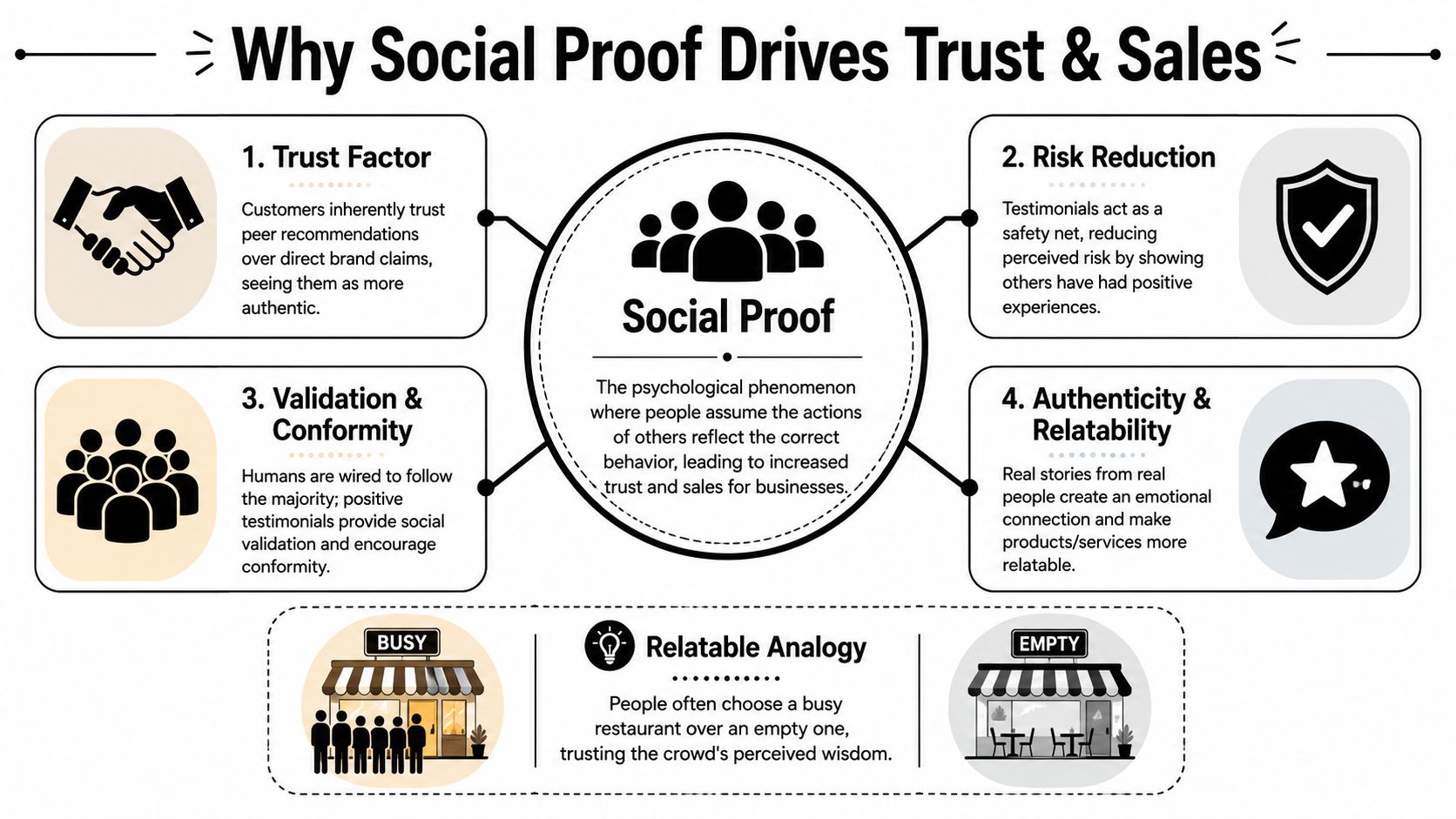
That isn't just a nice theory. Customer testimonials hold the highest effectiveness rating for content marketing at 89%, and Nielsen data cited by Kelly Anderson Group says 89% rely most on peer recommendations while only 23% trust ads from influencers. You can review those figures in Kelly Anderson Group's breakdown of testimonial impact.
The lesson for a beginner is straightforward. If your ads sound like ads, cold traffic stays skeptical. If your ads sound like customers explaining what changed for them, the message lands faster.
Trust rises when risk feels lower
Shoppers don't just ask, “Do I want this?” They also ask, “Will this disappoint me?” Testimonial advertising works because it lowers that second question.
A useful testimonial does this in a way product copy can't. It shows the before state, the purchase decision, and the after state. That sequence helps buyers visualize the outcome instead of guessing.
Here's what strong social proof usually communicates:
- Someone similar bought it first: That makes the decision feel less lonely.
- The product solved a specific problem: That makes the value easier to judge.
- The experience felt real: Small imperfections often make the message more believable than a polished slogan.
A testimonial ad works best when the shopper can say, “That's exactly the problem I'm trying to solve.”
This is especially important for first-time dropshippers. Unknown brands don't get the benefit of reputation. Your customer stories have to carry part of that weight. When they do, your ad creative stops sounding like a pitch and starts sounding like evidence.
The Main Types of Testimonials and Their Impact
Not all testimonial formats pull the same weight. For most small ecommerce stores, three formats matter most: UGC video, text quotes with an image, and star ratings or review snippets. Each has a different job.
Three formats most small stores should start with
UGC video is usually the strongest option when you need attention in-feed. It feels native on Instagram and Facebook, and it lets the shopper hear tone, see the product, and judge authenticity quickly. Yotpo reports that shoppers who interact with User-Generated Content convert at a 161% higher rate, and placing testimonials directly on product pages can lift conversion rates by 34%. The same source also notes that testimonial-based ads drive a lower CPA than brand-only creative. See Yotpo's testimonial advertising strategies for those figures.
Text quotes with a customer photo are cheaper and faster to produce. They won't stop the scroll like a good video can, but they're useful on landing pages, product pages, email, and as supporting proof in static ads. They work best when the quote is specific and tied to a clear use case.
Star ratings and review snippets are lightweight trust signals. They don't tell a full story on their own, but they reduce friction. Think of them as credibility support rather than the whole pitch.
If you're creating your own customer-style content, this guide on how to make UGC is a practical place to start.
Testimonial format comparison
| Format | Impact Level | Typical Cost | Best For |
|---|---|---|---|
| UGC video | High | Medium | Meta ads, product demos, cold traffic |
| Text quote with image | Medium | Low | Product pages, landing pages, static creatives |
| Star ratings and review snippets | Supportive | Low | Product pages, retargeting, trust reinforcement |
A common mistake is trying to make one format do everything. It won't.
- Use video when you need to create belief fast.
- Use quotes when you need clarity near the buying decision.
- Use ratings when you need quick reassurance.
The best format is the one that matches the stage of the click, not the one that looks the fanciest.
For a small budget, start with one clean video testimonial angle and support it with quote-based proof on the product page. That combination usually makes more sense than spending time building a large review library before you've tested whether the core offer resonates.
How to Turn Customer Praise into High-Converting Meta Ads
Many beginners often get stuck. They have reviews. They may even have a few good customer messages in email or DMs. But they don't know how to turn that raw feedback into a Meta ad that speaks to a cold audience.
The workflow is simpler than it looks if you do it in order.
Ask at the right moment
Timing changes the quality of the response. Mailchimp notes that automating testimonial collection immediately post-delivery yields a 30% higher response rate. The same resource says that testimonials structured with a clear Challenge-Solution-Result narrative and quantifiable outcomes can increase ad CTR by up to 25% compared to text quotes. Those details are summarized in Mailchimp's testimonial advertising resource.
“Immediately post-delivery” matters because that's when excitement is fresh. The product just arrived. The customer is engaged. If you wait too long, the emotional detail disappears and you get flat feedback like “pretty good” or “works well.”
Ask questions that pull out a story:
- What problem were you trying to solve?
- What made you try this product?
- What happened after you used it?
- What would you say to someone who's unsure?
Those answers are ad raw material.
Shape the raw feedback into ad-ready proof
A beginner mistake is using testimonials exactly as they arrive. Real customer language is valuable, but it often needs structure. The easiest framework is Challenge-Solution-Result.
Here's what that looks like in practice:
- Challenge: “I needed something that didn't take forever to set up.”
- Solution: “I tried this because it looked simpler than the other options.”
- Result: “I used it the same day and finally stopped wasting time.”
That format works because it mirrors how buyers think. They care about the problem first, then whether your product fits, then what result they can expect.
If the customer gave you a specific outcome such as time saved, keep it. Specificity makes the story more believable. If they didn't, don't invent numbers. Use the strongest qualitative outcome they gave you.
For more examples of ads built around social proof angles, this article on social proof ads is worth reviewing.
Don't edit a testimonial into brand copy. Edit it into clear customer language.
Match the testimonial to the click intent
This is the part most articles miss. A testimonial only works well when it matches the reason the person is paying attention to the ad.
If someone stops because your hook is about affordability, and the testimonial talks about premium quality without mentioning value, the message feels off. If someone clicks because they want a simple fix, and the testimonial focuses on advanced features, you create friction instead of trust.
A practical way to think about intent matching:
- Price-sensitive click: Use a testimonial that talks about value, practicality, or getting more for the money.
- Skeptical click: Use a testimonial that begins with hesitation or doubt, then explains what changed.
- Convenience-focused click: Use a testimonial that highlights ease, speed, or reduced hassle.
- Quality-focused click: Use a testimonial that talks about durability, feel, or comparison to cheaper alternatives.
This doesn't require dozens of testimonials. It requires a small set of clearly different stories. Even three to five solid customer angles can cover a lot of beginner testing.
Build the ad like a beginner who wants clean data
For first campaigns, keep the structure tight. One testimonial ad should have one core promise. Don't stack too many claims.
A simple Meta testimonial ad often looks like this:
- Hook: Call out the problem or objection.
- Customer clip or quote: Let the buyer explain the experience.
- Product visual: Show the item in use.
- Short CTA: Point to the product page without overselling it.
After you have that, test one variable at a time. Change the testimonial angle, not everything at once. If you rewrite the hook, swap the video, change the CTA, and alter the thumbnail in the same edit, you won't know what improved performance.
Here's a useful walkthrough before you build your first batch:
One more trade-off matters here. Raw-looking videos often outperform polished creative for social placement because they feel native. But “raw” doesn't mean sloppy. Viewers still need clear audio, visible product use, and a story that gets to the point fast.
If you remember one thing, make it this: a testimonial ad should answer the exact doubt that made the click expensive in the first place. When it does, Meta gets a clearer signal, your product page gets warmer traffic, and your budget stretches further.
The Rules of Testimonials Keeping It Legal and Ethical
Beginners sometimes treat testimonials like free copy they can use however they want. That's risky. Customer praise is powerful, but you still need permission, accuracy, and basic transparency.
What to do every time
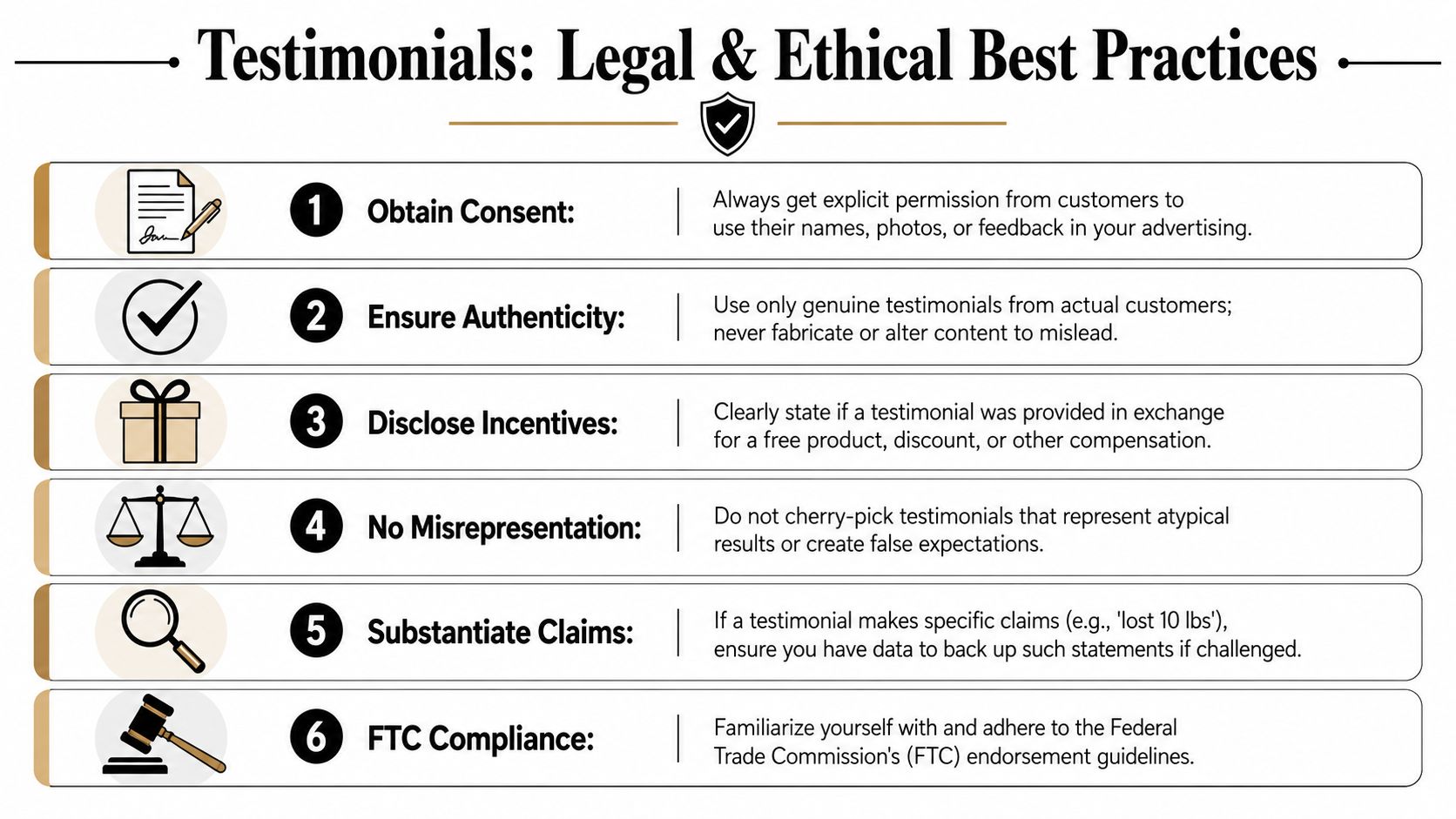
Use this as your operating checklist:
- Get clear permission: If you want to use someone's name, photo, video, or written feedback in ads, ask first and keep that approval documented.
- Use real customer statements: Don't write a better version and attach it to a buyer's name.
- Disclose incentives: If the customer received a free product, discount, or anything else in exchange for giving feedback, make that clear.
- Keep the meaning intact: Light editing for grammar or length is fine. Changing the message is not.
If you're building a broader review and content workflow, this guide to a user-generated content strategy can help you organize the process.
What to avoid
The biggest errors are usually avoidable.
- Don't fabricate testimonials: Fake reviews can damage trust fast and create legal problems.
- Don't imply universal results: One customer's experience doesn't automatically represent everyone's.
- Don't cherry-pick in a misleading way: Highlighting only extreme outcomes can create expectations your average buyer won't have.
- Don't use customer content without context: A nice DM doesn't automatically mean the person agreed to appear in your ads.
If a testimonial would make a customer say, “That's not what I meant,” don't publish it.
Ethical use also improves performance. Real stories are easier to sustain because they align with the actual buying experience. When the ad promise matches the post-purchase reality, customers complain less, refund pressure drops, and your creative library becomes easier to scale without crossing lines.
Start Turning Customer Voice into Your Best Asset
Testimonial advertising works because it replaces brand claims with customer evidence. For a new ecommerce store, that's one of the few trust advantages you can build quickly. You don't need a huge budget or a polished brand campaign. You need real feedback, the right format, and a better match between the testimonial and the shopper's intent.
The practical play is simple. Collect feedback close to delivery. Pull out stories that follow a clear challenge, solution, and result. Turn those into ads that answer one objection at a time. Put the strongest supporting proof on the product page so the click has somewhere credible to land.
If you're new to Meta ads, don't overcomplicate this. Start with a handful of authentic customer angles and test them cleanly. One story for convenience. One for quality. One for skepticism. One for value. That's enough to learn what your market responds to.
Most small stores already have more usable proof than they think. It's sitting in reviews, support messages, reorder notes, and customer DMs. The win comes from organizing that proof and deploying it with intent.
If you want help turning a product page into a practical Meta ads launch plan, Social Loop AI is built for first-time dropshippers and new ecommerce owners. It helps you choose clear angles, including social proof, and turns them into brand-aware creatives and testing plans you can launch without hiring an agency.