Blog
What Is Marketing Reach? Explained for Dropshippers
Published August 13, 2026
Marketing reach is the number of unique people who see an ad at least once. If you're staring at a Meta account and thinking a huge impression count means you're winning, that's the most common beginner mistake, because impressions can pile up on the same people while reach stays flat.
You can feel that confusion fast when you launch your first dropshipping campaign. The dashboard looks busy, the numbers keep moving, and it's easy to treat every rising metric like proof that the ad is working.
Table of Contents
- Understanding the True Meaning of Marketing Reach
- The Reach Formula and What It Tells You
- Reach vs Impressions vs Engagement
- How Meta Ads Manager Measures Reach
- Practical Steps to Grow Reach on a Small Budget
- Why Creative Angles Unlock New Reach
- Common Reach Pitfalls and How to Avoid Them
- Your One-Week Reach Action Plan
Understanding the True Meaning of Marketing Reach
A new store owner opens Meta Ads Manager, sees a pile of delivery numbers, and feels a rush of optimism. The ad has been served a lot, the campaign is active, and the instinct is to assume the audience is growing.
That instinct is why so many beginners confuse reach with impressions. Reach is the count of unique people or households exposed at least once to a campaign, so it answers one plain question, how many different humans did we touch? Amazon's marketing reach guide uses that same distinction, and it matters because a person seeing the same ad five times is still one person, not five new people.
The mistake most first campaigns make
If you launch a broad Meta ad and the same small pool keeps seeing it, the campaign can look active while the audience stays narrow. That is why marketers have treated reach as unduplicated audience for decades, long before digital dashboards made the metric feel more complicated. The old advertising logic still holds, the important question is not just how many times the ad appeared, but how many distinct people got exposure. The historical definition of reach) reflects that planning mindset.
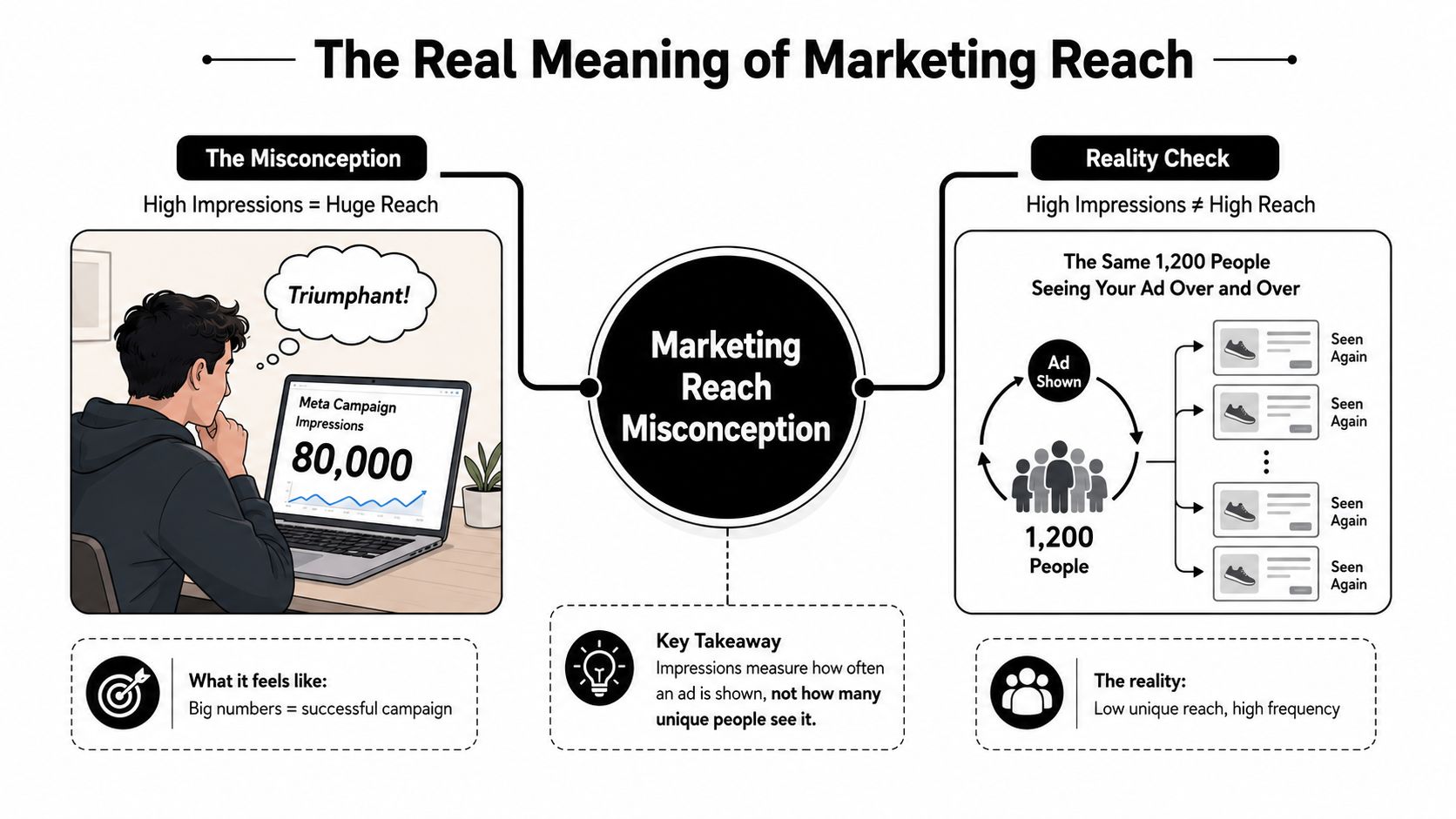
Practical rule: if your impressions climb but your reach barely moves, your ads are getting repeated more than they're getting discovered.
Why the definition still matters now
Reach still matters because social platforms can expose the same ad to huge audiences, yet each account still has to decide whether it is buying new people or recycling the same ones. That matters even more for a new dropshipper with a small daily budget, since a narrow audience can make a campaign feel busy without widening exposure.
Reach also helps you read frequency with more care. If the same people keep seeing the ad, frequency rises while reach stalls, and that usually means your budget is flowing into repetition instead of expansion. For a first Meta account, that is the point to watch on the dashboard, because a rising impression count can hide a flat audience.
New dropshippers usually get tripped up by three things, reach versus impressions, reach versus engagement, and estimated reach versus actual reach. Keep those three separate and the dashboard starts making sense instead of feeling like a slot machine.
The Reach Formula and What It Tells You
The simplest working version is Reach = Impressions ÷ Frequency. If a campaign delivers 50,000 impressions at an average frequency of 2.5, the reach is about 20,000 unique people. That formula and example are useful because they show how delivery turns into audience size.
What the ratio reveals
The ratio tells you whether your budget is buying new people or just replaying the same ad. If frequency rises while impressions stay flat, you're squeezing more repetition out of the same inventory instead of expanding the audience. That's the core tradeoff in paid media, more repetition doesn't automatically mean more market coverage.
For a dropshipper, that matters because small budgets can burn fast when the same users get hit over and over. You may still get a visible campaign, but the campaign can become a narrow loop instead of a discovery engine.
Practical rule: when frequency rises faster than reach, pause and ask whether the creative is too narrow or the audience is too small.
How to read it in Meta Ads Manager
Meta doesn't usually hand you the math in a neat little formula box, but the dashboard data lets you reverse-engineer it. Look at total impressions, then compare that with frequency and reach for the same date range. If reach grows and frequency stays controlled, you're expanding into new people. If frequency rises sharply, your budget is probably reinforcing the same viewers.
A beginner doesn't need to become a media planner to use this. You just need to read the relationship the way a store owner reads inventory. More unique viewers usually means more room to test creative, while high repetition with weak breadth usually means you need a bigger audience or a different angle.
Reach vs Impressions vs Engagement
These three metrics sit beside each other, but they answer different questions about the same ad set. Reach asks how many unique people saw it, impressions asks how many total deliveries happened, and engagement asks how many people did something meaningful after seeing it.
That distinction matters because a campaign can look busy and still be useless for growth. High impressions with low reach usually means repetition. Wide reach with low engagement usually means the ad got in front of people, but the message didn't pull them forward.
| Metric | What it counts | Strategic question it answers | Weak signal to watch |
|---|---|---|---|
| Reach | Unique people exposed at least once | How many different people saw this? | Flat reach with climbing spend |
| Impressions | Total times the ad was delivered | How often was the ad shown? | High impressions with narrow audience coverage |
| Engagement | Meaningful actions like clicks, likes, saves, or shares | Did the creative cause a response? | Attention without action |
If you want a clean explainer on how these metrics get confused in dashboards, the short guide at confused by ad performance metrics is a useful companion read.
The practical takeaway is simple. Reach tells you whether you're getting new eyes, impressions tell you how often the ad is circulating, and engagement tells you whether the message earned attention. A new dropshipper should never optimize all three the same way, because each one points to a different problem.
How Meta Ads Manager Measures Reach
A new dropshipping ad can show decent spend and still miss the mark if the same small group keeps seeing it. Inside Meta Ads Manager, reach is the platform's estimate of how many unique people saw your ad at least once. The system tries to count one person once, even if they saw the ad on more than one device or more than once during the same period. It is useful, but it is still an estimate rather than a perfect census.
That estimate only makes sense inside the audience pool Meta can serve. A lookalike audience starts from a different seed, interest stacking can narrow or widen the pool, and account behavior affects which users are likely to be included in delivery. Two ad sets can spend in a similar way and still hit very different reach ceilings because the eligible audience is not the same.
Why platform ceilings differ
Platform-level reach gives beginners a reality check. Reported monthly advertising reach is often discussed at the platform level, with figures such as 2.65 billion on YouTube, 2.39 billion on Facebook, 2.21 billion on TikTok, and 1.99 billion on Instagram. Those figures) are not your account results. They show that each platform has its own scale and its own ceiling.
That is why copying one channel's numbers into another channel's plan usually fails. A small dropshipping account works inside a platform system, not on a blank slate. The dashboard shows the best available estimate of unique exposure, but your audience pool, creative, and budget all shape what that estimate can become.
What to trust in the dashboard
Use reach as your breadth signal, frequency as your repetition signal, and impressions as your delivery signal. Then compare them over the same date range. If you want a clearer walkthrough of the reporting fields in Meta, the guide on Meta ads reporting is a useful companion.
A new dropshipper does not need perfect precision from the number. The real question is whether the estimate shows your budget reaching more unique people, or just showing the same people again. That is the part to watch on the dashboard.
Practical Steps to Grow Reach on a Small Budget
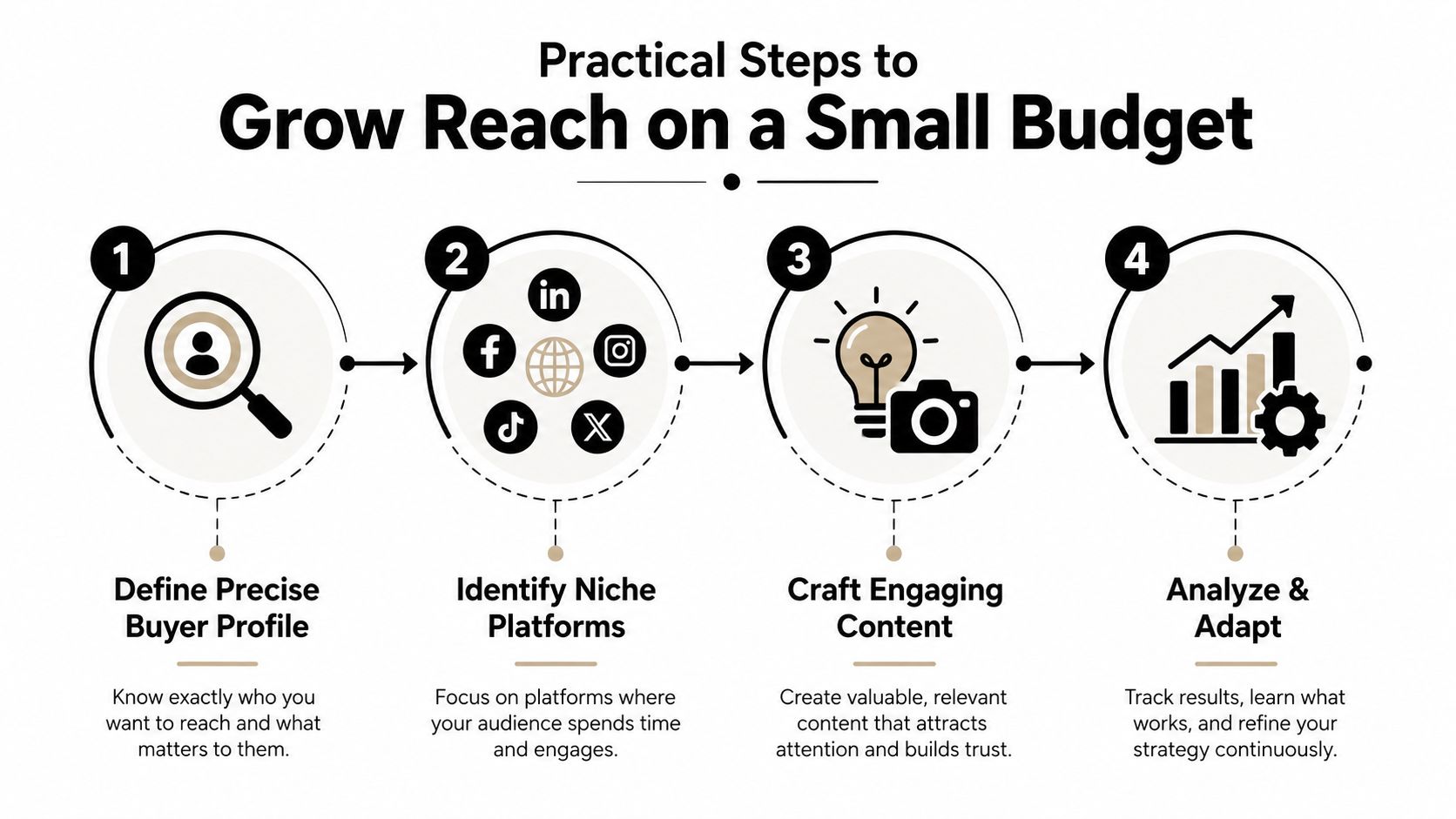
A small budget doesn't automatically mean small reach, but it does mean every choice has to work harder. The first lever is your buyer profile, because a precise audience stops wasted delivery before it starts. The second lever is your creative angle, because fresh angles help Meta find different clusters of people who respond to different messages.
A simple round-by-round way to test
Start by defining who buys the product, not who could vaguely like it. Then pick three to five angles that match common buyer motivations, such as Problem-Solution, UGC, Social Proof, FOMO, or Identity. Those angles give Meta different signals to work with, which helps the system explore more than one pocket of the market.
Practical rule: on a limited budget, audience clarity and creative clarity beat raw spend.
A useful test structure looks like this:
| Round | Audience | Angle | Daily budget | Decision rule after 5 to 7 days |
|---|---|---|---|---|
| 1 | Precise buyer profile | Problem-Solution | Capped for the test | Keep if reach grows without runaway frequency |
| 2 | Same audience, different angle | UGC | Capped for the test | Keep if unique delivery improves |
| 3 | Same audience, proof-based angle | Social Proof | Capped for the test | Pause if repetition climbs too fast |
| 4 | Secondary audience cluster | FOMO or Identity | Capped for the test | Scale only if breadth stays efficient |
The point of the round structure is to stop guessing with your whole budget at once. You give each audience and angle a fair shot, then you let the reach and frequency relationship tell you where to go next.
How to time the test
Give the campaign 5 to 7 days before judging it. That window is long enough to see whether unique delivery is happening and short enough to avoid drifting into a weak spend pattern. If you're comparing options inside a system like Social Loop AI, it can turn a product URL into a launch plan and creative batch, then help you map rounds by audience and angle instead of improvising inside Ads Manager.
If you want a broader view of brand-level testing, the guide on brand awareness campaigns is worth a look. For a first-time dropshipper, the lesson is the same, budget is not the only lever, structure is.
Why Creative Angles Unlock New Reach
Meta doesn't just match ads to demographics, it learns from how people respond to creative patterns. That means one product can hit different pockets of the market when the message changes, even if the audience stays similar. A new dropshipper who only changes budget is usually feeding the same message to the same kind of user.
Match the angle to the buyer mindset
Problem-Solution works for people who already feel the pain point and want relief. UGC tends to fit buyers who trust peer-style content more than polished branding. Social Proof helps comparison shoppers feel safer, while FOMO catches deal-driven scrollers who respond to urgency. Identity ads speak to people who buy partly because the product matches how they see themselves.
That variety matters because it widens the set of users who might respond. A single creative angle can lock you into one type of attention, while multiple angles give the delivery system more ways to find fresh sub-audiences.
Practical rule: if you only change the audience and keep the same creative, you often keep talking to the same buyer mindset.
Why variety beats brute force at low spend
Small accounts don't have room to brute-force their way into breadth. They need the algorithm to see different signals, and different angles create those signals. One batch can surface people who want a fix, another can surface people who want proof, and another can surface people who want belonging.
That's why rotating through 3 to 5 angles is more effective than just pumping in more money. It gives Meta a cleaner way to explore without forcing your budget into one repetitive loop.
Common Reach Pitfalls and How to Avoid Them
The first mistake is overspending on a broad audience with weak creative. The symptom is simple, impressions rise, but reach doesn't spread the way you expected. The fix is to tighten the buyer profile and improve the angle before you add more budget.
The second mistake is chasing reported reach without checking overlap. If your warm audience, retargeting pool, and prospecting set all blend together, you can end up double-counting people who already know you. A clean account separates those pools so you can tell whether you're finding new people or recycling familiar ones.
The third mistake is ignoring creative fatigue. The ad still runs, but the same people keep seeing the same message until delivery gets stale. If frequency starts climbing and unique-user growth flattens, it's time to refresh the creative before the audience burns out.
The fourth mistake is mistaking a vanity spike for a real system. A single post can pop off, or one unusual placement can inflate delivery, but that doesn't mean you've built repeatable reach. A scalable account looks steady enough that you can explain why it worked.
| Pitfall | What it looks like | What causes it | Fast fix |
|---|---|---|---|
| Broad audience, weak creative | Lots of delivery, little new audience growth | The message is too generic | Narrow the buyer profile |
| Overlap in warm traffic | Reach feels bigger than it really is | Audience pools blur together | Separate prospecting and retargeting |
| Creative fatigue | Repetition climbs, response falls | People keep seeing the same ad | Refresh the angle |
| Vanity spike | One sudden surge looks like success | A one-off post or placement | Test for repeatability |
If you catch these early, the budget lasts longer and the dashboard becomes easier to trust. If you miss them, small losses stack up because the campaign looks active even while it stalls.
Your One-Week Reach Action Plan
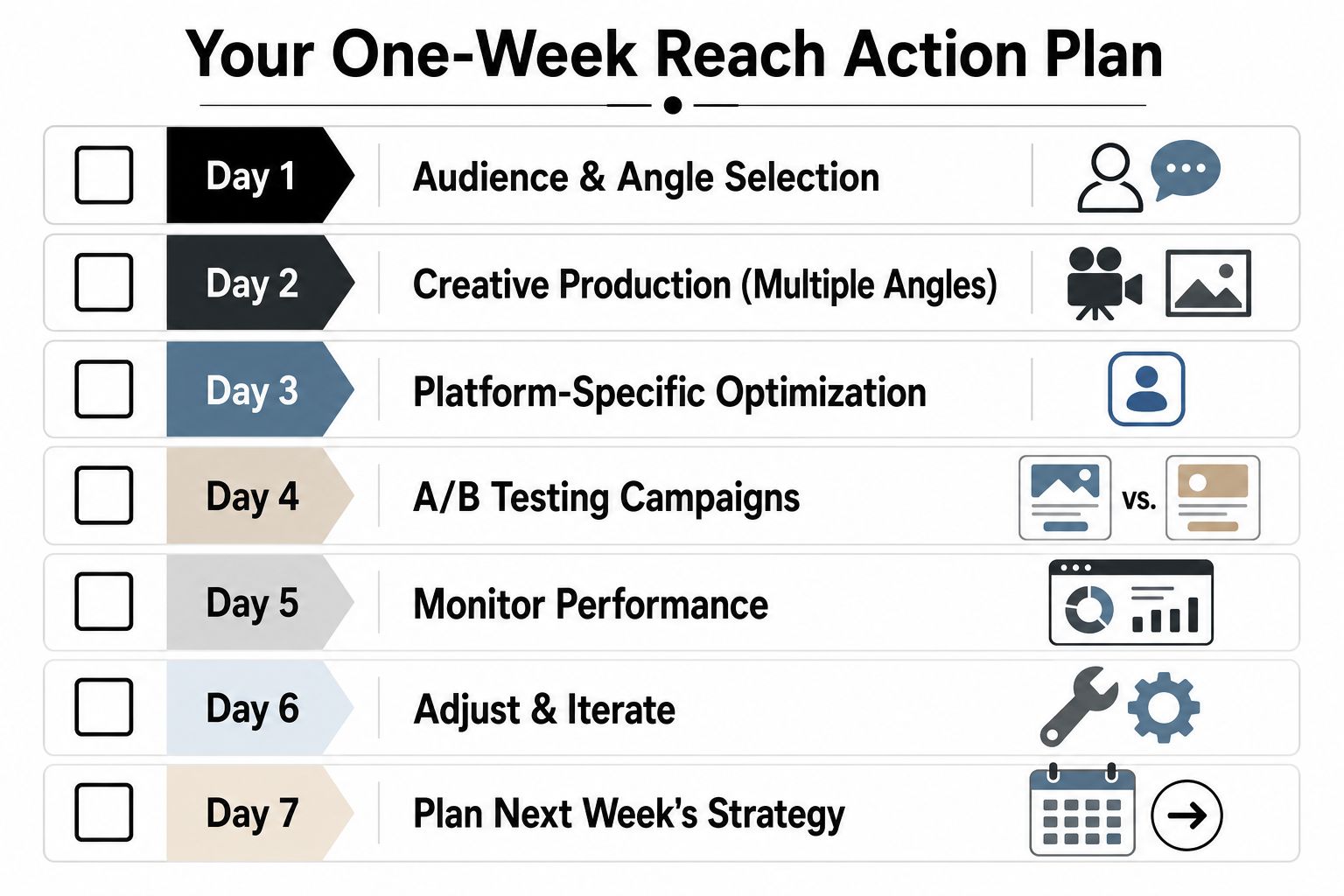
Start with audience and angle selection on day one. Choose a precise buyer profile, then pick a few creative angles that fit that buyer, so you're not launching with a vague message and hoping the algorithm figures it out for you.
On day two, produce the creative and keep each version tied to one angle. On day three, launch with capped budgets per round, so each test has a fair chance to show whether it can expand reach without pushing frequency too high.
The weekly rhythm
- Day 1, Audience and angle selection: lock the buyer profile and the test angles.
- Day 2, Creative production: build multiple versions instead of one generic ad.
- Day 3, Launch: keep budgets capped so each round stays readable.
- Days 4 to 6, Monitor only: don't chase every fluctuation with edits.
- Day 7, Review: compare reach, frequency, and the cost of each unique viewer, then decide what to scale or pause.
A clean weekly habit beats random tinkering. If reach is growing while frequency stays controlled, keep going. If frequency rises and reach stalls, the problem is usually audience fit or creative fit, not the dashboard itself.
That's the shift for a new dropshipper. Reach stops being a vanity metric and becomes a budget lever you can control with better audience choices, better angles, and a tighter test cycle.
If you want a faster way to turn a product page into a Meta launch plan, Social Loop AI builds the audience, angle, and creative structure for you in one workflow. Visit Social Loop AI to see how it can help you plan reach more deliberately before you spend your next ad dollar.