Blog
Referral Marketing Strategy: Beginner's Guide 2026
Published June 23, 2026
You launched the store. A few orders came in from Meta ads, maybe from a creator post, maybe from friends who wanted to support you. Then the uncomfortable math showed up. Every new sale still depends on more spend, more testing, and more risk.
That's the moment when most founders either keep buying traffic and hope efficiency improves, or they build a second acquisition path that gets stronger with each happy customer. For a new store, that second path is referral.
The catch is that most referral advice assumes you already have a loyal customer base, healthy margins, and a pile of glowing reviews. New ecommerce stores usually have none of that. You might have one product, thin margin, no advocates yet, and a very small list. Your referral marketing strategy has to respect that reality, or it becomes another nice-sounding tactic that burns cash.
Table of Contents
- Beyond Your First Sale Why Referrals Are Your Next Best Move
- Designing a Program That Works for New Stores
- Building Your Referral Engine Mechanics and Messaging
- Tracking Success and Optimizing Your Funnel
- Amplifying Your Program with Paid Social Ads
- Common Pitfalls and Your Launch Checklist
Beyond Your First Sale Why Referrals Are Your Next Best Move
Your first paid sales prove that strangers will buy. They do not prove that your store can grow profitably. That depends on what happens after the first order.
A strong referral marketing strategy gives you a channel that doesn't start from zero trust. A referred shopper arrives with context. They're not trying to figure out whether your product is real, whether the site looks sketchy, or whether your ad is exaggerating. Someone they know already did part of that filtering for them.
That trust changes the economics. A 2025 to 2026 industry research roundup on referral marketing reports that referral programs deliver roughly 3 to 5 times higher conversion rates than other major acquisition channels, and referred customers convert at rates about 30% higher than non-referred leads on average.
For a new store, that matters more than it does for a large brand. You don't have room for waste. You can't afford broad traffic that clicks, bounces, and asks you to keep paying for retargeting until maybe it converts later.

Why referrals fit early-stage stores
Most new founders think referrals are something to add later, after reviews, email flows, and repeat purchase systems are polished. In practice, referrals work best when they're built into the store early, while you're still shaping your post-purchase experience.
Three reasons:
- They compound trust: One good delivery experience can lead to the next buyer.
- They reduce dependence on cold traffic: You still need ads, but not every new customer has to come from them.
- They create better proof assets: Every referred buyer can become a review, UGC source, or the next sender.
If you're already working on creative that leans on testimonials and customer reactions, this pairs naturally with the thinking behind social proof ads for ecommerce growth.
Referred traffic doesn't replace paid traffic. It makes paid traffic less lonely.
What works better than waiting
What doesn't work is telling yourself you'll “launch a referral program once the brand is bigger.” New stores don't need a complex program. They need a basic loop:
- A buyer has a smooth first experience.
- You ask them to share at the right moment.
- Their friend gets a clear reason to try.
- You track what happened.
That's enough to start. The goal isn't to build a glossy loyalty machine. The goal is to turn the first pocket of customer satisfaction into your cheapest next acquisition source.
Designing a Program That Works for New Stores
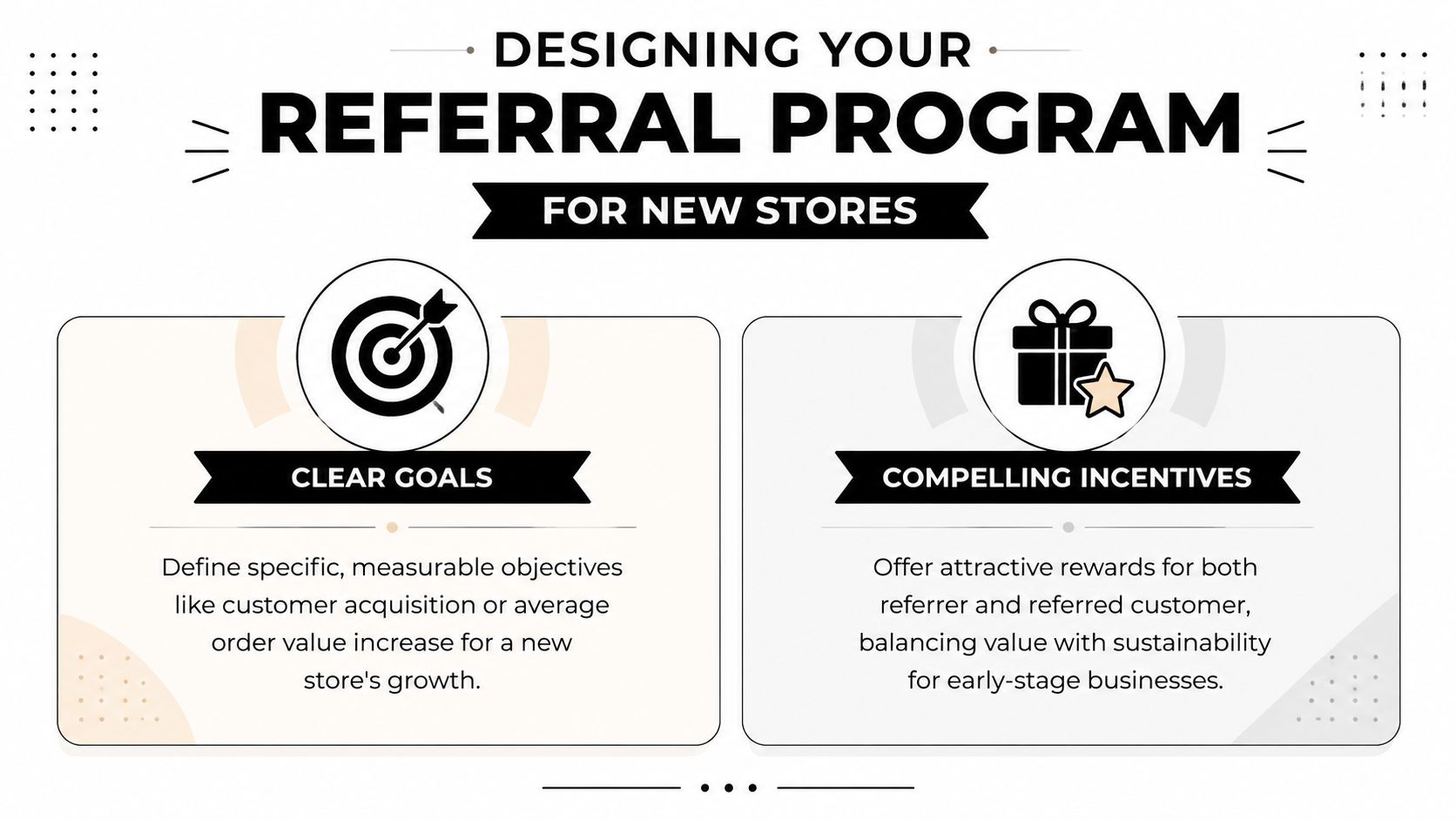
Most referral programs fail before launch because the reward math is wrong. Founders copy a big-brand template, offer cash or a deep discount to both sides, and realize the program only works if margin magically expands.
New stores need a tighter model. Your reward has to feel worth sharing without turning every referred order into a loss.
Start with one business goal
Don't launch with five goals. Pick one.
A practical first goal is usually one of these:
| Goal | Best when | Watch out for |
|---|---|---|
| Lower acquisition cost | Paid ads are working, but margins are tight | Don't over-reward and erase the savings |
| Increase repeat purchase | Your product can be bought again or paired with add-ons | Store credit often works better than cash |
| Build early social proof | You need shares, mentions, and friend-to-friend visibility | Avoid vague “ambassador” language |
If you're small, I'd usually favor either lower acquisition cost or repeat purchase. Both keep the program tied to survival, not vanity.
Pick incentives that protect margin
New dropshippers usually make an expensive mistake. They think the reward has to be cash-like to motivate anyone. Often it doesn't.
Research summarized by CustomerGauge on referral rewards and customer lifetime value mechanics notes that low-margin categories see higher referral uptake when rewards are framed as social capital or exclusive perks rather than pure monetary discounts. That's a useful lens for low-ticket ecommerce.
For a young store, good incentive options usually look like this:
- Store credit instead of cash: Credit keeps value inside your ecosystem and can pull the referrer back for another order.
- Early access to new drops: If you're testing product variations or limited inventory, early access feels exclusive without forcing a hard cost.
- Bundle perks: “Refer a friend and receive the bonus accessory on your next order” can be easier to support than a blunt discount.
- VIP treatment: Priority access, private previews, or first look emails cost little but can still feel earned.
- Recognition rewards: Featuring top referrers in your email or private customer group can work when your brand has identity appeal.
A weak incentive for low-margin stores is a generic blanket discount that both sides can stack. It sounds fair. It often wrecks contribution margin.
Later in the section, it helps to see someone explain the mechanics visually:
Keep the offer simple enough to explain in one line
If a customer can't repeat your referral offer from memory, it's too complicated.
Good:
- Give your friend a welcome perk. Get store credit when they place their first order.
- Share your link. If they buy, you get early access to our next drop.
Bad:
- Invite eligible new customers to complete a qualifying purchase under specific terms and receive a reward subject to review.
Practical rule: If your referral offer needs a FAQ to make sense, simplify the offer before you design the assets.
A simple structure for new stores looks like this:
- Friend benefit first. This gives the sender a clean reason to share.
- Referrer reward second. Keep it clear and delayed until the qualifying order happens.
- One validation event. Usually a completed first purchase.
- One delivery method. Either a link or a code, not both at launch.
You do not need a clever tier system on day one. You need a reward you can afford repeatedly.
A margin-safe way to think about reward size
You don't need a spreadsheet monster. You need one rule. The reward should leave room for product cost, fulfillment, payment fees, and a reasonable cushion. If that cushion disappears, your program is buying revenue, not generating profitable growth.
For many new stores, non-cash rewards are safer because they let you create perceived value without matching that value in hard cost. That's why exclusive perks, access, and credit often beat direct cash for young brands.
The right referral marketing strategy for a new store is not the most generous one. It's the one you can keep running without flinching every time someone uses it.
Building Your Referral Engine Mechanics and Messaging
A referral program is just a small machine. It needs a trigger, a path, and a reward. If any one of those parts is clumsy, people stop sharing.
The two most practical setup decisions are the mechanism and the timing. The mechanism is how customers share. The timing is when you ask.
Choose links or codes based on friction
For most new ecommerce stores, unique links are the better default. They're easier for customers to tap, forward, and use without explanation. They also make tracking cleaner because the click carries the referral identity with it.
Codes can still work, especially if your audience shares verbally, through creators, or in communities where people like posting short codes. But codes create more chances for error. Someone forgets a letter, types the wrong thing, or applies the code without the story behind it.
Use this quick decision table:
| Option | Better for | Main drawback |
|---|---|---|
| Referral link | Email, SMS, DM, post-purchase pages | Less memorable if shared offline |
| Referral code | Creator mentions, community posts, verbal sharing | More user error and weaker attribution |
If you're deciding between “clean branding” and “fewer drop-offs,” choose fewer drop-offs.
Ask at the moment of relief not the moment of purchase
Most stores ask too early. Right after checkout, the customer hasn't experienced anything yet. They bought with hope, not proof.
For new brands, timing matters even more because there are no established advocates carrying the program. According to Volta Strategies' discussion of the referral gap for early-stage brands, early-stage referral rates can be 2 to 3 times higher when a referral ask is embedded immediately after a frictionless first delivery confirmation rather than weeks later.
That lines up with what you'd expect emotionally. Delivery confirmation is the relief moment. The order arrived. The product is real. Anxiety drops. Sharing feels safer.
Use these touchpoints first:
- Delivery confirmation email: Best first ask for new stores.
- Post-delivery SMS: Keep it short and direct.
- Thank-you page for repeat buyers: Better for reactivation than first-touch referrals.
- Insert card in the package: Works if the experience is clean and the offer is easy to understand.
Ask after trust lands, not before.
Use copy people can forward without editing
Most referral copy fails because it sounds like a campaign, not a recommendation. Your customer isn't a media buyer. They want to send something that sounds normal in a text thread.
Here are practical starting templates.
Post-delivery email
Subject: Share with a friend, get a thank-you reward
Body:
Your order landed. If you liked the experience, you can share your link with a friend.
They'll get a welcome perk on their first order. Once their order qualifies, you'll get your reward too.
[Share my link]
SMS or WhatsApp prompt
Message:
Your order arrived. Want to share it with a friend? Send your link and they'll get a welcome perk on their first order: [referral link]
Pre-written friend message
Forwardable copy:
I ordered from this store recently and had a good experience. If you want to try it, use my link for the first-order perk: [referral link]
Referral landing page headline
Headline: A friend sent you here
Subhead: Use this referral offer on your first order and try the product with a little less risk.
That tone matters. It's specific, calm, and believable. It doesn't sound like your customer suddenly became your ad agency.
Tracking Success and Optimizing Your Funnel
If you don't track referrals properly, you'll either under-credit the channel or over-reward the wrong people. Both are expensive.
New founders usually overcomplicate measurement. You don't need a huge dashboard at launch. You need a short chain of evidence that tells you whether the loop is working.
Track three numbers first
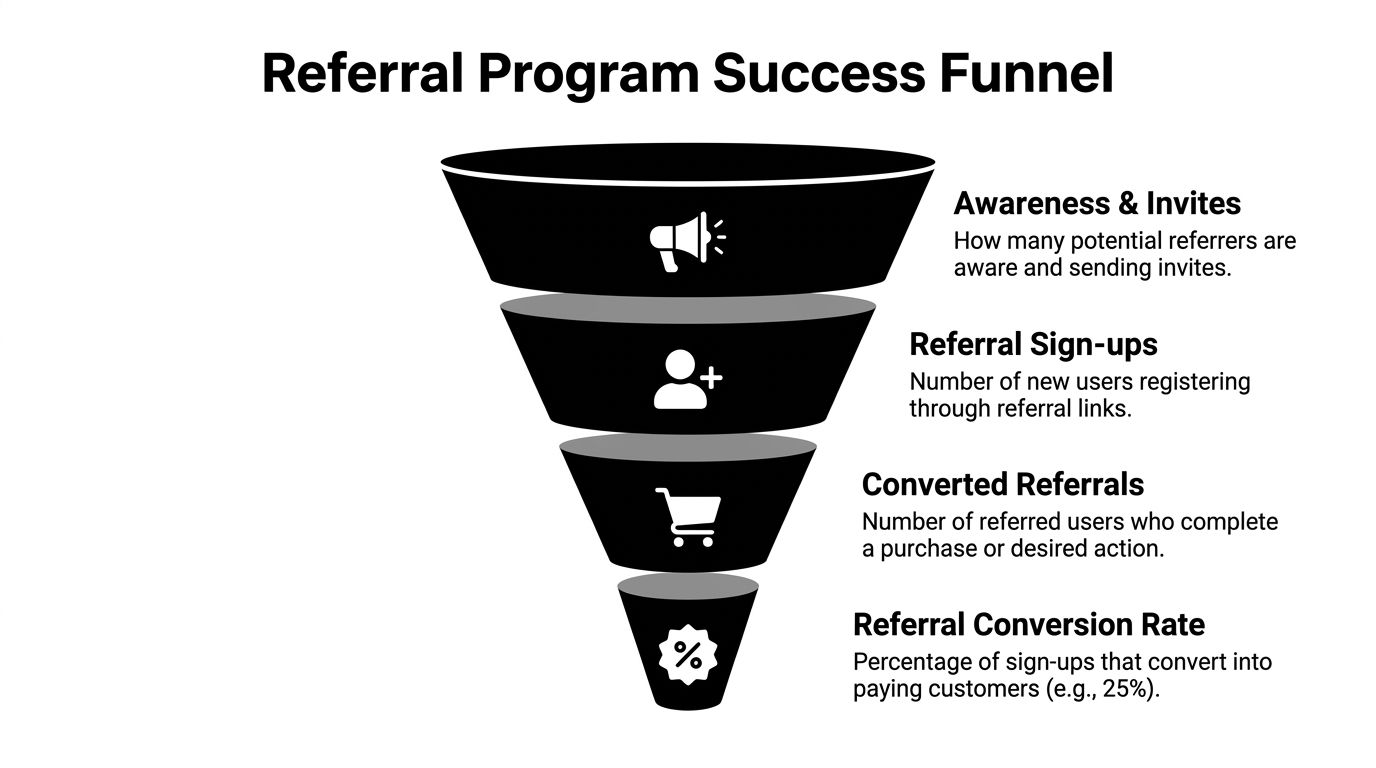
The first metric to lock down is referral rate. Wall Street Prep's explanation of referral rate defines it as (number of referred customers / total new customers) × 100 and notes that well-instrumented referral programs achieve referral rates of 15 to 25%.
That gives you a clean north star. Then add two supporting metrics:
- Referred friend conversion rate: Of the people who land through a referral, how many buy?
- Reward cost per converted referral: What did you have to give up to generate that order?
Those three numbers tell you whether the channel is healthy.
Treat attribution like labeling jars
Attribution sounds technical, but the basic idea is simple. If you put three spices into identical jars and remove the labels, you won't know what you're cooking with later.
Referral tracking works the same way. Every referred visit needs a label attached early enough that your store, CRM, or app can recognize it later.
At minimum, track:
| Field | Why it matters |
|---|---|
| Referral source | Tells you who sent the visit |
| Referral date | Helps validate timing rules |
| Prospect ID or email | Prevents duplicate reward issues |
| Conversion event | Confirms whether the referral actually qualified |
Clear validation rules matter just as much as the tracking. Decide upfront what counts as a valid referral. Usually that means a new customer completes a qualifying first purchase within your stated window. If you don't define this early, customer support ends up interpreting the rules one email at a time.
Send referred traffic to a page built for referred traffic
A common mistake is sending referral clicks to the homepage. That wastes the built-in trust of the referral.
A referral landing page should do three things fast:
- Acknowledge the friend connection
- Restate the first-order benefit clearly
- Push the visitor toward one action
Keep the page lean. Don't make the visitor hunt for the product, the discount, or the next step. If the referral came from a specific product owner or product page, consider sending them directly there with the referral state preserved.
If your current pages convert weakly, it's worth reviewing practical landing page conversion optimization tactics for ecommerce before scaling referral traffic.
A referral visit is warmer than cold traffic, but it still needs a clean page and an obvious next click.
You can optimize later with tests on headlines, friend-first copy, and page layout. At launch, clarity beats creativity.
Amplifying Your Program with Paid Social Ads
Referral and paid social usually get treated as separate channels. For new stores, that's a mistake. Paid social can help you recruit your first referrers, not just your next buyers.
That matters when your customer base is still tiny. A referral program hidden in an account page won't grow on its own if almost nobody knows it exists.
Use ads to recruit referrers not just buyers
A useful finding from Thrive Agency's referral marketing guide is that campaigns combining timely asks, low-friction sharing, and segmented incentives produce 20 to 40% higher referral volume. In practice, paid social can support the “timely ask” part by acting as an automated nudge to the right customer segment.
For a small store, that means you can run paid social in a different way:
- Retarget recent customers with a referral invite
- Show a soft referral message after delivery, not before
- Segment messaging by purchase type or product interest
- Promote the easiest sharing path, usually a direct link
This is a very different job from conversion campaigns. The ad doesn't need to sell the product from scratch. It needs to remind a recent buyer to share something they already trust.
Build a small loop before you scale it
Start with your warmest audience. Recent customers. Email subscribers who bought. People who engaged after delivery. Keep the creative plain. “Share with a friend” often works better here than brand theater.
Once you see who shares and who drives qualified orders, you can use that insight to shape broader acquisition. The message, audience traits, and post-purchase timing from your referral winners often reveal what your brand should emphasize elsewhere.
This is also where disciplined budget use matters. If you're already stretching paid spend across prospecting, retargeting, and creative testing, you need to protect the channel mix. A good primer on marketing spend optimization for ecommerce can help you decide when a referral-nudge campaign deserves budget.
One caution: don't force paid social to rescue a broken referral offer. Ads amplify. They don't fix a weak incentive, confusing rules, or a clunky sharing flow.
Common Pitfalls and Your Launch Checklist
Most new referral programs don't fail because founders lack ambition. They fail because the setup asks too much from the customer and too little from the operator.
Why referral programs fail early
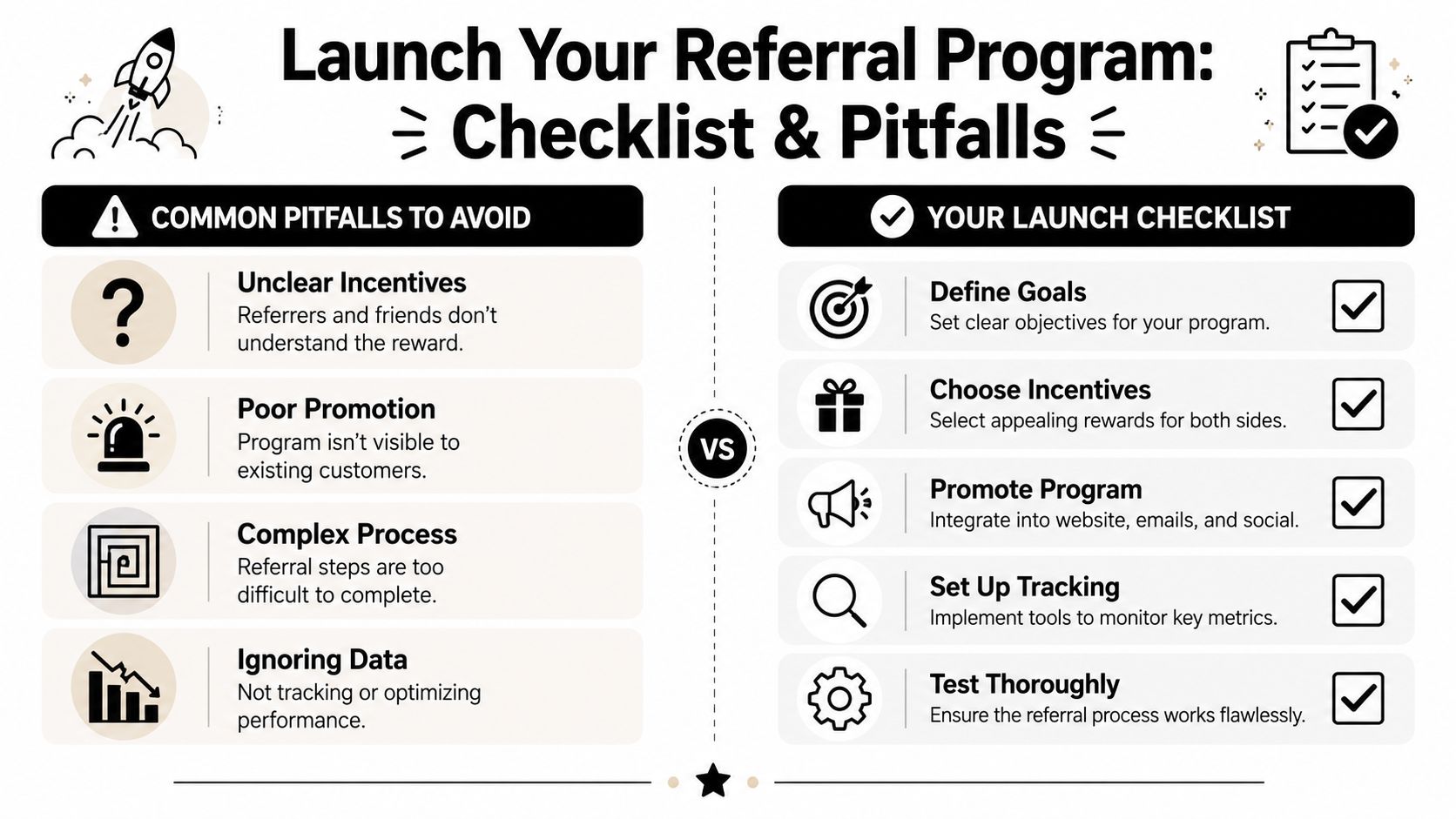
The first failure point is usually unclear incentives. If the customer can't tell who gets what and when, they won't share. The second is bad visibility. A decent program hidden in a footer link behaves like no program at all.
The third problem is too much friction. Long forms, multiple steps, or awkward code handling kill momentum. The fourth is no follow-up. If you ask once and disappear, the program stalls.
Here's the short list of what to avoid:
- Vague reward language: “Earn exciting perks” is weaker than a concrete benefit.
- Late asks: Waiting too long cools the customer's enthusiasm.
- Homepage-only routing: Referred visitors need a relevant destination.
- Manual tracking in scattered tools: This becomes a support mess fast.
- Set-and-forget thinking: Referral programs need small adjustments, not neglect.
The best early referral program is the one customers can use without contacting support.
A practical 7 day launch checklist
You do not need months to launch a first version. You need one focused week and a bias toward simplicity.
Day 1
Choose your single goal. Lower acquisition cost, repeat purchase, or social proof.
Day 2
Pick one reward structure that fits your margin. Write the offer in one sentence.
Day 3
Set your validation rule. Define what counts as a successful referral and when the reward triggers.
Day 4
Build the mechanics. Create the referral link or code system and make sure it works on mobile.
Day 5
Write the messaging. Delivery confirmation email, SMS prompt, share message, and referral page copy.
Day 6
Test the full path. Click the link, place a test order if possible, and confirm the reward logic is tracked correctly.
Day 7
Promote it. Add the referral message to post-purchase email, delivery confirmation, account area, and any warm retargeting audiences.
If you're a new founder, the main advantage you have is speed. Bigger brands can outspend you. They usually can't out-iterate you. Launch the simplest usable version, watch where customers hesitate, and tighten the loop.
A working referral marketing strategy doesn't need to look complex. It needs to be easy to understand, affordable to run, and tied to real customer moments.
If you're launching your first product and want a clearer way to connect ads, landing pages, and referral-friendly customer journeys, Social Loop AI helps new ecommerce owners turn a product URL into a practical Meta ads plan, brand-aware creatives, and conversion-focused page improvements without hiring an agency. It's built for founders who need a budget-aware system they can utilize.