Blog
How to Grow on Tik Tok: A Founder's 2026 Playbook
Published May 13, 2026
You've probably done this already. You filmed a product demo at your desk, added a trending sound, wrote a caption with a couple hashtags, hit post, and got almost nothing back. A few views. Maybe one like. No sales. No clue what to fix.
That's where most founders get stuck with TikTok. They assume growth comes from luck, personality, or endless posting. It doesn't. The accounts that turn TikTok into revenue usually run a system. They know who the content is for, what format they repeat, what signals they watch, and when to move from organic attention into paid retargeting.
For a small ecommerce brand, that shift matters. If you treat TikTok like a casino, you burn time. If you treat it like a testing channel, you learn what buyers respond to before you spend real money on ads. That's the difference between “trying content” and building a growth engine.
Table of Contents
- Your TikTok Growth Starts Here
- Build Your Foundation for Lasting Growth
- Develop Your Unbeatable Content Engine
- Create High-Impact Videos on a Budget
- Implement a Smart Distribution and Testing Strategy
- Scale from Views to a Profitable Community
- Your 30-60-90 Day TikTok Action Plan
Your TikTok Growth Starts Here
A founder I know had a good product, decent margins, and a clean Shopify store. TikTok still felt broken. She posted polished clips that looked like ads, got weak reach, then copied random trends that had nothing to do with the product. Reach improved a little, but sales didn't. The problem wasn't effort. The problem was that her content had no job.
That's the trap with advice on how to grow on tik tok. Most of it stops at visibility. More trends. More hooks. More posting. That can help, but it won't build a useful funnel unless each video does one of three things: stop the scroll, qualify the viewer, or warm up a future buyer.
What works better is a full-funnel view. Organic TikTok is where you test angles cheaply. You learn whether buyers respond to pain-point hooks, demonstrations, before-and-after framing, founder stories, or social proof. Then you take the angles that pull attention and carry them into Meta retargeting, where buyers see a more direct offer after they already know the product.
Practical rule: Don't ask every TikTok to make a sale. Ask it to earn the next step.
That changes how you judge content. A video that doesn't convert on-platform can still be a winner if it attracts the right people, drives profile visits, and creates a warm audience for later retargeting. On a tight budget, that's a smarter way to win than trying to force first-touch purchases from cold traffic.
Build Your Foundation for Lasting Growth
TikTok rewards momentum, but the setup still matters. If the account looks vague, off-brand, or hard to understand, even good videos lose follow-through. The first job is to make the account easy to classify for both viewers and the platform.
TikTok's scale is the reason this matters so much. The platform reached 1 billion monthly active users in September 2021 and surpassed 1.8 billion by early 2024, with 36% of users under 24, over two-thirds under 34, and 95 minutes of average daily use, according to TikTok user and demographic data. That's a massive pool of attention, but only if your page quickly tells the right people, “This is for you.”
Stop trying to talk to everyone
Most small brands stay too broad. “Home essentials.” “Beauty products.” “Lifestyle accessories.” Those aren't niches. They're shelf labels.
Pick a sharper lane based on buyer intent. A posture product isn't in “wellness.” It's for desk workers with back tension, students hunched over laptops, and people who want a simple at-home fix. A kitchen gadget isn't “cooking.” It's quick cleanup, small apartments, meal prep, or busy parents who hate extra steps.
Use this filter before you post anything:
- Buyer pain. What annoying problem shows up in daily life?
- Usage moment. When does someone reach for the product?
- Identity cue. Who sees this and says, “That's me”?
- Purchase trigger. What makes them buy now instead of later?
When your niche is clear, your content gets easier. Hooks improve. Comments become more relevant. Your future ads also get better because the organic signal already told you which angle resonates.
Turn your profile into a mini storefront
Your profile should do three jobs in seconds. Explain what you sell, why it matters, and what someone should do next.
A simple profile checklist works:
| Profile element | What to do | Common mistake |
|---|---|---|
| Username | Make it searchable and brand-aligned | Using extra symbols or unrelated words |
| Profile photo | Use a clear logo or face if founder-led | Tiny, cluttered image |
| Bio | Say who the product helps and the outcome | Writing a slogan nobody understands |
| Link | Send traffic to the most relevant page | Linking to a generic homepage |
| Pinned videos | Pin your clearest intro, best demo, best proof | Pinning random posts |
If TikTok offers a Pro Account upgrade in your region, use it. Analytics matter early. You want access to audience details, content performance, and follower activity patterns so posting turns into informed testing instead of guesswork.
Your bio isn't branding fluff. It's a conversion surface.
Keep the wording plain. “Portable blender for busy mornings” beats “redefining modern wellness.” “Jewelry that doesn't snag sweaters” beats “timeless elegance for every moment.” Founders often try to sound premium when they should sound clear.
Develop Your Unbeatable Content Engine
The biggest mistake I see is treating every TikTok like a brand new creative challenge. That burns time fast. A better move is to build a repeatable content engine where ideas come from a small set of proven themes.

Pick a few pillars and repeat them
For most ecommerce brands, three to five pillars are enough. More than that and the account starts to drift.
A practical setup looks like this:
-
Product in action
Show the item solving a real problem. Not a studio montage. A real use case, filmed like a customer would film it. -
Pain point and fix
Start with the frustration. Bad storage. Messy counters. Skin irritation. Dead phone battery. Then show the product removing friction. -
Behind the business
Packaging orders, testing samples, rejected versions, shipping mistakes, restocks. This gives a small brand texture and trust. -
Customer reactions or proof
Use testimonials, common questions, replies to objections, or stitched reactions if you have them. -
Comparison content
Old way versus new way. Cheap version versus durable version. Manual process versus faster process.
That gives you a weekly matrix instead of random posting. One founder video. One problem-solution demo. One proof clip. One comparison. One behind-the-scenes post. Now content planning is mechanical.
Here's a simple matrix you can reuse:
| Pillar | Hook example | Body | CTA |
|---|---|---|---|
| Product in action | “I stopped using the old version for this reason” | Show the product in use | “See the details in bio” |
| Pain point and fix | “If your kitchen always ends up like this…” | Show mess, then solution | “Would you use this?” |
| Behind the business | “What actually happens before we ship these” | Packing, testing, mistakes | “Ask me anything about the product” |
| Proof | “The comment we keep getting” | Answer with demo or screenshot-style proof | “Want me to test another use case?” |
Build every video around retention
TikTok doesn't just care whether people stop. It cares whether they stay. According to this TikTok algorithm growth analysis, videos with 70%+ average view duration are more likely to get broader distribution on the For You Page. That's why the first three seconds matter so much.
A lot of founders hear “strong hook” and think clickbait. That's not the point. The hook's job is to create immediate relevance. Show the problem. Show the outcome. Ask a sharp question. Make a claim the viewer wants resolved.
Good examples for product brands:
- “This fixed the mess under my sink.”
- “I didn't expect this kitchen tool to be useful.”
- “If your necklace does this, stop buying the cheap version.”
- “This is what happened after a week of using it.”
- “Three things I wish I knew before ordering inventory.”
Then earn the watch. Don't waste the middle with long setup, logo reveals, or generic talking. Move scene to scene. Show hands using the product. Add text overlays that carry the story. Keep each clip purposeful.
If viewers can predict the entire video after the first second, they leave. If they understand the payoff and want to see it happen, they stay.
Most “viral” advice breaks down at this point. Trends can help distribution, but structure is what keeps people watching. And on TikTok, retention is a technical variable, not just a creative one.
Create High-Impact Videos on a Budget
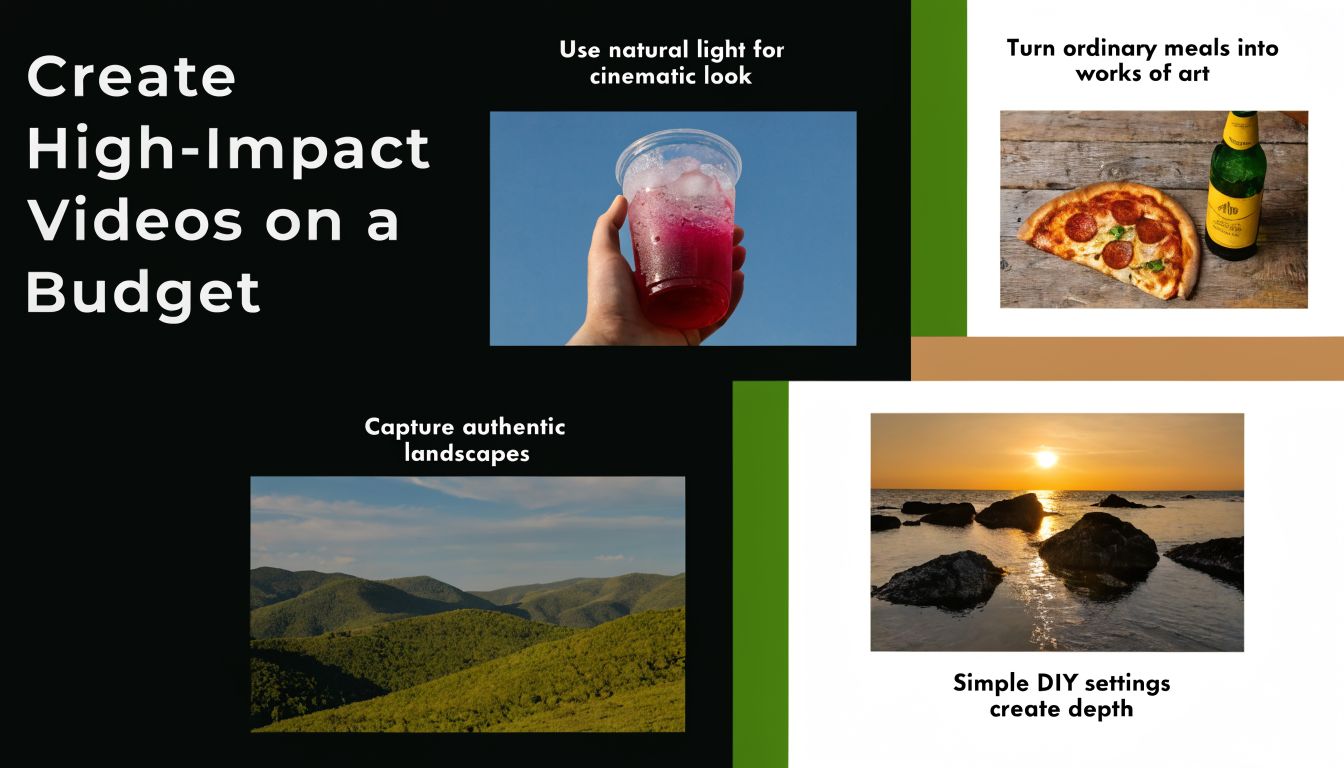
You do not need a camera rig, a studio, or a freelance editor to make TikToks that move product. In ecommerce, low-polish often beats over-produced because it feels native to the feed. Buyers trust clips that look like something a real person filmed in a normal room.
Use a simple UGC shooting setup
A basic founder setup is enough:
- Phone. Use the rear camera when possible for cleaner footage.
- Window light. Face the light source. Don't stand with a bright window behind you.
- Tripod or phone stand. This matters more than buying fancy gear.
- Clean surface. A table, counter, or desk that matches the product category.
- Product variants nearby. Keep alternate colors, packaging, or accessories within reach so you can film multiple angles in one session.
If you can only buy one extra thing, make it stability. Shaky footage makes low-budget feel careless. Steady footage makes low-budget feel intentional.
A useful filming workflow for solo founders:
- Write three hooks before you touch the camera.
- Film the hook first, with energy.
- Capture close-ups of the product in use.
- Film one objection-handling line, such as shipping time, durability, or ease of use.
- End with a simple call to action.
That whole process can fit into a short batch session if you keep the setup fixed.
Edit for clarity not style
The TikTok app is usually enough. CapCut is also practical if you want a little more control. Either way, the goal is simple editing that supports comprehension.
Focus on these choices:
- Cut dead space. If there's a pause, remove it.
- Add text overlays. Many people watch without sound at first.
- Lead with movement. Hands opening, pouring, snapping, attaching, wiping, comparing.
- Use captions. Auto-captions are good enough if you clean up obvious mistakes.
- End before the idea feels finished. A slightly tighter ending often improves watch behavior.
What usually doesn't work for small brands:
- Over-designed transitions
- Long animated intros
- Cinematic B-roll with no clear message
- Talking-head videos that take too long to get specific
- Product clips that look exactly like paid ads from the first frame
A founder can film these formats repeatedly without burning out:
| Format | What to show | Why it works |
|---|---|---|
| Unboxing | Packaging, first touch, first reaction | Feels natural and low-pressure |
| Problem and solution | Annoyance first, fix second | Immediate relevance |
| Comparison | Old option versus your product | Easy to understand quickly |
| Day-in-the-life use | Product appearing in routine | Helps buyers picture ownership |
The key is consistency. Native-looking footage shot repeatedly beats occasional “perfect” content that takes half a day to make.
Implement a Smart Distribution and Testing Strategy
A strong TikTok is only half creative. The other half is distribution discipline. You need enough repetition to learn, but not so much that you start posting junk just to fill the calendar.
TikTok gives small brands real room to compete because engagement is still unusually strong. The platform has an average engagement rate of 7.8%, and even accounts with 100,000+ followers average 5.3%. It also had 71.4 million TikTok Shop buyers in 2025, which shows a direct path from attention to commerce, based on these TikTok engagement and commerce figures.
Post on a rhythm you can survive
For a solo founder, 3 to 5 posts per week is a practical rhythm because it gives you enough data without turning content into a full-time job. More important than raw volume is format consistency. If every post uses a different voice, different style, and different audience angle, your data gets muddy.
Use a weekly mix like this:
- One core seller. Your clearest product benefit.
- One objection video. Answer the question buyers keep having.
- One founder or behind-the-scenes post. Human trust-builder.
- One trend-adjacent post. Only if the trend fits the product naturally.
- One experiment. New hook, new setting, or new angle.
That structure keeps learning clean. You're not just posting more. You're isolating variables.
Review posts like a media buyer
Don't judge a video only by total views. Look at what kind of response it earned and what that response says about future creative.
A simple review window helps:
| Review point | What to look for | What to do next |
|---|---|---|
| First check | Are people watching past the opening? | If not, rewrite the hook and opening shot |
| Day one | Are comments showing intent or confusion? | Turn questions into follow-up videos |
| End of week | Did the format keep attracting profile visits or traffic? | Repeat the angle if yes, cut it if no |
When a post underperforms, avoid the common founder reaction, which is to throw out the whole concept. Usually the issue is smaller. The opening frame was too slow. The text overlay was vague. The problem statement wasn't sharp enough. The product payoff arrived too late.
Treat each post like a creative test, not a referendum on your brand.
Trend participation also needs discipline. Don't copy dances or audio just because they're hot. Use trends when they create context for your product or give you a familiar format to deliver a clear message. If the trend makes the product less understandable, skip it.
Hashtags should work like search labels, not decoration. Use terms buyers would associate with the product, its use case, and the problem it solves. Relevance beats stuffing.
Scale from Views to a Profitable Community
Views are cheap. A useful audience is not. The founder mistake here is chasing reach while ignoring the people who already raised their hand. If someone comments, saves, visits the profile, or watches multiple clips, they're telling you they're warm. That attention should get pulled into a tighter loop.
Turn comments into content loops
One of the easiest growth moves on TikTok is replying to comments with another video. It does two things at once. It shows responsiveness, and it hands you a steady stream of content ideas from real buyer language.
The best comments to build on are:
-
Clarifying questions
“Does this work for small spaces?” becomes a demo. -
Objections
“How is this different from the cheap one?” becomes a comparison post. -
Edge-case use scenarios
“Would this hold up for travel?” becomes a test video. -
Skeptical reactions
Those are often the best prompts for proof content.
If you're a small brand, community depth matters more than vanity growth. You want repeat viewers who start recognizing the product, the founder, and the category promise. Ask questions in captions. Invite use-case requests. Encourage viewers to choose between two variants or two demos. The point is to increase interaction from people who are likely buyers, not just broaden reach for its own sake.
Use TikTok as the front end and Meta as the closer
This is the part most TikTok guides miss. Organic TikTok is excellent for discovering what stops attention. Meta is excellent for retargeting warm audiences with clearer purchase intent. Put together, they can be much stronger than using either one in isolation.
According to this hybrid TikTok and Meta funnel analysis, creators using a hybrid model see up to 4x higher ROAS, and warm audiences built with TikTok problem-solution hooks can increase Meta ad CTR by over 20% when retargeted with UGC and social proof angles.
That matters for founders with limited budgets because it changes the role of each channel:
| Channel | Best job | Weak spot if used alone |
|---|---|---|
| TikTok organic | Discover hooks, attract cold attention, build familiarity | Harder to force immediate purchases consistently |
| Meta retargeting | Convert warm traffic with stronger offer framing | Expensive if the audience has no prior context |
A practical handoff looks like this. Use TikTok to publish repeated pain-point clips, demos, objections, and founder content. Watch which ideas pull comments, profile visits, and deeper engagement. Then build Meta retargeting around those winning themes, usually with UGC-style creatives and direct response copy.
Don't send Meta cold traffic to angles you haven't pressure-tested organically if budget is tight.
That one habit can save a lot of wasted spend. TikTok tells you what buyers lean into. Meta helps you monetize that interest with more control.
Your 30-60-90 Day TikTok Action Plan
Most founders don't need more theory. They need a plan they can stick to when orders, customer support, and inventory issues start competing for time. This is the version I'd use for a small ecommerce brand starting from scratch or from a stalled account.
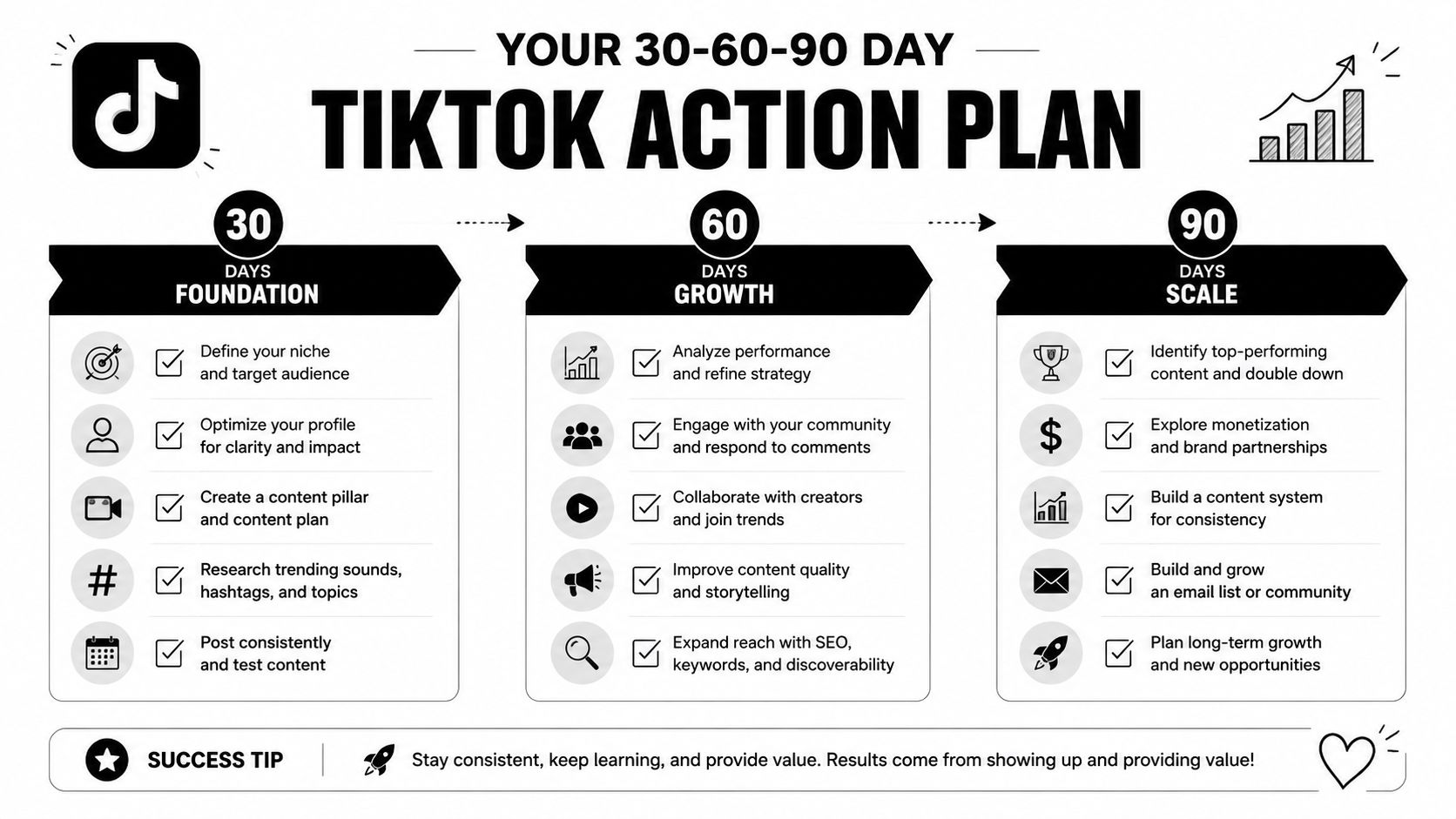
Days 1 to 30
Get the basics clean and start posting before you feel ready.
- Clarify your buyer angle. Define the main problem, use case, and identity cue for the product.
- Fix the profile. Sharper username, better bio, stronger link destination, and three useful pinned videos.
- Choose three to five content pillars. Keep them narrow enough to repeat.
- Batch your first set of videos. Aim for enough content to establish rhythm without scrambling every day.
- Post consistently. Don't overreact to early numbers. Early data is noisy.
Your only job in this phase is to create signal. You're looking for the first hints of resonance. Which hooks pull attention. Which demos trigger questions. Which founder clips make people curious instead of bored.
Days 31 to 60
Now start trimming what doesn't work and repeating what does.
Create a simple review habit each week. Keep a spreadsheet or notes doc with the video topic, hook, opening shot, content pillar, and your takeaway. You don't need advanced reporting. You need pattern recognition.
Look for things like:
- Hooks that consistently pull viewers in
- Questions that show buying intent
- Formats you can produce quickly without quality dropping
- Objections that keep coming up
- Posts that attract profile visits, not just casual likes
This is also the right time to deepen community behavior. Reply to comments. Turn questions into new posts. Make a few videos that address the same winning angle from different directions instead of chasing novelty.
A founder account usually grows faster when it repeats a strong idea several times than when it keeps inventing unrelated ones.
Days 61 to 90
By now you should know a few things with confidence. You should know what the audience responds to, what style feels native for your brand, and what you can produce on a repeatable schedule.
Use this phase to tighten the funnel:
-
Double down on the best-performing angles
Produce multiple versions, not one-offs. -
Build stronger conversion pathways
Make sure the bio link and destination page match the promise of the videos. -
Organize winning themes for retargeting
Separate pain-point creatives, proof creatives, founder creatives, and objection-handling creatives. -
Launch small Meta retargeting campaigns
Use the warm audience generated by TikTok engagement and site traffic. -
Keep TikTok running as your testing layer
New hooks and new angles should still get validated organically before they become paid priorities.
At the end of ninety days, the goal isn't celebrity-level reach. It's a working content system. You should have a sharper audience definition, repeatable video formats, a small library of proven hooks, and a cleaner path from organic discovery to paid conversion.
That's what sustainable TikTok growth looks like for a budget-conscious founder.
If you want help turning that TikTok momentum into a paid acquisition plan, Social Loop AI is built for exactly that stage. It helps first-time ecommerce founders turn a product URL into a practical Meta ads launch plan, creative batches, buyer angles, and test structure without hiring an agency. It's a useful next step when you've figured out what your audience responds to on TikTok and you're ready to retarget that interest with more precision.
Enhanced by the Outrank tool