Blog
Generating Leads on Facebook: A Beginner's Playbook
Published May 15, 2026
You launched your store, cleaned up the product page, and maybe even got a few friends to say the product looks legit. Then you open Ads Manager and the confidence drops fast. Too many buttons, too many objectives, too many opinions from people who all claim they have the one trick for generating leads on facebook.
Most beginners don't fail because Facebook can't work. They fail because they treat lead generation like a set of disconnected tasks. Audience targeting sits in one box, creative in another, and the page experience gets ignored until money is already leaking. That separation is what burns small budgets.
The better approach is tighter and simpler. Your audience, offer, ad angle, form or landing page, and follow-up need to work as one system. If one piece is weak, the whole campaign looks broken. If they line up, even a first campaign can produce useful signal fast.
Table of Contents
- Why Facebook Is Still Your First Best Bet for Leads
- Laying the Foundation Your Budget Deserves
- Choosing Your Campaign Objective Lead Gen vs Conversion
- Building and Testing Your Facebook Ad Audiences
- Crafting Ad Creatives and Hooks That Convert
- Setting Your Budget and Test Plan
- Your First 14 Days Scaling and Optimizing
Why Facebook Is Still Your First Best Bet for Leads
You launch your first campaign with a small budget, get a rush of cheap clicks, and then realize half the leads were never going to buy. That is the beginner version of Facebook lead gen. The platform is not the problem. The setup usually is.
Facebook still earns the first test budget because it gives small ecommerce brands three things in one place. Large reach, strong ad delivery tools, and multiple ways to match message to intent. Meta reported 3.43 billion people used at least one of its apps daily in Q4 2024, which matters because lead generation needs volume at the top of the funnel before you can filter for quality. Meta also reported more than 10 million active advertisers in Q4 2024. Serious advertisers keep spending there because the platform can still produce measurable customer acquisition, not just awareness.
The primary advantage for a beginner is not reach by itself. It is the ability to test strategy and execution together without rebuilding everything each time. You can run one angle to a native lead form, another to a product page, and a third to a quiz or offer page. You can keep the audience constant and test the hook. Or keep the creative constant and test audience quality. That makes Facebook one of the few channels where a founder can answer the question that truly matters early on: are the leads weak because of targeting, because of the promise in the ad, or because the page after the click is doing a poor job of filtering?
That matters more than cheap lead volume.
New advertisers often judge the channel too early by cost per lead alone. I would rather see a $14 lead that turns into real revenue than a $4 lead that ghosts your emails, ignores your offer, or was only curious enough to tap a form inside the app. Facebook gives you the control to work through that trade-off in rounds. Broaden or narrow the audience. Shift the creative from curiosity to qualification. Send colder traffic to a page that explains more, and warmer traffic to a shorter path.
This flexibility gives small-budget advertisers a real shot. You do not need a polished account on day one. You need a platform where targeting, creative, and landing experience can be tested as one system, so each round teaches you what to change without wasting the next $200.
Laying the Foundation Your Budget Deserves
Beginners usually want to jump straight into ad setup. That's the expensive move. Before you spend anything, define who the ad is for and what happens after the click.
Define the buyer before you define the campaign
A buyer profile doesn't need to look like a corporate persona deck. It needs to answer five practical questions:
- What are they trying to fix: Name the problem in plain language. Not "wants better wellness." More like "needs a simpler way to stay consistent."
- What makes them hesitate: Shipping time, product legitimacy, quality concerns, unclear results, or price shock all change ad copy.
- What do they already believe: Some buyers need education. Others already understand the category and just need a reason to choose your product.
- What kind of promise feels believable: Small, specific promises usually convert better than broad claims.
- What would make them act now: Convenience, bundle logic, urgency, trust, or a low-commitment first step.
This profile becomes the source code for your campaign. It shapes the interest targets you test, the hook in the first line of copy, the image style, the call to action, and the form questions if you use Lead Ads.
If you can't describe the buyer clearly, your ad will default to generic language. Generic ads get generic clicks. Generic clicks turn into weak leads.
Audit the page like a buyer, not like the owner
Your landing page or product page is where ad spend gets validated or wasted. Most founders judge it too kindly because they already know what the product does. A cold visitor doesn't.
Check these areas before launch:
- Headline clarity: Can a stranger understand the product and value fast?
- Offer match: Does the page continue the promise made in the ad, or does it feel like a different conversation?
- Trust signals: Reviews, policies, delivery clarity, product detail, and clean design all reduce hesitation.
- Visual hierarchy: The main image, price, CTA, and key benefits should be easy to find.
- Friction points: Long blocks of text, weak mobile layout, confusing variant choices, or distracting popups all hurt lead flow.
If the ad makes a precise promise and the page answers it cleanly, the campaign feels coherent. If the ad says one thing and the page rambles, people leave.
A quick self-test helps. Open the page on your phone and ask three things: What is this? Why should I care? What do I do next? If any answer is fuzzy, fix that before you buy traffic.
For small budgets, prep work isn't admin. It's performance work.
Choosing Your Campaign Objective Lead Gen vs Conversion
The first real fork in the road is objective choice. Most beginners ask which one is better. The better question is which one fits the friction level of your offer and the kind of lead you want.
Facebook Lead Ads keep people inside the platform. Conversion campaigns ask them to leave Facebook and complete the next step on your site. That one difference changes everything.
When Lead Ads make sense
Lead Ads are strong when your first ask is simple. Email capture, waitlist signup, quote request, sample request, early access, or a lightweight consultation all fit this structure.
According to LeadsBridge's Facebook lead generation benchmarks, Facebook Lead Ads average a 12.54% conversion rate, compared with 10.47% for landing page conversion campaigns. The same source notes that the average cost for a lead across industries is around $19.68. That doesn't mean Lead Ads are always cheaper or always better. It means the native form reduces friction enough that more people finish the action.
A native form is especially useful when:
- Your product needs a warmer follow-up: Think email nurture, SMS, or a founder message before the sale.
- Your site isn't conversion-ready yet: Not ideal, but common.
- Your offer is curiosity-led: A quiz, buyer guide, restock alert, or gated launch works well here.
When Conversion is the better filter
A Conversion campaign is often the better choice when the page itself does the qualifying. If someone has to click through, read details, and complete a meaningful next step, you've already filtered out some low-intent traffic.
That matters because easier lead capture can also let in weaker leads. Someone can submit a Facebook form with very little commitment. Asking them to move to your site creates more friction, but that friction can improve intent.
Use Conversion when:
- Your page explains the product better than a short form can
- You need buyers, not just contacts
- Your offer requires context, proof, or product education
- You want behavior on your site to guide future retargeting
| Objective | Best for | Main upside | Main trade-off |
|---|---|---|---|
| Lead Gen | Fast contact capture, simple offers, waitlists, quote requests | Lower friction and easier form completion | Lead quality can drop if the offer is too broad |
| Conversion | Product pages, deeper education, stronger qualification | Better pre-click and post-click filtering | More steps can reduce completion volume |
The mistake is treating this as a permanent choice. For generating leads on facebook, many good accounts eventually use both. One objective captures interest fast. The other qualifies and converts that interest more carefully.
Building and Testing Your Facebook Ad Audiences
Audience strategy is where new advertisers either oversimplify or overcomplicate. They go too broad with weak messaging, or they stack so many filters that delivery gets messy. The right move is phased testing.
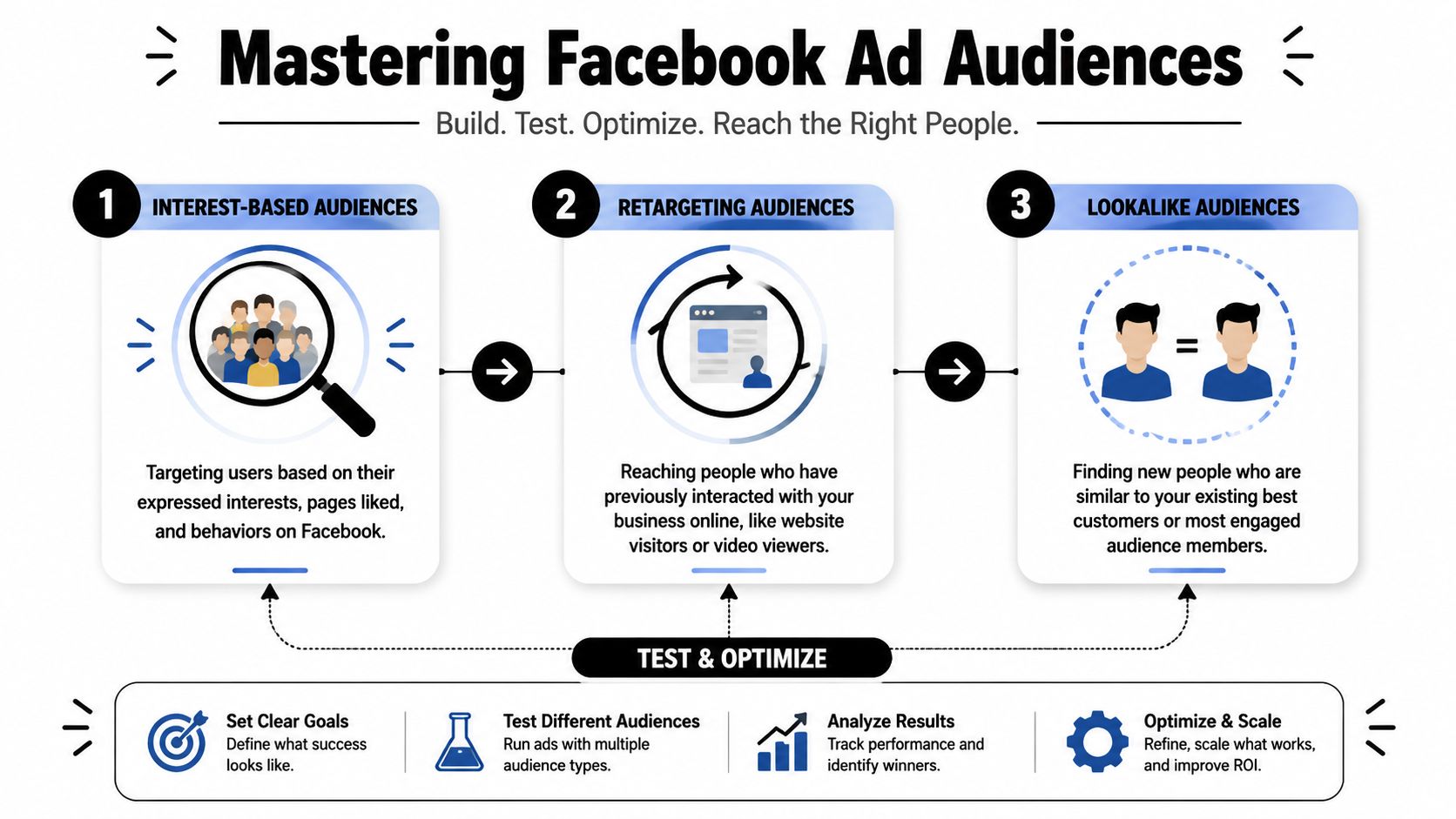
Start with interest audiences when you have no data
If your store is new, interest targeting is the cleanest place to begin. You're not trying to find the perfect audience in one shot. You're trying to identify promising pockets.
Build a few distinct audience ideas instead of one giant mixed audience:
- Category interest: People interested in the product category itself
- Problem-aware interest: People who follow behaviors, creators, or topics tied to the problem
- Adjacent lifestyle interest: People whose habits suggest the product fits their identity
- Competitor or alternative interest: Useful when your category has known brands or substitutes
Keep the messaging matched to the audience. A problem-aware audience usually needs a pain-to-solution angle. A lifestyle audience may respond better to identity and use-case creative.
Retargeting is your high-intent layer
Retargeting shouldn't be your starting point if you have no traffic, but it should be part of your plan early. These people already know you. They clicked, visited, watched, or engaged and didn't convert.
Retargeting works best when the second message is different from the first. Don't just repeat the same ad. Add the missing piece:
- more proof
- better explanation
- a clearer offer
- a stronger objection handler
- urgency, if it's real
A retargeting ad that says "still thinking about it?" is lazy. A retargeting ad that answers "Will this fit my routine?" is useful.
Use lookalikes only from strong source data
Lookalikes can be excellent, but only if the source is clean. Cognism's Facebook lead generation guidance recommends building lookalikes from about 500 to 2,000 highly relevant contacts, such as best-performing leads or closed-won customers. It also notes that a 1% lookalike is the tightest quality match, while 2% to 5% expands reach with some loss of precision.
That gives beginners a strong rule set:
| Audience type | When to use it | Common mistake |
|---|---|---|
| Interest | At launch with little or no account data | Mixing unrelated interests into one ad set |
| Retargeting | Once you have visitors or engagement | Repeating the same message instead of addressing objections |
| Lookalike | After you have a good source list | Using weak or mixed-quality source audiences |
The source audience decides the quality ceiling of the lookalike. If the source is muddy, scaling just spreads the mud farther.
For a first campaign, I like a simple order. Start with a few interest audiences. Add retargeting as traffic builds. Bring in lookalikes only when your source data deserves it.
Crafting Ad Creatives and Hooks That Convert
Most bad lead campaigns don't fail at targeting. They fail because the ad invites the wrong click.

Creative is where lead quality starts
If your ad screams discount before it explains value, you'll attract plenty of people who like clicking but don't like buying. If your ad leads with trust, proof, and clarity, the click volume may be lower, but the leads tend to be healthier.
That's the core quality-control layer many beginners miss. LeadsBridge's guidance on getting leads from Facebook points out that a common pitfall is generating leads without controlling for quality, and that creative positioning can pre-qualify prospects by emphasizing trust, proof, and clarity over broad discounts.
This is why creative isn't decoration. It's filtering.
Build angles before you build variations
Don't start by making ten random ads. Start by choosing a few clear angles, then create variations inside each angle.
A simple angle map for a new ecommerce product could look like this:
-
Problem to solution
Lead with the frustration the buyer already feels, then show the product as the simpler fix. -
Social proof
Use reviews, UGC-style framing, or visible customer validation to reduce skepticism. -
Identity
Speak to who the buyer sees themselves as. This works well for products tied to routines, taste, or self-image. -
Us versus the old way
Contrast your product with the clumsy, messy, expensive, or inconvenient alternative. -
Trust-first education
Best for products that need explanation. Teach just enough to make the click feel safe.
Each angle should change more than the headline. The image, first sentence, CTA, and landing experience should all carry the same argument.
Weak campaigns test formats. Strong campaigns test ideas.
Here's a useful walkthrough on thinking about Facebook creative more deliberately:
What weak creative usually sounds like
Weak ads are usually vague, overexcited, or too broad. They promise "must-have" benefits without saying for whom or why. They chase the click instead of shaping it.
Watch for these patterns:
- Broad discount hooks: These can pull in low-commitment users fast.
- Pretty but context-free visuals: If the image doesn't support the argument, it isn't helping.
- Generic body copy: Phrases like "upgrade your lifestyle" rarely qualify anyone.
- Mismatch with the next step: If the ad feels premium and the page feels cheap, trust drops immediately.
Good creative gives the right person a reason to continue and gives the wrong person a reason to scroll past. For generating leads on facebook, that's a win.
Setting Your Budget and Test Plan
Small budgets don't need heroic strategy. They need clean structure. The goal of your first test isn't to prove you've found the winner. It's to identify what deserves the next round of budget.
A simple round-by-round launch structure
Start with a manageable daily budget and split it across a few controlled tests. Don't launch too many audiences and angles at once or you won't know what caused the result.
Use a basic matrix. One audience target, one angle, one ad set. That keeps the learning readable.
Example 3-Day Ad Test Plan (Daily Budget: $30)
| Ad Set | Audience Target | Creative Angle | Daily Budget |
|---|---|---|---|
| Ad Set 1 | Interest audience tied to core category | Problem to solution | $10 |
| Ad Set 2 | Interest audience tied to adjacent lifestyle | Social proof | $10 |
| Ad Set 3 | Interest audience tied to competitor or alternative behavior | Trust-first education | $10 |
That structure works because each ad set has a clear job. If one audience responds and another doesn't, you learn something. If one angle gets strong clicks but weak lead quality, you learn something different.
A few rules keep early testing sane:
- Change one major variable at a time. Don't swap audience, creative, and offer all at once.
- Keep the offer consistent across first-round tests. Otherwise you won't know whether the audience liked the message or the incentive.
- Write down your hypothesis before launch. "This audience should respond to convenience" is enough.
What to watch in the first few days
Beginners often stare at every metric and still miss the point. Focus on the handful that tell you whether the system is working.
- CTR: Tells you whether the ad is earning attention from the audience you chose
- CPC: Helps you see whether your click is getting expensive too early
- CPL: Tells you what you're paying for the lead itself
- Lead quality notes: Are these real prospects, or just easy submissions?
- On-page behavior: If you're using Conversion, look at whether visitors seem to engage or bounce quickly
A cheap lead isn't useful if the person never buys, never replies, or never remembers submitting the form.
The first three days are for signal collection, not emotional decision-making. Don't panic over every fluctuation. Read the pattern, then act.
Your First 14 Days Scaling and Optimizing
Launch day isn't the hard part. Restraint is. Most beginners either kill ads too early or scale noise because the lead count looks exciting.

Days one through three
Your job is observation. Check delivery, spend distribution, click quality, and whether leads look real.
Pause clear losers when the pattern is obvious. That usually means poor click engagement, weak lead quality, or a message-audience mismatch. Don't pause an ad set just because another one started faster.
Also make sure you're excluding people who already converted. Aira and LeadsBridge guidance summarized here stresses that campaigns should be balanced for CPA and lead quality, not raw lead volume, and that exclusion audiences help reduce wasted spend and ad fatigue.
Days four through fourteen
Once a winner starts to separate itself, scale carefully. Increase budget gradually on ad sets that produce the right kind of lead, not just the most leads. If an ad gets form fills but those people don't answer emails, don't reward it.
Use the second week to create follow-up tests based on what you've learned:
- a new hook built on the winning angle
- a retargeting ad that answers a specific objection
- a tighter audience built from the best early signals
- a cleaner landing page version if drop-off suggests confusion
A practical checklist helps:
- Keep winners live: Don't reset the campaign every day.
- Kill repetition, not just low volume: If the same weak pattern keeps showing up, cut it.
- Promote what qualifies the lead: Stronger copy often beats broader reach.
- Document every change: You need a record of what improved quality, not just volume.
Good optimization is less dramatic than people expect. You're not hunting for magic. You're removing waste, protecting what works, and making the next test smarter than the last.
If you're launching your first product and want help turning a product URL into a practical Meta ads plan, Social Loop AI is built for that exact stage. It helps new ecommerce founders define the buyer, audit the landing page, choose creative angles, and build a round-by-round testing plan without needing an agency.