Blog
Facebook Ads for Dropshipping: A 2026 Launch Playbook
Published June 18, 2026
Most beginner advice on Facebook ads for dropshipping is stuck in an older playbook. It tells you to hunt for a hidden interest, a magic audience stack, or some targeting trick nobody else knows. That used to be the obsession. It isn't the lever that matters most now.
The bigger shift is creative and post-click conversion. Facebook became a foundational channel for dropshipping largely because of scale. One strategy guide notes the platform has over 2.8 billion active users, which gave even brand-new stores access to a massive audience without needing marketplace traffic first (Minea on Facebook ads strategy for dropshipping). That scale made testing fast. But in 2026, access to attention isn't the hard part. Earning the click, then converting it, is.
If you're launching your first product, think like a media buyer, not a gambler. Your job isn't to guess the one perfect audience. Your job is to build a repeatable system: set up tracking correctly, test multiple creative angles against the same conditions, and send traffic to a product page that matches the promise in the ad.
Table of Contents
- Your First Dropshipping Ads Start Here
- Lay the Foundation Before You Spend a Dollar
- Choose Winning Creative Angles Not Just Audiences
- Build Your First Low-Budget Test Campaign
- Craft Ad Creatives and a Landing Page That Convert
- Read the Data and Scale What Works
Your First Dropshipping Ads Start Here
A lot of first-time sellers waste weeks on targeting research and almost no time on the ad itself. That's backwards.
Recent 2026 creator guidance points to a different reality. The stronger question isn't "Which audience should I target?" It's "Which creative angle will people and the algorithm respond to first?" That shift shows up in public tutorials that emphasize broad setups, multiple creative angles, and testing batches instead of audience micro-targeting (2026 creator discussion on creative-led Meta testing).
That changes how you should think about Facebook ads for dropshipping. Your first campaign isn't a one-shot attempt to force sales from a cold audience. It's a controlled experiment. You test different messages, observe which one earns engagement and buying intent, then improve the page and offer around that signal.
Practical rule: If your creative is weak, better targeting rarely saves it. If your product page is weak, even a strong ad can still lose money.
Beginners usually assume ad performance lives inside Ads Manager. It doesn't. Performance starts before launch. The product page, shipping clarity, trust signals, offer framing, and ad angle all shape what happens after the click.
That means your first campaign should answer three questions:
- What promise gets attention: Is the product solving a visible problem, creating convenience, signaling identity, or reducing friction?
- What proof supports the promise: Can the visitor quickly understand why this product is credible?
- What page element removes hesitation: Shipping details, reviews, images, and offer clarity often decide whether curiosity turns into a purchase.
If you approach Facebook ads for dropshipping this way, the process gets less mysterious. You're not trying to outsmart the platform. You're building a small testing engine that finds the best message first, then scales the message that survives the click.
Lay the Foundation Before You Spend a Dollar
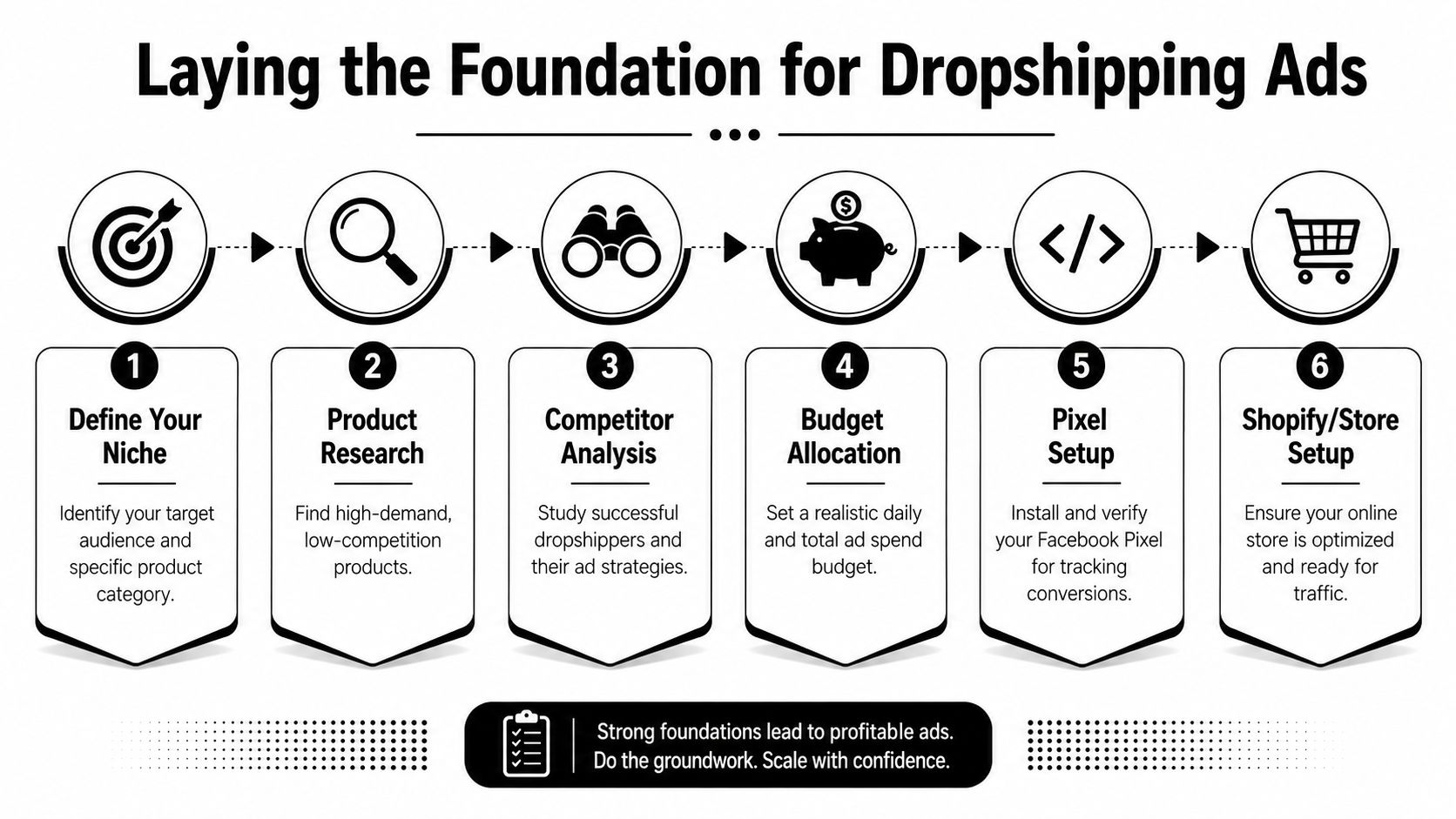
Beginners lose money on Facebook ads for dropshipping long before Meta has enough data to optimize anything. The failure usually starts with setup. Tracking is incomplete, the product page feels thin, or the checkout creates doubt right when the buyer is ready.
That matters because 2026 performance is less about finding a hidden audience and more about building a testable system. If the page cannot convert and the tracking cannot show you where people drop off, every creative test gets harder to read.
A practical launch sequence is simple: create the Facebook Page and ad account, install the Meta Pixel on the store, confirm the store works on mobile, build the campaign, then review results. AutoDS makes the same point on setup order. The Pixel has to be in place before launch so Meta can track conversion events and optimize toward them (AutoDS on Meta ads setup for dropshipping).
Set up the account structure correctly
Keep the setup clean.
Use one ad account, one Facebook Page, and one store domain that matches the brand in the ad. That sounds basic, but mismatched names, random domains, and copied product pages are common reasons cold traffic bounces before you learn anything useful.
Check these basics before launch:
- Page identity: The page name, logo, and store branding should match the offer people clicked.
- Destination accuracy: Test every product URL and CTA yourself. One wrong link can waste a full day of spend.
- Store readiness: Make sure the product is in stock, the cart updates correctly, and checkout works from start to finish.
- Policy visibility: Shipping, returns, and contact details should be easy to find without digging.
New dropshippers tend to obsess over ad copy first. The setup work matters just as much because clean inputs produce clean feedback.
Make the Pixel your first priority
If the Meta Pixel is not working, you are paying for traffic without a reliable way to judge what happened after the click. That makes optimization slower and diagnosis sloppy.
Start with the events that matter for a first test. You need to know whether someone viewed the product, added to cart, began checkout, and purchased. If those steps are missing or firing incorrectly, you cannot tell whether the problem is the ad, the offer, or the page.
For Shopify and WooCommerce, this usually means checking the integration, then running your own test visit. Load the page, view the product, add it to cart, begin checkout, and confirm the events fire in Meta's diagnostics tools.
Do not trust the app install blindly.
Audit the product page before traffic hits
A product page can kill a promising ad angle fast. I treat the page as part of the ad system, not a separate task for later. If visitors click with interest and land on a weak page, Meta records poor downstream behavior and your test gets noisier.
Review the page like a skeptical first-time buyer:
- Headline clarity: The first screen should explain what the product is and why it is worth attention.
- Visual proof: Images and videos should show the product in use, not just isolated mockups.
- Trust support: Reviews, shipping details, return policy, and contact information should be visible.
- Offer clarity: The buyer should understand what is included, when it ships, and why the offer is worth the price.
- Mobile experience: The page should load quickly, read cleanly, and make the add-to-cart button easy to find on a phone.
One trade-off matters here. Speed beats perfection. You do not need a polished brand store before testing, but you do need a page that answers obvious objections without friction. That is the minimum standard before spending on traffic.
Choose Winning Creative Angles Not Just Audiences
The biggest mindset shift for Facebook ads for dropshipping is this. You're not testing "ads" first. You're testing angles.
An angle is the core reason someone should care. Same product, different angle. A posture corrector can be sold as pain relief, work-from-home comfort, confidence, or a daily habit upgrade. The product hasn't changed. The framing has.

What an angle actually means
Most beginner creatives fail because they describe the item instead of selling a reason to act. Features alone rarely move cold traffic.
A few common angle types work well for dropshipping because they map to familiar buying motivations:
- Problem to solution: The ad opens with a frustration and presents the product as relief.
- UGC style: The product appears in a customer-like format, often casual, direct, and demonstration-led.
- Social proof: The creative leans on visible adoption, reactions, or trust cues.
- FOMO or urgency: The message pushes action by making delay feel costly.
- Identity: The ad speaks to the kind of person who would use the product, not just the product itself.
Not every product deserves every angle. A kitchen gadget may work with problem to solution and UGC. A fashion accessory may work better through identity and visual proof.
Pick angles from the product not from guesswork
Start with the product page, not Ads Manager. Ask three simple questions:
| Question | What you're looking for | Example output |
|---|---|---|
| What pain or desire is obvious? | The clearest reason someone buys | "Cuts cleanup hassle" |
| What proof can I show fast? | Demonstration, reaction, result, comparison | "Before and after use" |
| What objection will show up first? | Doubt about quality, need, fit, or shipping | "Show texture, use case, and delivery clarity" |
New sellers often overcomplicate things. You don't need twenty concepts. You need a few distinct messages that aren't saying the same thing in slightly different words.
If all your creatives use the same promise with different colors, you aren't testing angles. You're testing decoration.
A practical first batch might include one direct problem-solution ad, one UGC-style demonstration, one proof-led ad, and one identity or lifestyle version. If the product naturally supports urgency, add a fifth.
How many angles to test first
For a first campaign, restraint helps. You want enough variety to learn, but not so much that each concept gets muddy.
A good rule for beginners is to choose 3 to 5 clearly different angles and make each one compete in the same environment. That gives you cleaner signal than splitting tiny budgets across too many audiences or too many nearly identical ads.
When you review results, don't ask which ad looked nicest. Ask which angle pulled the best quality traffic. The winner isn't the prettiest creative. It's the message that earns intent and holds up once people reach the page.
Build Your First Low-Budget Test Campaign
Your first campaign should be simple enough to manage without second-guessing every setting. Complexity feels advanced, but it usually hides bad learning.
One practical testing pattern from expert tutorials is to start with a $10/day test, keep five creatives in the same ad set so they compete under the same conditions, and scale by increasing budget by about 20% per day once performance is stable (expert tutorial on low-budget Facebook testing structure).
Use a simple campaign build
For a beginner, a clean test usually looks like this:
- One campaign: Keep the objective tied to the action you want.
- One ad set: This reduces noise when you're trying to learn which message wins.
- Three to five ads: Each ad represents a different creative angle.
- Product page destination: Send traffic to the page that matches the creative promise.
That structure matters because it creates a level playing field. If each ad runs in a separate ad set with different targeting, placements, or budgets, you won't know whether the creative won or the setup did.
Broad targeting often makes sense at this stage. If the product has clear appeal and the creative is strong, broad delivery gives the system room to find response patterns without forcing you into brittle interest stacks.
Keep the test clean
Small-budget testing only works when variables stay controlled. New advertisers sabotage their own campaigns by changing too many things too early.
Keep these elements stable during the first test window:
- Same destination page: Don't send one ad to the homepage and another to the product page.
- Same core offer: If one creative includes a stronger offer than the others, the comparison is distorted.
- Same audience conditions: The point is to compare messages, not create separate mini-experiments at once.
A clean test also means checking the duplicated campaign carefully. Wrong URL, missing CTA, broken pixel event, or swapped creative file can make a good angle look weak.
What to watch in the first few days
Early data is useful, but only if you read it in order.
Start with the click. Are people responding to the hook, the visual, and the headline? Then move to on-page behavior. Does the traffic continue into product engagement, add-to-cart behavior, or checkout intent? If not, the creative may be winning attention from the wrong people, or the page may be breaking trust.
Use a simple triage model:
- No click interest: The angle or first-frame creative probably isn't strong enough.
- Clicks but weak page engagement: The ad promise and landing page likely don't match.
- Page engagement but weak purchase intent: Objections around trust, pricing, shipping, or product clarity are probably blocking the sale.
Good testing doesn't just tell you what won. It tells you where the buyer lost confidence.
The goal of this first campaign isn't to force scale immediately. It's to identify which creative angle deserves more budget and which ones should be paused without regret.
Craft Ad Creatives and a Landing Page That Convert
Most dropshippers overrate the ad and underrate the page. They celebrate cheap clicks, then wonder why sales don't follow.
That gap matters because a lot of post-click failure has nothing to do with the ad itself. Recent guidance around dropshipping Facebook ads points out that many campaigns fail from weak page-message alignment, low trust, and unclear offers, not from the creative alone (Zeely on post-click performance in dropshipping ads).
The ad wins attention
A strong dropshipping ad usually does three jobs fast. It stops the scroll, communicates one clear promise, and gives the viewer a reason to click now.
That doesn't require fancy copy. It requires focus. One ad should push one angle.
Here are practical ways to tighten the creative:
- Lead with the outcome: If the product solves a visible problem, open on the relief, not the product name.
- Show the use case early: Static images can work, but demonstration often reduces confusion faster.
- Keep body copy narrow: Don't stack every feature into one ad. Pick the feature that supports the angle.
- Use a direct CTA: "Shop now" works when the creative already did the persuasion. If the angle needs education, let the copy earn the click first.
A UGC-style ad for a cleaning tool should feel like a person showing why the tool makes a task easier. An identity-led ad for apparel should feel like a reflection of taste, status, or belonging. Same platform. Different persuasion logic.
The page closes the gap
Once the click happens, the page has to continue the same conversation. If the ad says "solve this annoying problem in minutes" and the product page opens with vague branding and weak images, the buyer loses momentum.
The product page should answer the buyer's next questions in order:
| Buyer question | What the page should provide |
|---|---|
| What is this? | Clear title and immediate product context |
| Why should I care? | Value proposition tied to the ad angle |
| Can I trust it? | Reviews, believable visuals, policy clarity |
| What am I actually getting? | Product details, variants, what's included |
| What happens next? | Shipping expectations and straightforward checkout |
Use that sequence as a diagnostic tool. If your ad promises convenience, the page should immediately show how the product creates convenience. If your ad uses social proof, the page should reinforce trust instead of dropping into generic copy.
Here is a useful visual walkthrough before you build your own variants:
Message match is where beginners lose money
Message match sounds technical, but it's simple. The first promise in the ad should reappear on the product page in a stronger, more credible form.
If your ad angle is problem-solution, the page should show the problem, the product in action, and why this version is worth buying. If your ad angle is identity, the page should feel branded and visually coherent, not like a random supplier listing.
Watch for these common breakdowns:
- Curiosity ad, generic page: The ad is specific. The page is vague.
- Premium framing, low-trust layout: The ad feels polished. The page looks thin or rushed.
- Fast benefit, slow explanation: The ad is easy to understand. The page buries the main value.
- Confident CTA, missing reassurance: The ad asks for action. The page doesn't resolve anxiety around quality or delivery.
This is why Facebook ads for dropshipping work best as a system. The ad creates intent. The page protects it. If one side is weak, the whole funnel feels more expensive than it really is.
Read the Data and Scale What Works
Most beginners open Ads Manager and look at too many metrics at once. That creates panic, not clarity.
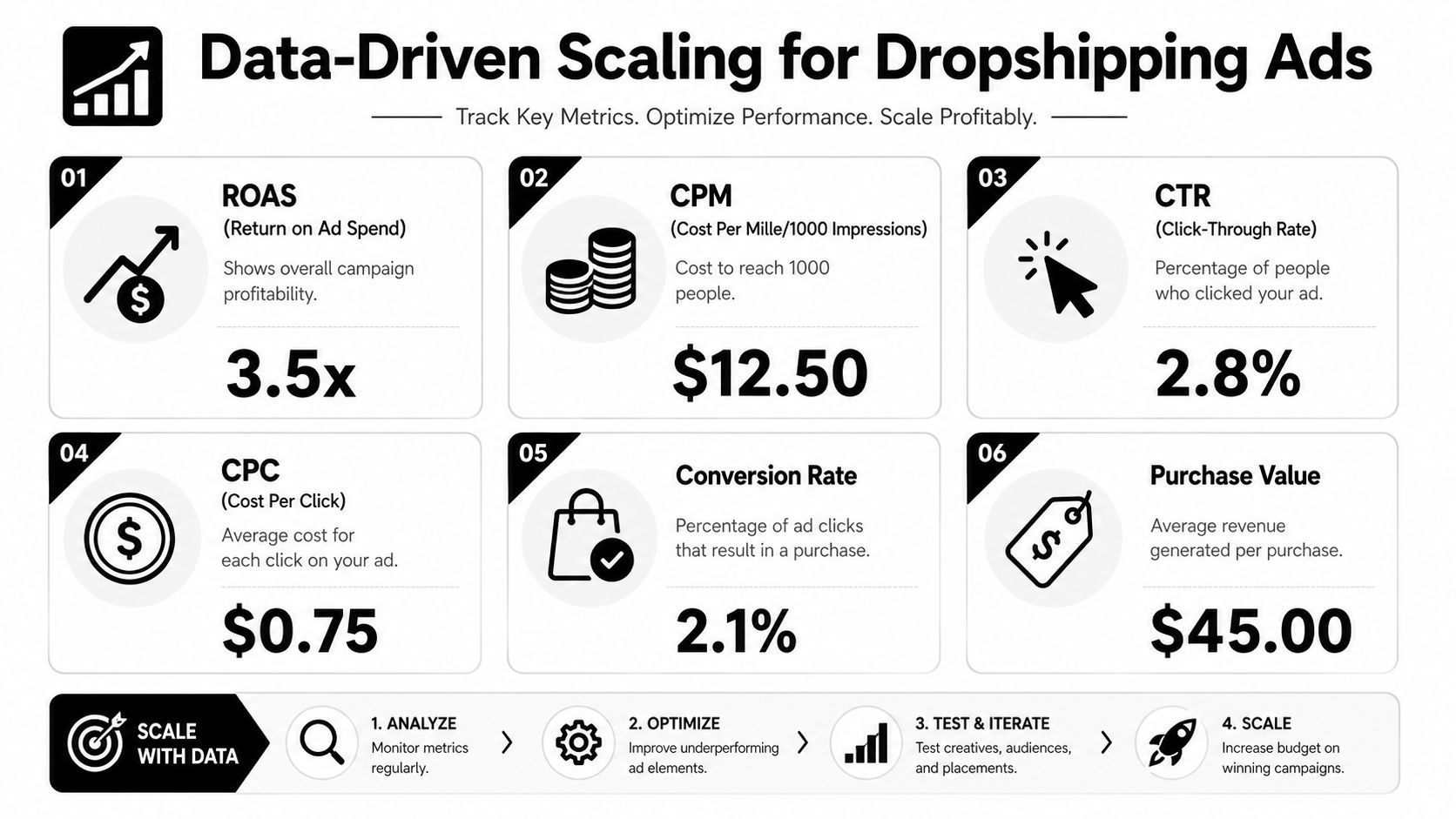
For Facebook ads for dropshipping, you only need a few operating numbers to make early decisions. Benchmark data gives useful guardrails: one ad-metrics source lists an average Facebook CPA of $18.68, while practical dropshipping guidance often treats CPC under $1.50 as a workable early target and aims for conversion rate of at least 2% or higher on thin-margin offers (KlientBoost Facebook ad benchmarks and practical targets). Those aren't guarantees. They're reference points.
Focus on the few numbers that matter
Read performance in layers.
- CPC: This tells you what you're paying for traffic. If clicks are expensive early, the creative may not be resonating strongly enough.
- Conversion rate: This tells you whether the page and offer are doing their job after the click.
- CPA: The meeting point of ad cost and conversion quality. For most dropshippers, this is the pressure point.
- CTR and other click signals: Useful for diagnosing interest, but never enough on their own.
A campaign with a decent CTR can still fail if the traffic doesn't trust the page. A campaign with a mediocre CTR can still work if the people who do click buy efficiently.
Use a simple diagnosis model
The easiest way to troubleshoot is to connect each symptom to one likely cause.
Cheap clicks with weak sales usually point to a message-match problem, not a scaling opportunity.
Use this framework:
| If you see this | Check this first | Likely next action |
|---|---|---|
| High CPC | Hook, first frame, headline | Test a new angle or stronger opening visual |
| Acceptable CPC but weak conversion rate | Product page trust and offer clarity | Improve page alignment with the ad promise |
| Strong conversion rate but unstable CPA | Budget changes or inconsistent setup | Hold the setup steady before scaling |
| One creative clearly outperforming | Angle strength | Pause weaker ads and feed the winner more budget |
This keeps you from making emotional edits. Most bad optimization decisions happen when advertisers react to one metric without asking what part of the system it belongs to.
Scale slowly and protect signal quality
When you find a winner, don't rush it. Stable performance matters more than dramatic budget moves.
A practical scaling method is gradual. Increase budget by about 20% per day when the campaign is holding up, and duplicate proven ad sets into a fresh campaign when you want to expand without disturbing the original learning path, as noted earlier in the testing workflow. Slow scaling protects the data and makes it easier to spot when performance starts slipping.
The discipline here is simple:
- Scale the angle, not just the asset: A winning message can often support new formats or fresh visuals.
- Keep controls in place: Don't change targeting, page copy, and offer all at once.
- Kill cleanly: If an ad isn't working, pause it and move on. Don't keep funding a weak angle because you like the creative.
Winning at Facebook ads for dropshipping isn't about guessing better. It's about reading buyer behavior with enough discipline to know what deserves the next dollar.
If you want a structured way to do that, Social Loop AI helps first-time dropshippers turn a product URL into a Meta ads launch plan, angle-based creatives, and a landing-page audit so you can test more methodically before scaling spend.