Blog
AI Affiliate Writing: A System for High-Converting Content
Published June 26, 2026
Most advice about AI affiliate writing is backwards. It tells you to publish faster, scale harder, and let the model handle the heavy lifting. That works right up until readers stop trusting what they're reading.
The problem isn't AI itself. The problem is treating AI like a replacement for judgment. In affiliate content, speed helps, but trust converts. If the review feels generic, if the product claims sound borrowed, or if the article reads like it was stitched together from search results, people bounce before they click.
That's a serious mistake in a market this large. The affiliate marketing industry is projected to grow from $18.5 billion in 2024 to nearly $32 billion by 2031, and businesses earn an average $6.50 for every dollar invested, according to Wix's affiliate marketing statistics roundup. There's real money here, which is exactly why low-effort content loses.
A tighter system proves effective. Use AI for ideation, research synthesis, outlining, and draft acceleration. Then add the layer most affiliates skip: verification. That means checking every claim, extracting real buying angles from the offer itself, and adding proof that a human reviewed the piece before it went live.
Table of Contents
- The Unspoken Problem with AI Affiliate Content
- AI-Powered Ideation and Strategic Research
- Drafting Persuasive Content with Advanced AI Prompts
- The Human Verification Layer for Building Trust
- Conversion Optimization Legal Compliance and Links
- Closing the Loop Tracking Testing and Iteration
The Unspoken Problem with AI Affiliate Content
Most AI affiliate content fails for one simple reason. It sounds finished before it's credible.
Readers have seen enough machine-written product roundups to spot the pattern. Vague praise. Recycled features. No proof that the writer touched the product, tested the workflow, or checked whether the claims were still true. That kind of content can rank for a while, but it struggles to persuade anyone with even mild skepticism.
Trust breaks before traffic does
A lot of affiliates notice the wrong symptom. They think the issue is traffic, when the deeper problem is trust decay. The page may get impressions. It may even collect clicks. But if the article feels synthetic, the buyer doesn't move forward.
Practical rule: A fast draft is useful. A fast-published draft is dangerous.
That's why “publish 100 AI articles” is weak advice. In affiliate marketing, every article is a sales asset. If it doesn't reduce doubt, it won't earn much, even when the keyword looks attractive.
The better model is editor, not operator
The strongest AI affiliate writing workflow starts before the draft exists. Use AI to map the buying query, compare what top-ranking pages are missing, and identify where the offer is persuasive. Then write from that brief.
A good affiliate doesn't ask AI to “write a review.” A good affiliate asks AI to surface blind spots, objections, weak competitor patterns, and missing proof requirements.
That shift matters because raw output tends to smooth everything into average language. Buyers don't respond to average. They respond to specific evidence, useful framing, and honest trade-offs.
Here's the standard I use before a piece goes live:
- Every claim needs support. If the draft states a feature, result, or comparison, I either verify it or remove it.
- Every recommendation needs context. A product isn't “best” in general. It's best for a use case, budget, or skill level.
- Every affiliate article needs visible proof of care. Screenshots, photos, comparison tables, testing notes, or direct caveats do more work than polished prose.
That's the difference between content that fills a site and content that sells.
AI-Powered Ideation and Strategic Research
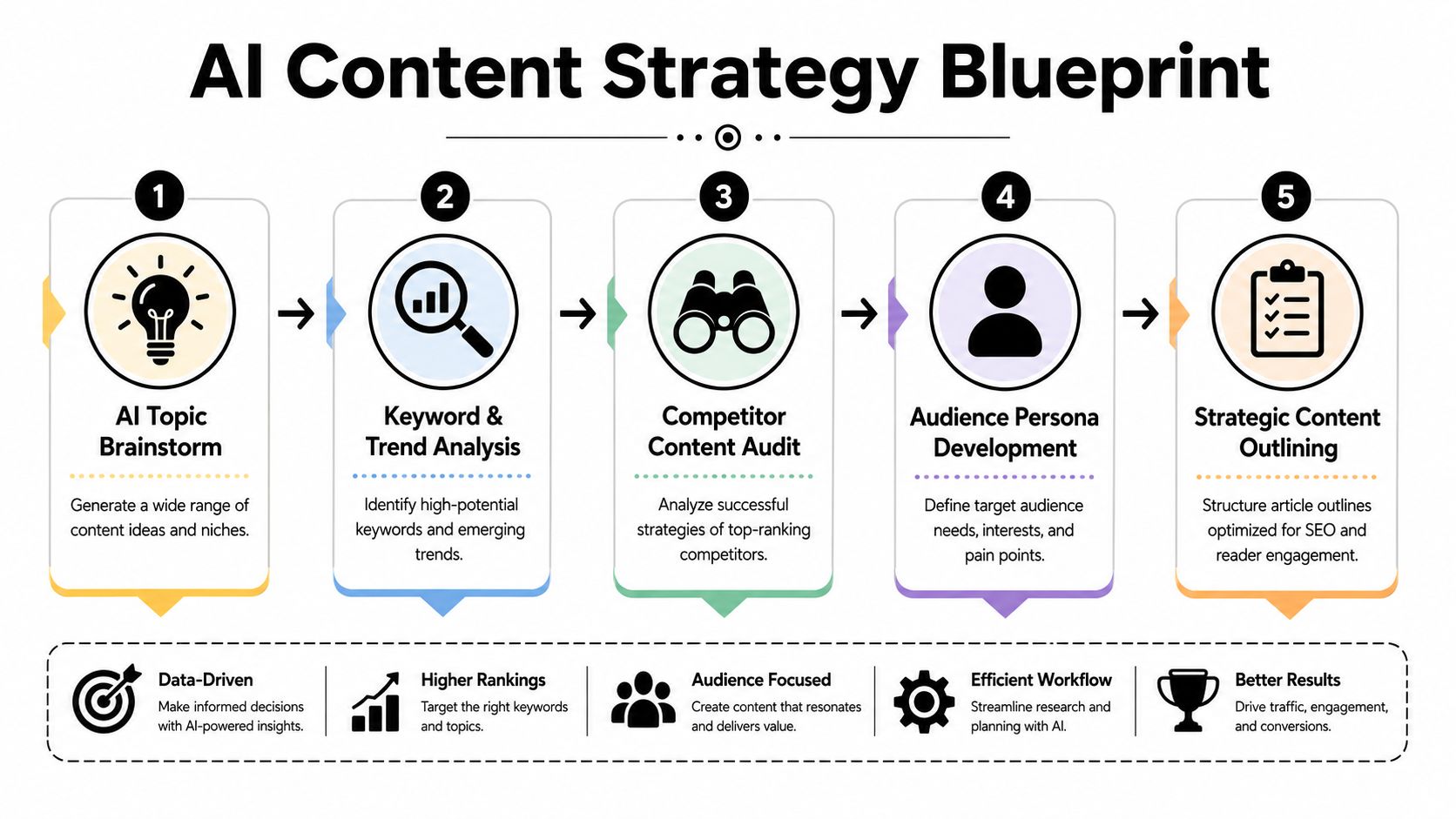
Good AI affiliate writing starts long before the first paragraph. The planning phase decides whether the article becomes another generic review or a page with genuine purchase intent behind it.
AI is becoming more important in this part of the workflow. IMD notes that by 2025, AI is anticipated to optimize affiliate campaigns through enhanced data analysis and dynamic personalization, with automation in affiliate tracking systems expected to grow by 45%, as covered in this IMD overview of AI in affiliate marketing. That matters because the research stage is where AI saves the most time without damaging trust.
Start with buyer queries, not broad topics
Most beginners start with a niche. That's too vague. Start with a query that signals a person is close to choosing.
The Jasper methodology for AI affiliate writing emphasizes identifying high-intent buyer searches such as “best [product] for [use case],” then using AI to analyze top-ranking content for gaps in structure, product coverage, and depth. That principle is more useful than asking for random topic ideas.
Use a prompt like this:
Find high-intent search angles for [product category]. Prioritize queries where the searcher is comparing options, solving a specific problem, or looking for the best fit for a clear use case. Group results by intent: beginner, budget, performance, convenience, and niche scenario.
After that, compare the search intent with what ranking pages are doing. If every page is saying the same thing, that's often the opportunity.
I also like using AI to summarize repetitive SERP patterns:
- What every page includes
- What nobody proves
- What objections are ignored
- Which products appear due to affiliate incentives rather than fit
That gives you a sharper brief than standard keyword tools alone. For a broader content planning framework, this kind of thinking aligns with practical systems used in content marketing and blogging workflows.
Pull the offer apart before you outline
Most affiliate writers leave money on the table due to a specific oversight. They study keywords, but they don't study the sales page.
Take the actual product page, landing page, or VSL script and feed it into your AI tool. Ask the model to extract the emotional and practical levers behind the offer. I'm looking for five things:
| Element | What to extract |
|---|---|
| Core pain | What problem feels urgent to the buyer |
| Desired outcome | What result the product promises |
| Mechanism | Why this product claims to work |
| Objections | What would stop someone from buying |
| Proof cues | What evidence the seller uses |
Use a prompt like this:
Analyze this sales page as a conversion copywriter. Extract the pain points, desired outcomes, mechanism, objections, proof elements, and repeated emotional phrases. Then turn them into content angles for an affiliate article that helps a skeptical buyer make a decision.
That process gives you stronger article angles than keyword-first research alone. Instead of “best project management tool,” you get something closer to “best project management tool for teams that keep missing handoffs” or “best tool for founders who need client visibility without adding meetings.”
The best affiliate briefs combine search intent with sales psychology. One brings traffic. The other creates movement.
Once that's done, ask AI for an outline built around decision-making, not filler. I want sections like who it's for, who should skip it, key trade-offs, setup friction, and what changed after use. That makes the eventual draft far easier to trust.
Drafting Persuasive Content with Advanced AI Prompts
Many users get weak results from AI because they give weak instructions. “Write me a product review” tells the model nothing about standards, audience, proof, or commercial intent. It produces smooth copy, but smooth copy isn't the goal.
The goal is a draft that is organized, restrained, and easy to verify.

A better framework is FUR, which stands for Facts, Instructions, Rules. That method is recommended in this AISEOInsider discussion of AI affiliate strategy. I use it because it forces the model to separate source material from writing behavior.
Why most prompts produce weak affiliate copy
Bad prompts usually fail in one of three ways.
First, they ask the model to improvise facts. Second, they don't define the reader's actual stage of awareness. Third, they don't set any rules for uncertainty, so the draft fills gaps with generic confidence.
That's where a lot of AI affiliate writing goes wrong. The output looks polished, but it hasn't earned the right to sound certain.
If you've ever read a review that praised “powerful features,” “effortless integration,” or “intuitive design” without showing what any of that means, you've seen the result of a low-control prompt.
For a stronger conversion mindset, it helps to think like a direct response writer, not a content spinner. The discipline behind that style is well explained in this guide to direct response copywriting.
Prompt templates that produce usable drafts
Here's the structure I use most often.
Facts
- Product name
- Source material pasted in
- Notes from personal testing
- Audience segment
- Competitor list
- Known limitations or missing data
Instructions
- Desired article type
- Target reading level
- Tone
- Required sections
- CTA style
- Link placement plan
Rules
- Don't invent claims
- Flag uncertain statements
- Prefer specifics over adjectives
- Include trade-offs
- Write with buyer skepticism in mind
Here's a prompt for a “best X for Y” article:
You are an affiliate editor writing for buyers who are comparing products carefully.
Facts: [paste verified notes, product specs, use-case notes, competitor names, your own observations].
Instructions: Write a “best X for Y” article with an introduction, quick picks, comparison table, detailed reviews, who each product is for, drawbacks, and a final recommendation.
Rules: Do not invent specs or outcomes. If information is missing, write a placeholder note that says verification required. Avoid hype. Include buyer objections and trade-offs.
And one for a single-product review:
You are reviewing [product] for a reader deciding whether to buy this week.
Facts: [paste testing notes, screenshots available, feature confirmations, pricing notes if verified, support experience if personally observed].
Instructions: Write a review with verdict first, then ideal user, setup experience, strengths, weaknesses, best alternative, and a clear disclosure-friendly CTA.
Rules: No generic praise. If a claim cannot be verified from the provided facts, mark it as unverified.
Working standard: If the draft is publishable without heavy editing, the prompt was probably too loose.
The draft should come out around three-quarters done. That's enough. You don't want a final article from AI. You want a structured document that gives you momentum while preserving room for judgment, proof, and differentiation.
The Human Verification Layer for Building Trust
This is the part most affiliate writers skip because it doesn't feel scalable. It is also the part that keeps the article from sounding disposable.
Partnerize highlights the trust gap clearly. Affiliates who verify claims with stats, images, or video see 3x higher affiliate clicks in the AI era, according to Partnerize's discussion of AI in affiliate ecosystems. That doesn't surprise me. Readers don't just want information anymore. They want signs that someone checked the information.
A clean way to think about this is simple. AI produces text. You produce confidence.
Build a claim-checking workflow
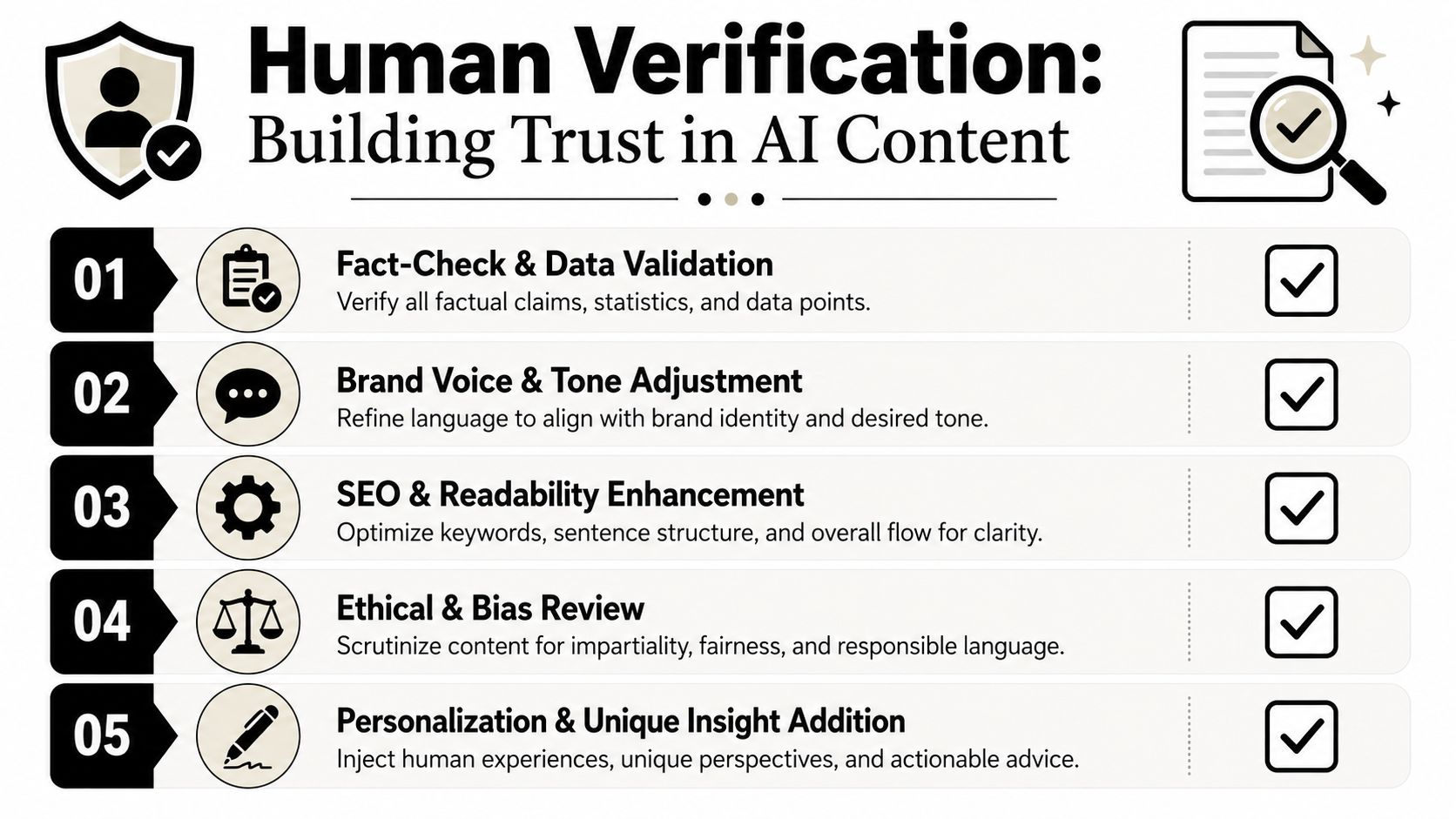
I treat every AI draft like a marked-up manuscript, not a finished asset. The first pass is claim extraction. I highlight anything that sounds factual, comparative, or performance-related.
Then I sort each claim into one of four buckets:
- Verified directly from the product site, official docs, or my own use.
- Verified indirectly from trustworthy supporting material already in hand.
- Plausible but unverified, which means it stays out.
- Too vague to matter, which usually gets cut.
A significant amount of weak affiliate content collapses when writers include impressive-sounding language because it reads well, despite proving nothing.
If a product claim can't survive one minute of scrutiny, it shouldn't survive one draft.
The human layer also includes language cleanup. AI tends to overstate certainty and understate friction. I rewrite those sections by adding setup annoyances, learning curve comments, edge cases, and who the product is wrong for. Those details don't reduce conversions. They improve them because they make the recommendation believable.
A useful companion resource for sharpening this editing mindset is the video below.
Add proof that readers can actually see
Trust rises when the article includes visible evidence. Not decorative images. Evidence.
That can include:
- Original screenshots showing the interface, setup flow, or results screen
- Annotated comparison tables that explain differences instead of just listing features
- Personal notes on what was confusing, fast, annoying, or unexpectedly useful
- Short video clips or screen recordings if the product experience is visual
- Clear disclosures so readers know where the financial incentive exists
I also add friction-reducing phrases that AI rarely includes on its own:
- what I'd choose if budget matters
- what I'd skip if you need simplicity
- what changed my mind after testing
- what would make me hesitate before recommending it
Those lines do two things. They signal actual evaluation, and they give the reader language for their own internal decision.
That's the missing verification layer in most AI affiliate writing. Not more words. More proof.
Conversion Optimization Legal Compliance and Links
A well-written affiliate article can still underperform if the monetization layer is sloppy. Bad disclosures create suspicion. Weak link placement hides buying intent. Generic CTAs waste the momentum your review just built.
The strongest methodology doesn't stop at an optimized draft. Jasper's affiliate writing guidance emphasizes strategic affiliate link placement, visual elements like comparison tables, and transparent disclosure of affiliate relationships, in addition to the draft itself, as outlined in Jasper's guide to AI affiliate marketing.

Disclosures that protect trust instead of hurting it
A lot of affiliates still treat disclosure like a legal chore. That's the wrong mindset. A clear disclosure improves credibility because it removes ambiguity.
I prefer simple language near the top of the article and again near major recommendation sections. Something like:
This article contains affiliate links. If you buy through them, I may earn a commission at no extra cost to you. I only recommend products that fit the use case discussed here.
That works because it's direct and readable. It doesn't interrupt the flow, and it tells the reader what matters.
The same applies to recommendation framing. If you're promoting several products, don't pretend they're all equal. Declare the winner for a specific use case, then explain the trade-off. Ambiguity lowers clicks.
Place links where buying intent peaks
Most affiliate articles under-link the moments where the buyer is most ready to act. Then they over-link random product mentions in body copy. That's backwards.
These placements usually perform best in practice:
| Placement area | Why it works |
|---|---|
| Quick verdict box | Captures the impatient buyer |
| Comparison table | Serves readers already narrowing choices |
| After drawback discussion | Reassures skeptical buyers who kept reading |
| End-of-section button | Converts readers after a focused mini-review |
| Final recommendation summary | Helps decisive readers act immediately |
The anchor text matters too. “Check current availability” often feels more natural than “Buy now” in informational reviews. In software reviews, “See the dashboard” or “Try the free plan” can fit better if that reflects the actual next step.
For stronger page-level monetization, it's worth studying how landing page conversion optimization principles apply to affiliate content blocks. The same logic holds. Reduce friction, increase clarity, and make the next action obvious.
Two practical rules keep link strategy clean:
- Match the CTA to the buyer's stage. Early in the article, use softer language. Near the conclusion, be more direct.
- Use formatting to create decision points. Buttons, comparison tables, and “best for” summary boxes make action easier than plain text links buried in paragraphs.
Good affiliate content doesn't hide the sale. It earns the click first, then makes the click easy.
Closing the Loop Tracking Testing and Iteration
Publishing is where the learning starts. If you don't measure what happens after the article goes live, you can't tell whether the problem is traffic quality, page experience, link placement, or offer fit.
The most useful feedback loop is simple. Watch how readers behave, identify where intent drops, and update the page with sharper proof or clearer decisions.
Watch the signals that matter
The first layer is engagement. I care about whether people are consuming the review, not just landing on it. Time on page, scroll behavior, and which sections attract clicks tell you whether the article matched the promise of the headline.
The second layer is commercial behavior. Which links get clicks. Which buttons get ignored. Whether the “best for” framing attracts more movement than neutral product descriptions.
That often reveals practical issues fast:
- Strong traffic, weak clicks usually means the article informs but doesn't persuade.
- Strong clicks, weak commissions usually means the offer or landing page is the bottleneck.
- Drop-off before comparison sections often means the introduction is too generic or too long.
- Clicks concentrated on one product can signal that your article structure already has a winner, even if the copy doesn't state it clearly.
Publish less often if needed, but learn from every page you publish.
Use performance data to rewrite winners
I don't overhaul underperforming pages all at once. I change one decision point at a time.
Start with the headline and introduction. If the searcher expected a recommendation for a narrow use case, make that use case explicit earlier. Then test the quick-pick section. If one product keeps earning more clicks, move its proof higher and make the rationale clearer.
You can also test:
- CTA wording such as “See full details” versus “Visit official site”
- Product order in list posts
- Amount of proof before the first link
- Depth of drawbacks in each mini-review
- Table design and whether it helps scanning
Over time, this turns AI affiliate writing into a compounding system. AI helps you research and draft faster. Verification protects trust. Tracking tells you what to sharpen next.
The affiliates who win with AI aren't the ones producing the most text. They're the ones building the best editorial process around it.
If you're building product-focused content and also need help turning product pages into ad-ready angles, launch plans, and creative direction, Social Loop AI is worth a look. It's built for first-time dropshippers and new ecommerce owners who need a practical system for moving from product URL to usable marketing assets without hiring an agency.